Loading...

2,281 posters, 63 videos, 56 audios, 43 topics, 18 sessions, 6,174 authors, 2,323 institutions

ePostersLive by SciGen Technologies S.A. All rights reserved.

RCOG World Congress 2025

June 23 - 25, 2025 | ExCeL London, UK

PP.0013

Customised twin specific vs singleton growth charts and SGA associated stillbirth risk
Part of Topic

Fetal medicine

Customised twin specific vs singleton growth charts and SGA associated stillbirth risk

Jason Gardosi, Oliver Hugh, Emily Butler, Hanna Ellson, Hannah Taylor

Perinatal Institute, UK


Objectives

• Twin fetuses are born earlier and have slower growth
than singletons. It is uncertain as to what degree this is
pathological or a physiological adaptation.
• We set out to develop a customised chart for twin
pregnancy and compare it with the corresponding
singleton chart in their ability to assess stillbirth risk.

Methods

•The cohort consisted of 8,457 twin pregnancies (16,914 twins) recorded routinely in UK hospitals in the GAP program and contained stillbirth data. A subset of 3174 twins had also neonatal outcomes.

•To derive customised coefficients, we excluded stillbirths and preterm deliveries (<34 weeks).
 
•We performed a mixed-effects linear regression analysis to derive coefficients for maternal height, weight, parity and ethnic origin to help determine pregnancy specific optimal weight at 37 weeks.
 
•We compared the new customised standard for twins (GROW-T) with that for singletons  (GROW-S) by calculating rate of SGA (<10th centile) and associated risk of stillbirth (SB) as well as indicators of neonatal outcome, using generalised estimating equations.
 
Results
 
•The same maternal physiological characteristics affect the twin weight standard as the singleton standard.
 
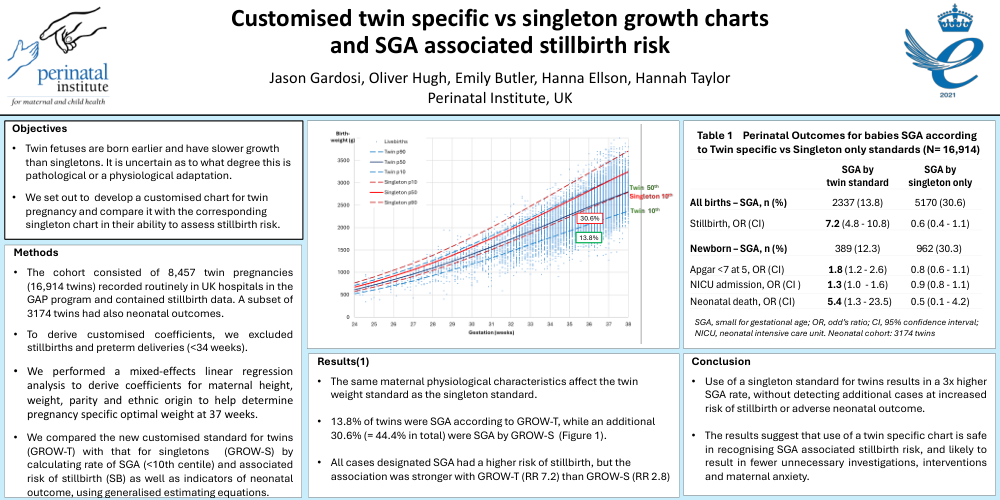
•13.8% of twins were SGA according to GROW-T, while an additional 30.6% (= 44.4% in total) were SGA by GROW-S  (Figure 1).
 
•All cases designated SGA had a higher risk of stillbirth, but the association was stronger with GROW-T (RR 7.2) than GROW-S (RR 2.8)
 
Conclusions
•Use of a singleton standard for twins results in a 3x higher SGA rate, without detecting additional cases at increased risk of stillbirth or adverse neonatal outcome.
 
•The results suggest that use of a twin specific chart is safe in recognising SGA associated stillbirth risk, and likely to result in fewer unnecessary investigations, interventions and maternal anxiety. 


Copyright © 2015-2026, ePostersLive® SciGen is a registered trademark of SciGen Technologies S.A. Patent pending.

This website and third-party tools we use rely on cookies for the best user experience. By selecting "I agree", you agree to cookie usage as described in our Privacy Policy.