2,281 posters, 63 videos, 56 audios, 43 topics, 18 sessions, 6,174 authors, 2,323 institutions
ePostersLive by SciGen Technologies S.A. All rights reserved.
RCOG World Congress 2025
June 23 - 25, 2025 | ExCeL London, UK
EP.2214
Vesicovaginal Fistula and Recurrent Pregnancy Loss: Urinary Ileal Conduit and Transabdominal Cerclage
Poster Presenter
Authors
Judith Kluge, Hesma van Heerden, Frederick Mbise, David Hall, Khumbo Jere
Affiliations
Part of Topic
Urogynaecology/pelvic floor
Vesico-vaginal Fistula and Recurrent Pregnancy Loss: Urinary Ileal Conduit and Transabdominal Cerclage
– A Case Report
J. Kluge1,2, H. van Heerden1,3, F. Mbise1,2, D. Hall1,4, K. Jere1,5
1: Stellenbosch University 2: Urogynaecology Fellow, Tygerberg Hospital, South Africa. 3: Urology, Tygerberg Hospital, South Africa.
4: Maternal Medicine, Tygerberg Hospital, South Africa.
5: Urogynaecology, Tygerberg Hospital, South Africa
Background
Obstetric fistula (OF) is caused by severe tissue damage and necrosis which occurs with prolonged obstructed labour. Vesicovaginal fistulas (VVFs) are the most common form, disproportionately affecting women in low- and middle-income countries (LMICs).
Fertility and fecundity rates are significantly reduced following obstetric fistula. This decline is due to a combination of social, psychological, and physical factors. Among the most prominent contributors are relationship breakdown and sexual dysfunction, often resulting from traumatic childbirth, genital scarring, and psychological trauma
The social stigma and unacceptability of urinary incontinence frequently experienced by women with obstetric fistula can further inhibit sexual activity, compounding fertility challenges
Despite these barriers, many women with obstetric fistula express a strong desire to conceive and carry a pregnancy to viability, which often supersedes their concern for continence or other quality-of-life issues
Unfortunately, achieving a live birth remains a challenge. It is estimated that up to 70% of women with obstetric fistula are unable to deliver a live infant due to uterine or cervical damage, recurrent urinary tract infections, and obstetric complications.
In a review of studies involving women from Sub-Saharan Africa with previously repaired obstetric fistulas, only 17.4% experienced subsequent pregnancy. Among those who did conceive, pregnancy was often accompanied by a higher incidence of complications, including miscarriage, stillbirth, neonatal death, and cesarean section-related morbidity.
Notably, recurrence of fistulas after childbirth—even when the initial repair was successful—was not uncommon
A case report of recurrent pregnancy loss and VVF is presented emphasizing the need of a multidisciplinary approach
Case History
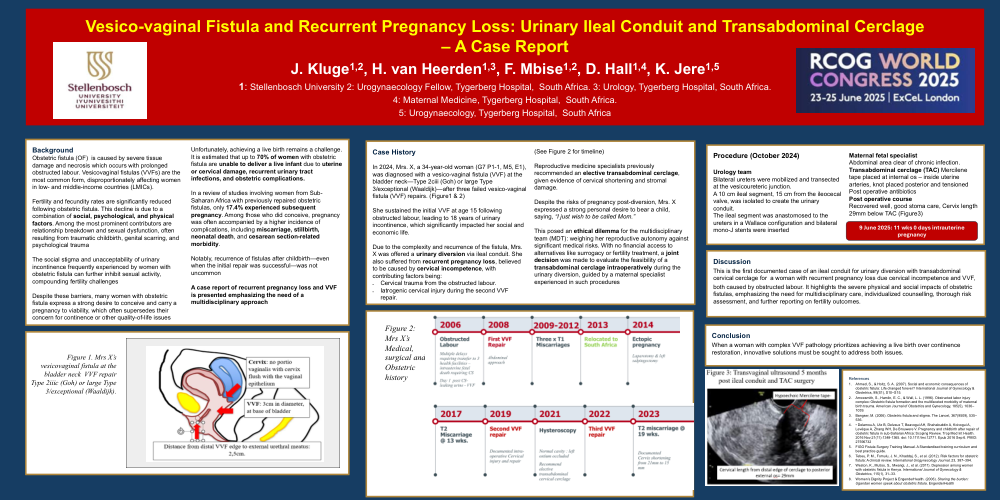
In 2024, Mrs. X, a 34-year-old woman (G7 P1-1, M5, E1), was diagnosed with a vesico-vaginal fistula (VVF) at the bladder neck—Type 2ciii (Goh) or large Type 3/exceptional (Waaldijk)—after three failed vesico-vaginal fistula (VVF) repairs. (Figure1 & 2)
She sustained the initial VVF at age 15 following obstructed labour, leading to 18 years of urinary incontinence, which significantly impacted her social and economic life.
Due to the complexity and recurrence of the fistula, Mrs. X was offered a urinary diversion via ileal conduit. She also suffered from recurrent pregnancy loss, believed to be caused by cervical incompetence, with contributing factors being:
(See Figure 2 for timeline)
Reproductive medicine specialists previously recommended an elective transabdominal cerclage, given evidence of cervical shortening and stromal damage.
Despite the risks of pregnancy post-diversion, Mrs. X expressed a strong personal desire to bear a child, saying, “I just wish to be called Mom.”
This posed an ethical dilemma for the multidisciplinary team (MDT): weighing her reproductive autonomy against significant medical risks. With no financial access to alternatives like surrogacy or fertility treatment, a joint decision was made to evaluate the feasibility of a transabdominal cerclage intraoperatively during the urinary diversion, guided by a maternal specialist experienced in such procedures
Procedure (October 2024)
Urology team
Bilateral ureters were mobilized and transected at the vesicoureteric junction.
A 10 cm ileal segment, 15 cm from the ileocecal valve, was isolated to create the urinary conduit.
The ileal segment was anastomosed to the ureters in a Wallace configuration and bilateral mono-J stents were inserted
Maternal fetal specialist
Abdominal area clear of chronic infection.
Transabdominal cerclage (TAC) Mercilene tape placed at internal os – inside uterine arteries, knot placed posterior and tensioned
Post operative antibiotics
Post operative course
Recovered well, good stoma care, Cervix length 29mm below TAC (Figure3)
9 June 2025: 11 wks 0 days intrauterine pregnancy
Discussion
This is the first documented case of an ileal conduit for urinary diversion with transabdominal cervical cerclage for a woman with recurrent pregnancy loss due cervical incompetence and VVF,
both caused by obstructed labour. It highlights the severe physical and social impacts of obstetric fistulas, emphasizing the need for multidisciplinary care, individualized counselling, thorough risk assessment, and further reporting on fertility outcomes.
Conclusion
When a woman with complex VVF pathology prioritizes achieving a live birth over continence restoration, innovative solutions must be sought to address both issues.