2,281 posters, 63 videos, 56 audios, 43 topics, 18 sessions, 6,174 authors, 2,323 institutions
ePostersLive by SciGen Technologies S.A. All rights reserved.
RCOG World Congress 2025
June 23 - 25, 2025 | ExCeL London, UK
EP.2209
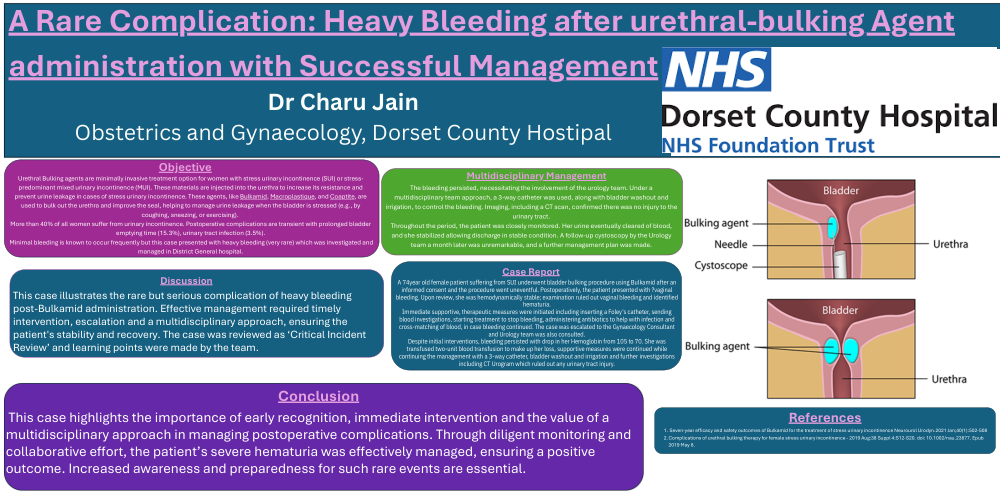
A Rare Complication: Heavy Bleeding after urethral-bulking Agent administration with Successful Management
Poster Presenter
Authors
Affiliations
Part of Topic
Urogynaecology/pelvic floor
A Rare Complication: Heavy Bleeding after urethral-bulking Agent administration with Successful Management
Dr Charu Jain
Obstetrics and Gynaecology, Dorset County Hostipal
Objective:
Urethral Bulking agents are minimally invasive treatment option for women with stress urinary incontinence (SUI) or stress-predominant mixed urinary incontinence (MUI). These materials are injected into the urethra to increase its resistance and prevent urine leakage in cases of stress urinary incontinence. These agents, like Bulkamid, Macroplastique, and Coaptite, are used to bulk out the urethra and improve the seal, helping to manage urine leakage when the bladder is stressed (e.g., by coughing, sneezing, or exercising).
More than 40% of all women suffer from urinary incontinence. Postoperative complications are transient with prolonged bladder emptying time (15.3%), urinary tract infection (3.5%).
Minimal bleeding is known to occur frequently but this case presented with heavy bleeding (very rare) which was investigated and managed in District General hospital.
Case Report:
A 74year old female patient suffering from SUI underwent bladder bulking procedure using Bulkamid after an informed consent and the procedure went uneventful. Postoperatively, the patient presented with ?vaginal bleeding. Upon review, she was hemodynamically stable; examination ruled out vaginal bleeding and identified hematuria.
Immediate supportive, therapeutic measures were initiated including inserting a Foley's catheter, sending blood investigations, starting treatment to stop bleeding, administering antibiotics to help with infection and cross-matching of blood, in case bleeding continued. The case was escalated to the Gynaecology Consultant and Urology team was also consulted.
Despite initial interventions, bleeding persisted with drop in her Hemoglobin from 105 to 70. She was transfused two-unit blood transfusion to make up her loss, supportive measures were continued while continuing the management with a 3-way catheter, bladder washout and irrigation and further investigations including CT Urogram which ruled out any urinary tract injury.
Multidisciplinary Management:
The bleeding persisted, necessitating the involvement of the urology team. Under a multidisciplinary team approach, a 3-way catheter was used, along with bladder washout and irrigation, to control the bleeding. Imaging, including a CT scan, confirmed there was no injury to the urinary tract.
Throughout the period, the patient was closely monitored. Her urine eventually cleared of blood, and she stabilized allowing discharge in stable condition. A follow-up cystoscopy by the Urology team a month later was unremarkable, and a further management plan was made.
Discussion:
This case illustrates the rare but serious complication of heavy bleeding post-Bulkamid administration. Effective management required timely intervention, escalation and a multidisciplinary approach, ensuring the patient's stability and recovery. The case was reviewed as ‘Critical Incident Review’ and learning points were made by the team.
Conclusion:
This case highlights the importance of early recognition, immediate intervention and the value of a multidisciplinary approach in managing postoperative complications. Through diligent monitoring and collaborative effort, the patient’s severe hematuria was effectively managed, ensuring a positive outcome. Increased awareness and preparedness for such rare events are essential.
References
- Seven-year efficacy and safety outcomes of Bulkamid for the treatment of stress urinary incontinence Neurourol Urodyn.2021 Jan;40(1):502-508
- Complications of urethral bulking therapy for female stress urinary incontinence - 2019 Aug:38 Suppl 4:S12-S20. doi: 10.1002/nau.23877. Epub 2019 May 8.