2,281 posters, 63 videos, 56 audios, 43 topics, 18 sessions, 6,174 authors, 2,323 institutions
ePostersLive by SciGen Technologies S.A. All rights reserved.
RCOG World Congress 2025
June 23 - 25, 2025 | ExCeL London, UK
EP.2207
Forgotten Vaginal Ring Pessary Migration and Embedment with Rectal Prolapse
Poster Presenter
Authors
Yi Jie Chew, Selina Chin, Shao Nan Khor, Shau Khng Lim, Wai Yen Lee
Affiliations
Part of Topic
Urogynaecology/pelvic floor
To highlight a rare but serious complication associated with long-term use of a vaginal ring pessary without appropriate follow-up, and to emphasize the importance of patient selection and ongoing management in the nonsurgical treatment of pelvic organ prolapse.
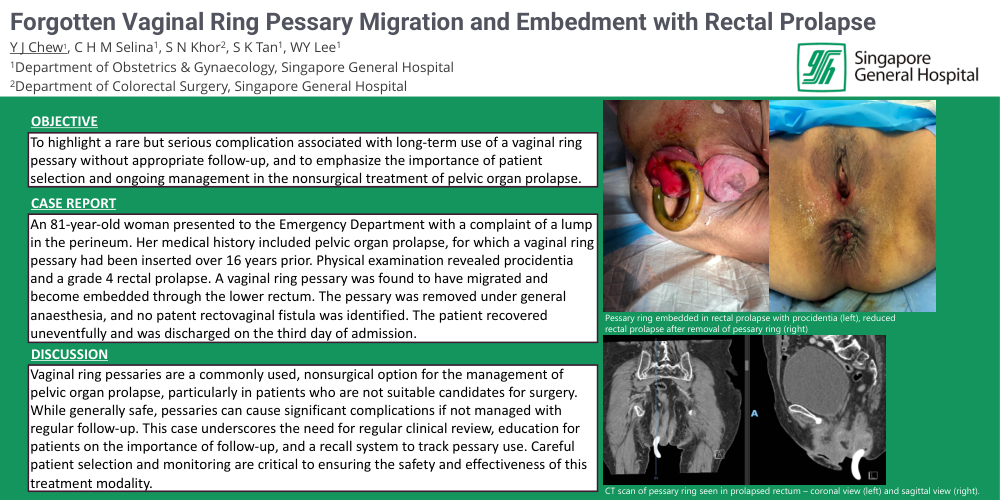
An 81-year-old woman presented to the Emergency Department with a complaint of a lump in the perineum. Her medical history included pelvic organ prolapse, for which a vaginal ring pessary had been inserted over 16 years prior. Physical examination revealed procidentia and a grade 4 rectal prolapse. A vaginal ring pessary was found to have migrated and become embedded through the lower rectum. The pessary was removed under general anaesthesia, and no patent rectovaginal fistula was identified. The patient recovered uneventfully and was discharged on the third day of admission.
Vaginal ring pessaries are a commonly used, nonsurgical option for the management of pelvic organ prolapse, particularly in patients who are not suitable candidates for surgery. While generally safe, pessaries can cause significant complications if not managed with regular follow-up. This case underscores the need for regular clinical review, education for patients on the importance of follow-up, and a recall system to track pessary use. Careful patient selection and monitoring are critical to ensuring the safety and effectiveness of this treatment modality.