2,281 posters, 63 videos, 56 audios, 43 topics, 18 sessions, 6,174 authors, 2,323 institutions
ePostersLive by SciGen Technologies S.A. All rights reserved.
RCOG World Congress 2025
June 23 - 25, 2025 | ExCeL London, UK
EP.2204
Postmenopausal Small Bowel Evisceration 20 Years After hysterectomy: A Case Report.
Poster Presenter
Authors
Affiliations
Part of Topic
Urogynaecology/pelvic floor
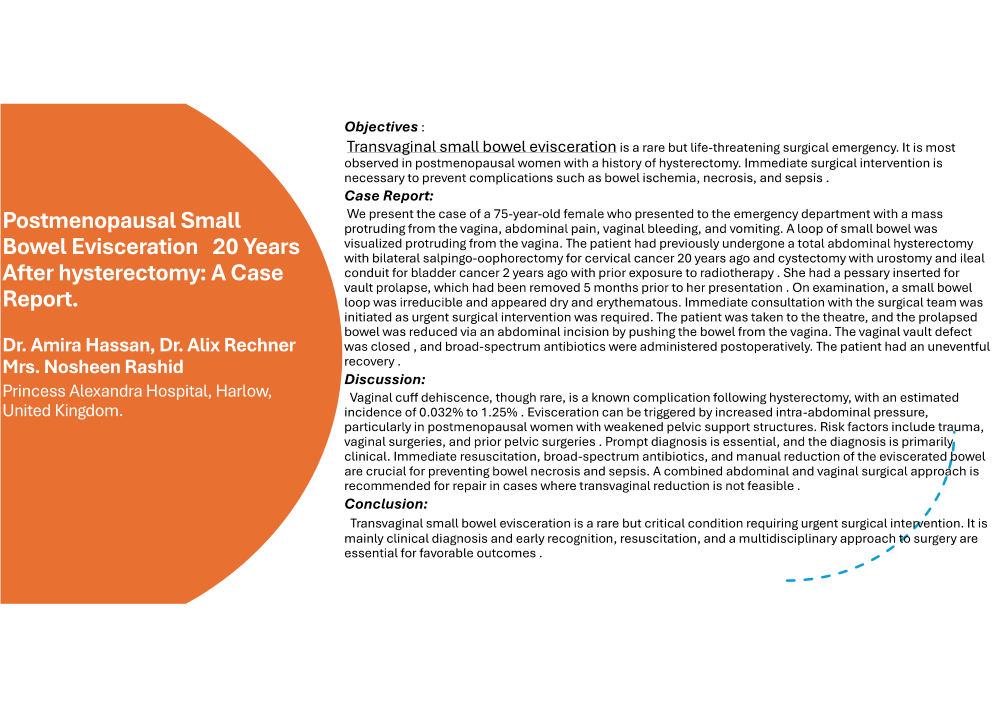
Objectives : Transvaginal small bowel evisceration is a rare but life-threatening surgical emergency. It is most commonly observed in postmenopausal women with a history of hysterectomy. Immediate surgical intervention is necessary to prevent complications such as bowel ischemia, necrosis, and sepsis .
Case Report: We present the case of a 75-year-old female who presented to the emergency department with a mass protruding from the vagina, abdominal pain, vaginal bleeding, and vomiting. A loop of small bowel was visualized protruding from the vagina. The patient had previously undergone a total abdominal hysterectomy with bilateral salpingo-oophorectomy for cervical cancer 20 years ago and cystectomy with urostomy and ileal conduit for bladder cancer 2 years ago with prior exposure to radiotherapy . She had a pessary inserted for vault prolapse, which had been removed 5 months prior to her presentation . On examination, a small bowel loop was irreducible and appeared dry and erythematous. Immediate consultation with the surgical team was initiated as urgent surgical intervention was required. The patient was taken to the theatre, and the prolapsed bowel was reduced via an abdominal incision by pushing the bowel from the vagina. The vaginal vault defect was closed, and broad-spectrum antibiotics were administered postoperatively. The patient had an uneventful recovery .
Discussion: Vaginal cuff dehiscence, though rare, is a known complication following hysterectomy, with an estimated incidence of 0.032% to 1.25% . Evisceration can be triggered by increased intra-abdominal pressure, particularly in postmenopausal women with weakened pelvic support structures. Risk factors include trauma, vaginal surgeries, and prior pelvic surgeries . Prompt diagnosis is essential, and the diagnosis is primarily clinical. Immediate resuscitation, broad-spectrum antibiotics, and manual reduction of the eviscerated bowel are crucial for preventing bowel necrosis and sepsis. A combined abdominal and vaginal surgical approach is recommended for repair in cases where transvaginal reduction is not feasible .
Conclusion: Transvaginal small bowel evisceration is a rare but critical condition requiring urgent surgical intervention. It is mainly clinical diagnosis and early recognition, resuscitation, and a multidisciplinary approach to surgery are essential for favourable outcomes .