2,281 posters, 63 videos, 56 audios, 43 topics, 18 sessions, 6,174 authors, 2,323 institutions
ePostersLive by SciGen Technologies S.A. All rights reserved.
RCOG World Congress 2025
June 23 - 25, 2025 | ExCeL London, UK
EP.2199
Comparing Posterior Tibial Nerve Stimulation Methods In Women With Idiopathic Overactive Bladder
Poster Presenter
Part of Topic
Urogynaecology/pelvic floor
Comparing Posterior Tibial Nerve Stimulation Methods In Women With Idiopathic Overactive Bladder
Nishamini Subramaniam, Natharnia Young, Anna Rosamilia
Pelvic Floor Unit, Monash Health, Victoria, Australia
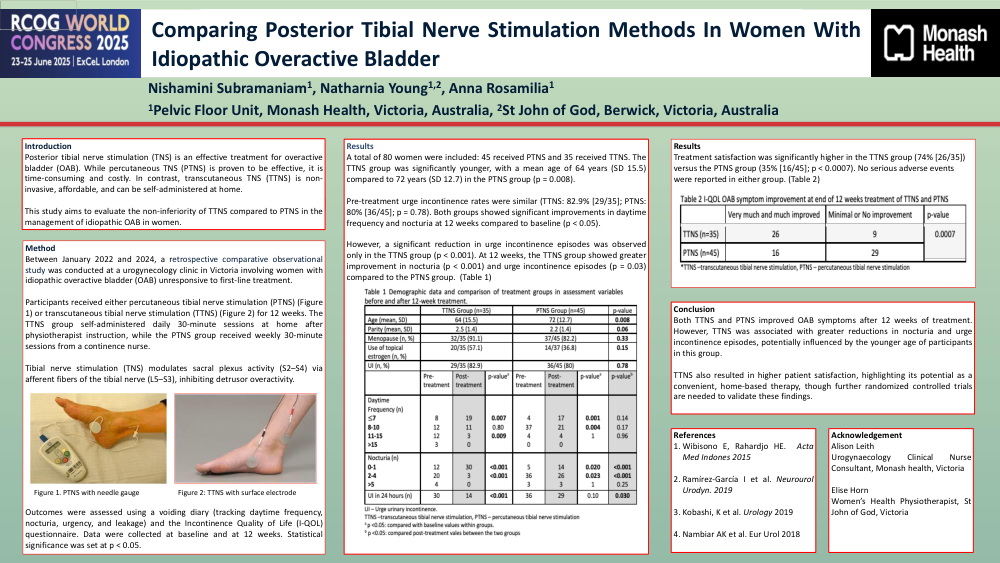
Objective: Posterior tibial nerve stimulation (TNS) is an effective treatment for overactive bladder (OAB). While percutaneous TNS (PTNS) is proven to be effective, it is time-consuming and costly. In contrast, transcutaneous TNS (TTNS) is non-invasive, affordable, and can be self-administered at home. This study evaluates the non-inferiority of TTNS to PTNS in women with idiopathic OAB.
Design: Retrospective comparative observational study.
Method: Between January 2022 and 2024, a study was conducted at a urogynecology clinic in Victoria involving women with idiopathic overactive bladder (OAB) unresponsive to first-line treatment. Participants received either transcutaneous tibial nerve stimulation (TTNS) or percutaneous tibial nerve stimulation (PTNS) for 12 weeks. The TTNS group self-administered daily 30-minute sessions at home after physiotherapist instruction, while the PTNS group received weekly 30-minute sessions from a continence nurse. Outcomes were assessed using a voiding diary (tracking daytime frequency, nocturia, urgency, and leakage) and the Incontinence Quality of Life (I-QOL) questionnaire. Data were collected at baseline and at 12 weeks. Statistical significance was set at p < 0.05.
Results: A total of 80 women were included: 45 received PTNS and 35 received TTNS. The TTNS group was significantly younger, with a mean age of 64 years (SD 15.5) compared to 72 years (SD 12.7) in the PTNS group (p = 0.008). Pre-treatment urge incontinence rates were similar (TTNS: 82.9% [29/35]; PTNS: 80% [36/45]; p = 0.78). Both groups showed significant improvements in daytime frequency and nocturia at 12 weeks compared to baseline (p < 0.05). However, a significant reduction in urge incontinence episodes was observed only in the TTNS group (p < 0.001). At 12 weeks, the TTNS group showed greater improvement in nocturia (p < 0.001) and urge incontinence episodes (p = 0.03) compared to the PTNS group. Treatment satisfaction was significantly higher in the TTNS group (74% [26/35]) versus the PTNS group (35% [16/45]; p < 0.0007). No serious adverse events were reported in either group.
Conclusion: Both TTNS and PTNS improved OAB symptoms after 12 weeks of treatment. However, TTNS was associated with greater reductions in nocturia and urge incontinence episodes, potentially influenced by the younger age of participants in this group. TTNS also resulted in higher patient satisfaction, highlighting its potential as a convenient, home-based therapy, though further randomized controlled trials are needed to validate these findings.