2,281 posters, 63 videos, 56 audios, 43 topics, 18 sessions, 6,174 authors, 2,323 institutions
ePostersLive by SciGen Technologies S.A. All rights reserved.
RCOG World Congress 2025
June 23 - 25, 2025 | ExCeL London, UK
EP.2197
PTNS to TENS and beyond: Rethinking the treatment pathway
Poster Presenter
Part of Topic
Urogynaecology/pelvic floor
PTNS to TENS and beyond: Rethinking the treatment pathway
Charlotte Downing1, Georgina Thompson1, Debora Alcayde1, Katie Allan1, Claudine Domoney1
AIM: Exploring a Hybrid Approach to Neuromodulation in the Management of Overactive Bladder
Where initial management strategies prove inadequate, NICE guideline recommends percutaneous tibial nerve stimulation (PTNS) as a second-line treatment, typically involving a course of 12 weekly sessions. This treatment is often reserved for patients who are not suitable for bladder instillations or more aggressive pharmacological intervention.
During the COVID-19 pandemic, the Urogynaecology team at Chelsea and Westminster Hospital introduced an innovative 12-week hybrid neuromodulation program combining PTNS and transcutaneous tibial nerve stimulation (TTNS). This approach included 6 sessions of PTNS followed by 6 sessions of TTNS, with continued TTNS maintenance therapy.
This pathway has been audited to assess treatment benefit and modifications to the current pathway have been suggested.
Method
Population
Data Collection
Analysis
Outcome
Results
PTNS response
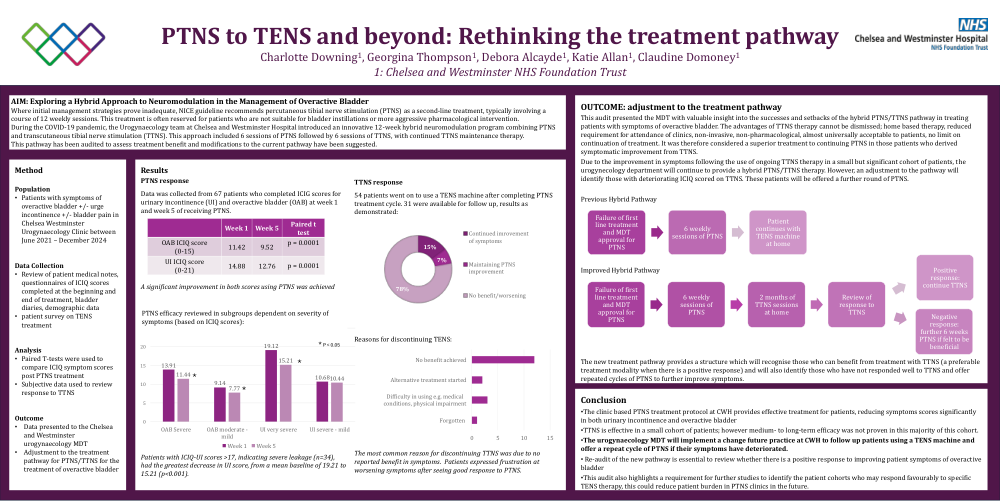
Data was collected from 67 patients who completed ICIG scores for urinary incontinence (UI) and overactive bladder (OAB) at week 1 and week 5 of receiving PTNS.
A significant improvement in both scores using PTNS was achieved
PTNS efficacy reviewed in subgroups dependent on severity of symptoms (based on ICIQ scores):
Patients with ICIQ-UI scores >17, indicating severe leakage (n=34), had the greatest decrease in UI score, from a mean baseline of 19.21 to 15.21 (p<0.001).
TTNS response
54 patients went on to use a TENS machine after completing PTNS treatment cycle. 31 were available for follow up, results as demonstrated:
Reasons for discontinuing TENS:
The most common reason for discontinuing TTNS was due to no reported benefit in symptoms. Patients expressed frustration at worsening symptoms after seeing good response to PTNS.
OUTCOME: adjustment to the treatment pathway
This audit presented the MDT with valuable insight into the successes and setbacks of the hybrid PTNS/TTNS pathway in treating patients with symptoms of overactive bladder. The advantages of TTNS therapy cannot be dismissed; home based therapy, reduced requirement for attendance of clinics, non-invasive, non-pharmacological, almost universally acceptable to patients, no limit on continuation of treatment. It was therefore considered a superior treatment to continuing PTNS in those patients who derived symptomatic improvement from TTNS.
Due to the improvement in symptoms following the use of ongoing TTNS therapy in a small but significant cohort of patients, the urogynecology department will continue to provide a hybrid PTNS/TTNS therapy. However, an adjustment to the pathway will identify those with deteriorating ICIQ scored on TTNS. These patients will be offered a further round of PTNS.
Previous Hybrid Pathway
Improved Hybrid Pathway
The new treatment pathway provides a structure which will recognise those who can benefit from treatment with TTNS (a preferable treatment modality when there is a positive response) and will also identify those who have not responded well to TTNS and offer repeated cycles of PTNS to further improve symptoms.
Conclusion
The clinic based PTNS treatment protocol at CWH provides effective treatment for patients, reducing symptoms scores significantly in both urinary incontinence and overactive bladder
TTNS is effective in a small cohort of patients; however medium- to long-term efficacy was not proven in this majority of this cohort.
The urogynaecology MDT will implement a change future practice at CWH to follow up patients using a TENS machine and offer a repeat cycle of PTNS if their symptoms have deteriorated.
Re-audit of the new pathway is essential to review whether there is a positive response to improving patient symptoms of overactive bladder
This audit also highlights a requirement for further studies to identify the patient cohorts who may respond favourably to specific TENS therapy, this could reduce patient burden in PTNS clinics in the future.