2,281 posters, 63 videos, 56 audios, 43 topics, 18 sessions, 6,174 authors, 2,323 institutions
ePostersLive by SciGen Technologies S.A. All rights reserved.
RCOG World Congress 2025
June 23 - 25, 2025 | ExCeL London, UK
EP.2189
FACTORS AFFECTING URODYNAMIC STUDIES IN FEMALES
Part of Topic
Urogynaecology/pelvic floor
Beyond the bladder – what factors affect urodynamic studies in females?
Background and Aims Urodynamics is the study of the capacity and flow rate of urine of the urinary bladder. It is a key test used in the investigation of patients complaining of urinary incontinence, or lower urinary tract symptoms, or both.
It is well-known that several medical calculations and values are standardised and adjusted to different variables including age, sex, and ethnicity. Currently, there is no standardisation for urinary dynamic studies according to different variables.
We investigated whether different factors may contribute to contribute to bladder capacity. This study also aimed to investigate the of several demographic and clinical factors on the development of urinary stress incontinence (USI), detrusor overactivity (DO), detrusor failure (DF), or a combination of these diagnoses, to identify any causal relationships.
Method-This study is a retrospective single-centre cohort study. Patients who presented to the urogynaecology clinic and underwent urodynamic evaluation between the dates of 01/06/21 – 31/08/21 were included.
A total of 56 patients were identified during the study period. 12 patients were excluded due to no urodynamic studies being reported. 44 patients were ultimately included in the study. For each case, medical notes were collected to ascertain demographic data, as well as the results of urodynamic investigations.
Demographic data included age, ethnicity, body mass index (BMI), parity, and relevant comorbidities. Where data was missing, no imputation was made and all analyses pertained to the remaining data sets.
Results - 44 patients were included in our study.
The median participant age was 56 (21 – 87) years, mean BMI was 28.82 (SD 6.33), and mean parity was 1.55 (SD 0.87).
Urodynamic diagnoses
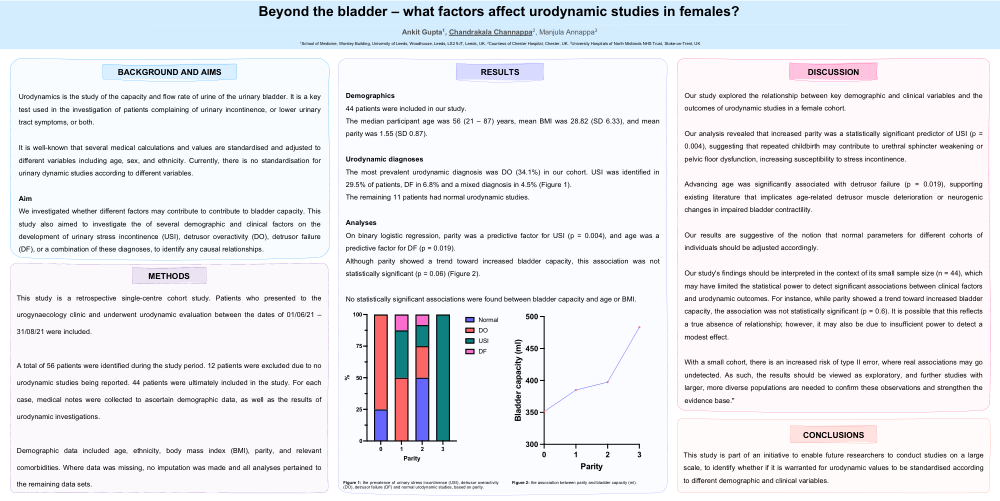
The most prevalent urodynamic diagnosis was DO (34.1%) in our cohort. USI was identified in 29.5% of patients, DF in 6.8% and a mixed diagnosis in 4.5% (Figure 1).
The remaining 11 patients had normal urodynamic studies.
Analyses
On binary logistic regression, parity was a predictive factor for USI (p = 0.004), and age was a predictive factor for DF (p = 0.019).
Although parity showed a trend toward increased bladder capacity, this association was not statistically significant (p = 0.06) (Figure 2).
No statistically significant associations were found between bladder capacity and age or BMI.
Discussion
Our study explored the relationship between key demographic and clinical variables and the outcomes of urodynamic studies in a female cohort.
Our analysis revealed that increased parity was a statistically significant predictor of USI (p = 0.004), suggesting that repeated childbirth may contribute to urethral sphincter weakening or pelvic floor dysfunction, increasing susceptibility to stress incontinence.
Advancing age was significantly associated with detrusor failure (p = 0.019), supporting existing literature that implicates age-related detrusor muscle deterioration or neurogenic changes in impaired bladder contractility.
Our results are suggestive of the notion that normal parameters for different cohorts of individuals should be adjusted accordingly.
Our study's findings should be interpreted in the context of its small sample size (n = 44), which may have limited the statistical power to detect significant associations between clinical factors and urodynamic outcomes. For instance, while parity showed a trend toward increased bladder capacity, the association was not statistically significant (p = 0.6). It is possible that this reflects a true absence of relationship; however, it may also be due to insufficient power to detect a modest effect.
With a small cohort, there is an increased risk of type II error, where real associations may go undetected. As such, the results should be viewed as exploratory, and further studies with larger, more diverse populations are needed to confirm these observations and strengthen the evidence base."
Conclusion - This study is part of an initiative to enable future researchers to conduct studies on a large scale, to identify whether if it is warranted for urodynamic values to be standardisedaccording to different demographic and clinical variables.