2,281 posters, 63 videos, 56 audios, 43 topics, 18 sessions, 6,174 authors, 2,323 institutions
ePostersLive by SciGen Technologies S.A. All rights reserved.
RCOG World Congress 2025
June 23 - 25, 2025 | ExCeL London, UK
EP.2188
Anterior and posterior sacrospinous ligament fixation procedures - an audit of outcomes
Poster Presenter
Part of Topic
Urogynaecology/pelvic floor
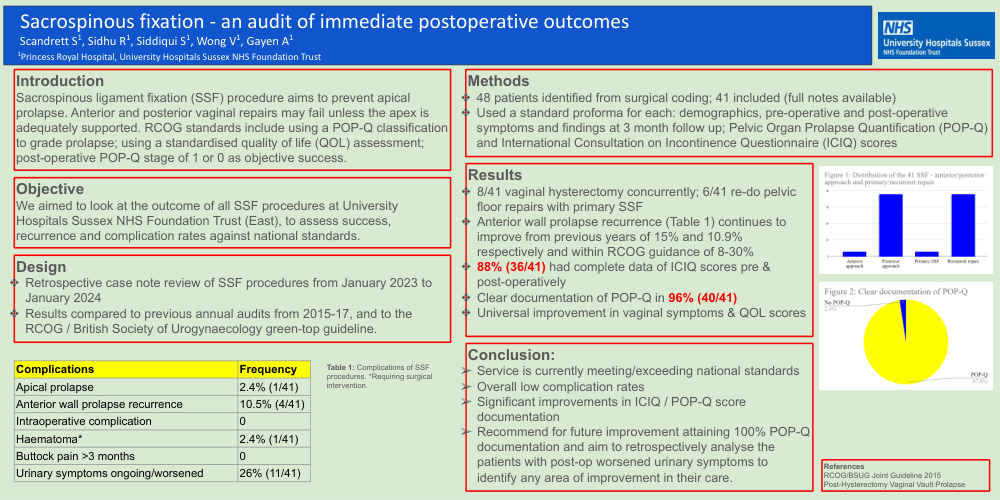
Sacrospinous fixation - an audit of immediate postoperative outcomes
Scandrett S1, Sidhu R1, Siddiqui S1, Wong V1, Gayen A1
1Princess Royal Hospital, University Hospitals Sussex NHS Foundation Trust
Introduction
Sacrospinous ligament fixation (SSF) procedure aims to prevent apical prolapse. Anterior and posterior vaginal repairs may fail unless the apex is adequately supported. RCOG standards include using a POP-Q classification to grade prolapse; using a standardised quality of life (QOL) assessment; post-operative POP-Q stage of 1 or 0 as objective success.
Objective
We aimed to look at the outcome of all SSF procedures at University Hospitals Sussex NHS Foundation Trust (East), to assess success, recurrence and complication rates against national standards.
Design
-
Retrospective case note review of SSF procedures from January 2023 to January 2024
-
Results compared to previous annual audits from 2015-17, and to the RCOG / British Society of Urogynaecology green-top guideline.
-
Methods
-
48 patients identified from surgical coding; 41 included (full notes available)
-
Used a standard proforma for each: demographics, pre-operative and post-operative symptoms and findings at 3 month follow up; Pelvic Organ Prolapse Quantification (POP-Q) and International Consultation on Incontinence Questionnaire (ICIQ) scores
Results
-
8/41 vaginal hysterectomy concurrently; 6/41 re-do pelvic floor repairs with primary SSF
-
Anterior wall prolapse recurrence (Table 1) continues to improve from previous years of 15% and 10.9% respectively and within RCOG guidance of 8-30%
-
88% (36/41) had complete data of ICIQ scores pre & post-operatively
-
Clear documentation of POP-Q in 96% (40/41)
-
Universal improvement in vaginal symptoms & QOL scores
-
Conclusion:
-
Service is currently meeting/exceeding national standards
-
Overall low complication rates
-
Significant improvements in ICIQ / POP-Q score documentation
-
Recommend for future improvement attaining 100% POP-Q documentation and aim to retrospectively analyse the patients with post-op worsened urinary symptoms to identify any area of improvement in their care.
References
RCOG/BSUG Joint Guideline 2015 Post-Hysterectomy Vaginal Vault Prolapse
Complications
Apical prolapse
Anterior wall prolapse recurrence
Intraoperative complication
Haematoma*
Buttock pain >3 months
Urinary symptoms ongoing/worsened
-
-