2,281 posters, 63 videos, 56 audios, 43 topics, 18 sessions, 6,174 authors, 2,323 institutions
ePostersLive by SciGen Technologies S.A. All rights reserved.
RCOG World Congress 2025
June 23 - 25, 2025 | ExCeL London, UK
EP.2175
Re-Audit: Referral of postnatal patients with failed TWOC to community bladder services
Part of Topic
Urogynaecology/pelvic floor
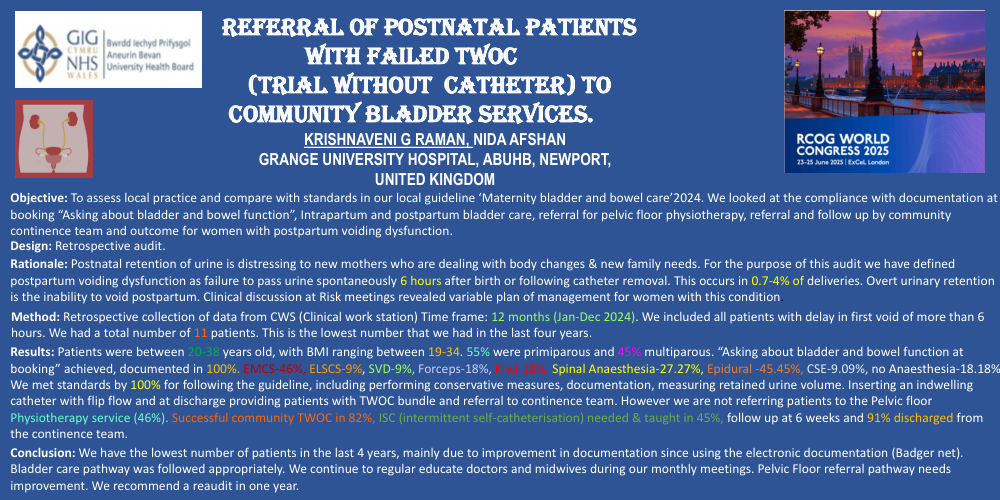
Referral of postnatal patients with failed TWOC (trial without catheter) to community bladder services.
KRISHNAVENI G RAMAN, NIDA AFSHAN
GRANGE UNIVERSITY HOSPITAL, ABUHB, NEWPORT,
UNITED KINGDOM
Objective: To assess local practice and compare with standards in our local guideline ‘Maternity bladder and bowel care’2024. We looked at the compliance with documentation at booking “Asking about bladder and bowel function”, Intrapartum and postpartum bladder care, referral for pelvic floor physiotherapy, referral and follow up by community continence team and outcome for women with postpartum voiding dysfunction.
Design: Retrospective audit.
Rationale: Postnatal retention of urine is distressing to new mothers who are dealing with body changes & new family needs. For the purpose of this audit we have defined postpartum voiding dysfunction as failure to pass urine spontaneously 6 hours after birth or following catheter removal. This occurs in 0.7-4% of deliveries. Overt urinary retention is the inability to void postpartum. Clinical discussion at Risk meetings revealed variable plan of management for women with this condition.
Method: Retrospective collection of data from CWS (Clinical work station) Time frame: 12 months (Jan-Dec 2024. We included all patients with delay in first void of more than 6 hours. We had a total number of 11 patients. This is the lowest number that we had in the last four years.
Results: Patients were between 20-38 years old, with BMI ranging between 19-34. 55% were primiparous and 45% multiparous. “Asking about bladder and bowel function at booking” achieved, documented in 100%. EMCS-46%, ELSCS-9%, SVD-9%, Forceps-18%, Kiwi-18%. Spinal Anaesthesia-27.27%, Epidural -45.45%, CSE-9.09%, no Anaesthesia-18.18%. We met standards by 100% for following the guideline, including performing conservative measures, documentation, measuring retained urine volume. Inserting an indwelling catheter with flip flow and at discharge providing patients with TWOC bundle and referral to continence team. However we are not referring patients to the Pelvic floor Physiotherapy service (46%). Successful community TWOC in 82%, ISC (intermittent self-catheterisation) needed & taught in 45%, follow up at 6 weeks and 91% discharged from
the continence team.
Conclusion: We have the lowest number of patients in the last 4 years, mainly due to improvement in documentation since using the electronic documentation (Badger net). Bladder care pathway was followed appropriately. We continue to regular educate doctors and midwives during our monthly meetings. Pelvic Floor referral pathway needs improvement. We recommend a reaudit in one year.