2,281 posters, 63 videos, 56 audios, 43 topics, 18 sessions, 6,174 authors, 2,323 institutions
ePostersLive by SciGen Technologies S.A. All rights reserved.
RCOG World Congress 2025
June 23 - 25, 2025 | ExCeL London, UK
EP.2174
The correlation between percentage coaptation at periurethral bulking injection and symptom improvement.
Poster Presenter
Authors
Ephraim Samuels, Kristina Fairbrother, Mausumi Das, Paul Hooper
Affiliations
Part of Topic
Urogynaecology/pelvic floor
Introduction:
Periurethral bulking injection (PUBI) for the management of stress urinary incontinence in selected patients remains a valuable treatment option after thorough multidisciplinary team (MDT) input. This option of treatment for stress urinary incontinence (SUI) can be used for frail and obese patients, those who prefer the option and as an additional intervention for individuals who have had some other form of SUI procedure for further symptom improvement. Achieving symptom relief is dependent on successful coaptation of at least 3 equally spaced injection sites at the bladder neck.
Aim:
This audit set out to correlate the percentage of coaptation at PUBI with symptom relief for SUI.
Objectives:
1.To determine the correlation between degree of coaptation at PUBI and improvement of symptoms
2. To determine symptom improvement with repeat PUBI after previous PUBI or other form of SUI surgery
Methodology:
This was a retrospective study that looked at the coaptation percentage at PUBI procedure for SUI and the symptom improvement for patients at Nottingham University Hospitals.
Results:
All patients who had SUI and mixed urinary incontinence (MUI), urodynamics, MDT discussion, PUBI and follow up appointment were included in the study.
The operation notes for the procedure and assessment at three months follow up clinic appointment was reviewed to obtain the required information.
Symptom improvement was obtained using the patient global impression of improvement (PGI-I) for continence questionnaire by comparing pre and post operative symptomatology. All data were entered onto a database and analysed.
30 patients were identified who had PUBI for SUI and MUI. Nine were excluded because 8 were awaiting follow up and one was lost to follow up. Hence, data was obtained and analysed for 21 patients, who met the inclusion criteria.
They all had urodynamics with 23% having detrusor overactivity with stress incontinence. 77% had urodynamic SUI. They all had multidisciplinary discussion with the urogynaecology/urology team before proceeding for PUBI. The procedure on average took 22 minutes with achievement of at least 80% coaptation.
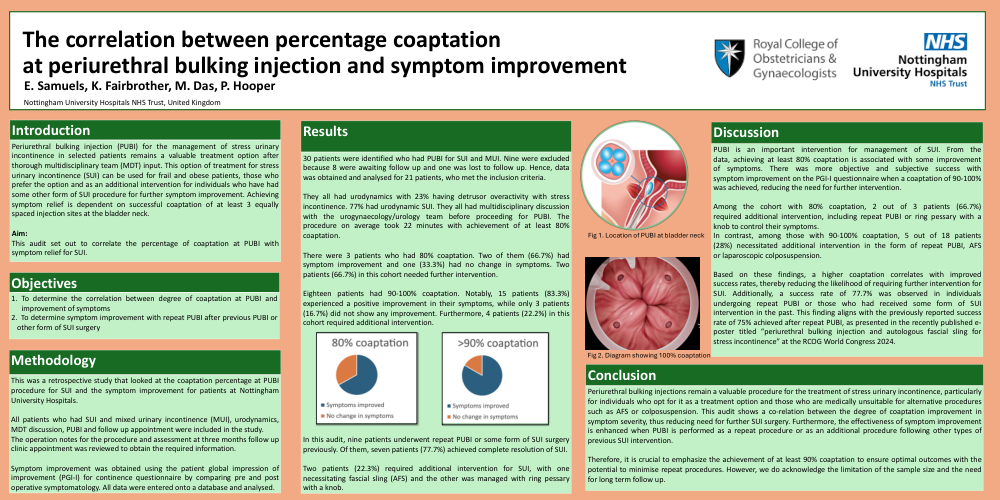
There were 3 patients who had 80% coaptation. Two of them (66.7%) had symptom improvement and one (33.3%) had no change in symptoms. Two patients (66.7%) in this cohort needed further intervention.
Eighteen patients had 90-100% coaptation. Notably, 15 patients (83.3%) experienced a positive improvement in their symptoms, while only 3 patients (16.7%) did not show any improvement. Furthermore, 4 patients (22.2%) in this cohort required additional intervention.
In this audit, nine patients underwent repeat PUBI or some form of SUI surgery previously. Of them, seven patients (77.7%) achieved complete resolution of SUI.
Two patients (22.3%) required additional intervention for SUI, with one necessitating fascial sling (AFS) and the other was managed with ring pessary with a knob.
Discussion:
PUBI is an important intervention for management of SUI. From the data, achieving at least 80% coaptation is associated with some improvement of symptoms. There was more objective and subjective success with symptom improvement on the PGI-I questionnaire when a coaptation of 90-100% was achieved, reducing the need for further intervention.
Among the cohort with 80% coaptation, 2 out of 3 patients (66.7%) required additional intervention, including repeat PUBI or ring pessary with a knob to control their symptoms.
In contrast, among those with 90-100% coaptation, 5 out of 18 patients (28%) necessitated additional intervention in the form of repeat PUBI, AFS or laparoscopic colposuspension.
Based on these findings, a higher coaptation correlates with improved success rates, thereby reducing the likelihood of requiring further intervention for SUI. Additionally, a success rate of 77.7% was observed in individuals undergoing repeat PUBI or those who had received some form of SUI intervention in the past. This finding aligns with the previously reported success rate of 75% achieved after repeat PUBI, as presented in the recently published e-poster titled “periurethral bulking injection and autologous fascial sling for stress incontinence” at the RCOG World Congress 2024.
Conclusion:
Periurethral bulking injections remain a valuable procedure for the treatment of stress urinary incontinence, particularly for individuals who opt for it as a treatment option and those who are medically unsuitable for alternative procedures such as AFS or colposuspension. This audit shows a co-relation between the degree of coaptation improvement in symptom severity, thus reducing need for further SUI surgery. Furthermore, the effectiveness of symptom improvement is enhanced when PUBI is performed as a repeat procedure or as an additional procedure following other types of previous SUI intervention.
Therefore, it is crucial to emphasize the achievement of at least 90% coaptation to ensure optimal outcomes with the potential to minimise repeat procedures. However, we do acknowledge the limitation of the sample size and the need for long term follow up.