2,281 posters, 63 videos, 56 audios, 43 topics, 18 sessions, 6,174 authors, 2,323 institutions
ePostersLive by SciGen Technologies S.A. All rights reserved.
RCOG World Congress 2025
June 23 - 25, 2025 | ExCeL London, UK
EP.2170
Vesicovaginal Fistula from a Shelf Pessary Erosion- A Case Reflection
Part of Topic
Urogynaecology/pelvic floor
Vesicovaginal Fistula from eroded Shelf Pessary- A Case Reflection
S Dhital 1, N Rahman 2
1.Luton and Dunstable University Hospital NHS Trust, Luton, UK
2 Hinchingbrooke Hospital, North West Anglia NHS Trust, Huntington, UK
INTRODUCTION
Urogenital prolapse is common condition causing significant negative impact on quality of life. Pessaries are widely used as first-line interventions for the management of pelvic organ prolapse (POP), offering a non-surgical approach with minimal risks. However, despite their generally favourable safety profile, occurrences of complications are not uncommon. Vesicovaginal Fistula (VVF), an abnormal connection between the bladder and vagina inducing urine continuously into the vagina, is one of the serious complication associated with it.
We describe a challenging case management of POP in elderly frail patient with complex medical history complicated further by VVF. This case highlights the critical role of an interdisciplinary team, shared decision-making and personalised care in managing complex urogynaecological condition.
CASE REPORT
- A 92 years old, para 2, history of total abdominal hysterectomy, longstanding vaginal vault prolapse had been managed successfully with Simpson shelf pessaries, with regular replacement every 5-6 monthly.
- Multiple complex comorbidities including supraventricular tachycardia (SVT), angina, osteoarthritis, asthma, hypertension, temporal lobe epilepsy, mild cognitive impairment, history of breast cancer, recurrent falls, bilateral deafness and was on long-term Edoxaban along with other medications.
- A size 15 shelf pessary was inserted with planned 4-month review, which did not take place. Patient presented to GP nine months later with new onset hematuria without urinary tract infections.
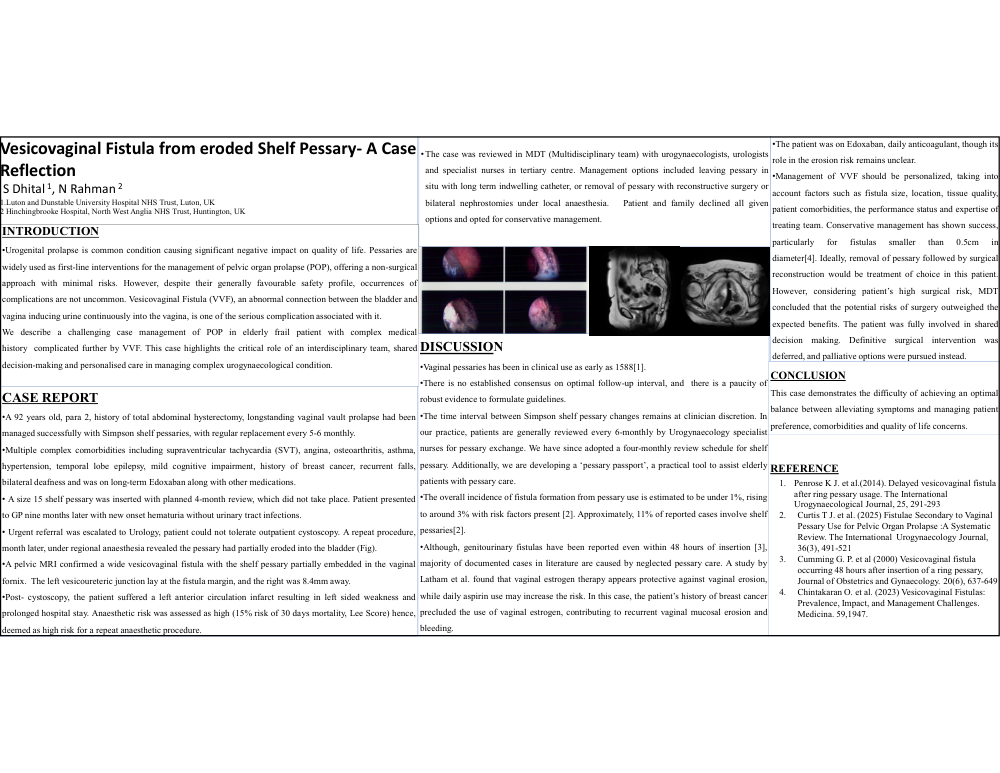
- Urgent referral was escalated to Urology, patient could not tolerate outpatient cystoscopy. A repeat procedure, month later, under regional anaesthesia revealed the pessary had partially eroded into the bladder (Fig).
- A pelvic MRI confirmed a wide vesicovaginal fistula with the shelf pessary partially embedded in the vaginal fornix. The left vesicoureteric junction lay at the fistula margin, and the right was 8.4mm away.
- Post- cystoscopy, the patient suffered a left anterior circulation infarct resulting in left sided weakness and prolonged hospital stay. Anaesthetic risk was assessed as high (15% risk of 30 days mortality, Lee Score) hence, deemed as high risk for a repeat anaesthetic procedure.
- The case was reviewed in MDT (Multidisciplinary team) with urogynaecologists, urologists and specialist nurses in tertiary centre. Management options included leaving pessary in situ with long term indwelling catheter, or removal of pessary with reconstructive surgery or bilateral nephrostomies under local anaesthesia. Patient and family declined all given options and opted for conservative management.
DISCUSSION
- Vaginal pessaries has been in clinical use as early as 1588[1].
- There is no established consensus on optimal follow-up interval, and there is a paucity of robust evidence to formulate guidelines.
- The time interval between Simpson shelf pessary changes remains at clinician discretion. In our practice, patients are generally reviewed every 6-monthly by Urogynaecology specialist nurses for pessary exchange. We have since adopted a four-monthly review schedule for shelf pessary. Additionally, we are developing a ‘pessary passport’, a practical tool to assist elderly patients with pessary care.
- The overall incidence of fistula formation from pessary use is estimated to be under 1%, rising to around 3% with risk factors present [2]. Approximately, 11% of reported cases involve shelf pessaries[2].
- Although, genitourinary fistulas have been reported even within 48 hours of insertion [3], majority of documented cases in literature are caused by neglected pessary care. A study by Latham et al. found that vaginal estrogen therapy appears protective against vaginal erosion, while daily aspirin use may increase the risk. In this case, the patient’s history of breast cancer precluded the use of vaginal estrogen, contributing to recurrent vaginal mucosal erosion and bleeding.
- The patient was on Edoxaban, daily anticoagulant, though its role in the erosion risk remains unclear.
- Management of VVF should be personalized, taking into account factors such as fistula size, location, tissue quality, patient comorbidities, the performance status and expertise of treating team. Conservative management has shown success, particularly for fistulas smaller than 0.5cm in diameter[4]. Ideally, removal of pessary followed by surgical reconstruction would be treatment of choice in this patient. However, considering patient’s high surgical risk, MDT concluded that the potential risks of surgery outweighed the expected benefits. The patient was fully involved in shared decision making. Definitive surgical intervention was deferred, and palliative options were pursued instead.
CONCLUSION
- This case demonstrates the difficulty of achieving an optimal balance between alleviating symptoms and managing patient preference, comorbidities and quality of life concerns.
REFERENCE
- Penrose K J. et al.(2014). Delayed vesicovaginal fistula after ring pessary usage. The International Urogynaecological Journal, 25, 291-293
- Curtis T J. et al. (2025) Fistulae Secondary to Vaginal Pessary Use for Pelvic Organ Prolapse :A Systematic Review. The International Urogynaecology Journal, 36(3), 491-521
- Cumming G. P. et al (2000) Vesicovaginal fistula occurring 48 hours after insertion of a ring pessary, Journal of Obstetrics and Gynaecology. 20(6), 637-649
- Chintakaran O. et al. (2023) Vesicovaginal Fistulas: Prevalence, Impact, and Management Challenges. Medicina. 59,1947.