2,281 posters, 63 videos, 56 audios, 43 topics, 18 sessions, 6,174 authors, 2,323 institutions
ePostersLive by SciGen Technologies S.A. All rights reserved.
RCOG World Congress 2025
June 23 - 25, 2025 | ExCeL London, UK
EP.2168
Management of OASI in Kuwait: a proposal to a comprehensive guideline protocol.
Poster Presenter
Authors
Affiliations
Part of Topic
Urogynaecology/pelvic floor
Management of OASI in Kuwait: a proposal to a novel comprehensive guideline protocol.
Authors
Heba Rabea1, Hossam Kamel1, Panayoti Bachkangi1,2
1 Private Sector in Obstetrics and Gynaecology, Kuwait
2 University of Leicester, United Kingdom
Introduction
Obstetric anal sphincter injury (OASI) is a serious obstetric complication with an incidence of from 0.1% to 10.9% (1). The incidence of OASI has been rising (1-2) [something something] the Royal College of Obstetricians and Gynaecologists introduced the OASI bundle and the (3).
In Kuwait, most clinical practices, with regards the management of OASI, are based on the RCOG guidelines, as there are no formal national guidelines yet. The aim is to introduce a new model of guideline that includes every possible recommendation, ensuring the safest management of OASI.
Methodology
A quality improvement project (QIP) was conducted, following the Institute of Health Improvement (IHI) model and by using the SMART (specific – measurable, achievable, sustainable, relevant, timely) approach. For the comparison we used the cumulative list of recommendations from the UK, USA, Australia-Queensland, and Canadian guidelines (2-6). The recommendations and guidelines were chosen based on a recent review published by Roper et.al where an Appraisal of Guidelines for Research and Evaluation (AGREE) II assessment was conducted and these 5 guidelines scored >70%, suggesting a higher quality of methodology (7).
Results
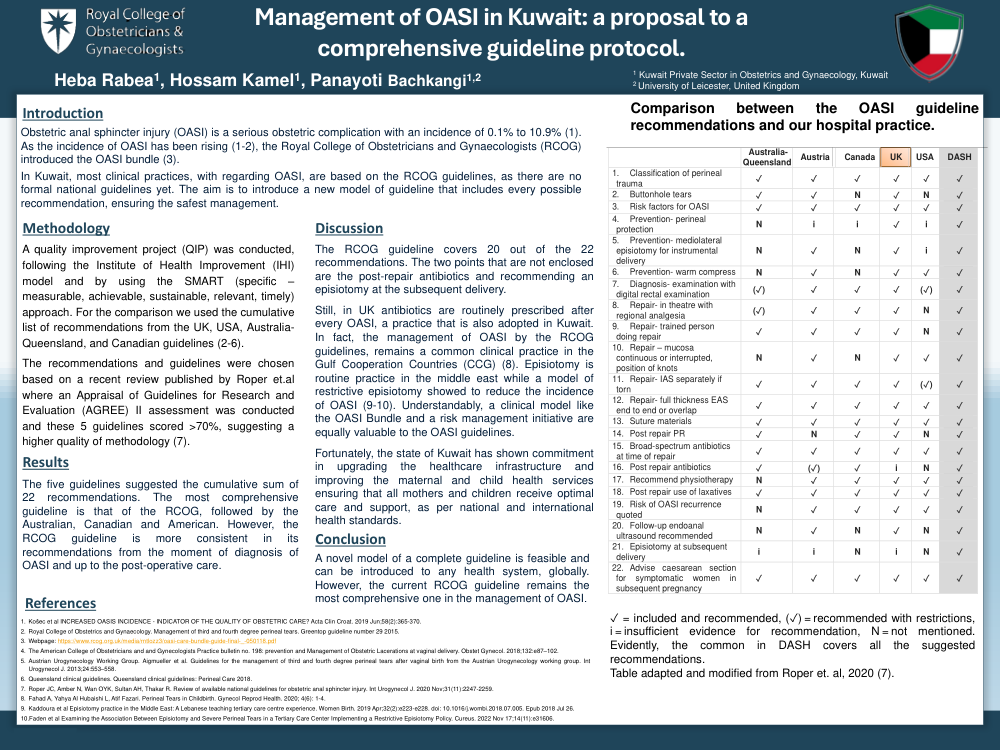
The five selected guidelines suggested the cumulative sum of 22 recommendations (Table 1). The most comprehensive guideline is that of the RCOG, followed by the Australian guidelines, then the Canadian and American guidelines. However, the RCOG guideline is more consistent in its recommendation from the moment of diagnosis of OASI to the completion of the repair (points 7 to 15 in Table 1).
Discussion
The RCOG guideline covers 20 out of the 22 points of recommendations Despite the variety in methodological quality and evidence, worldwide, cover all the vital points of recommendations suggested in the guidelines examined (7). The two points that are not enclosed explicitly are the post-repair antibiotics and recommending an episiotomy at the subsequent delivery.
Still, in the UK antibiotics are routinely prescribed after every OASI, a practice that is also adopted in Kuwait. In fact, the management of OASI by the RCOG guidelines, remains a common /conventional practice in the entire Gulf Cooperation Countries (CCG) (8).
Episiotomy is used commonly in the middle east (9) while introducing a model of restrictive episiotomy showed to reduce the incidence of OASI (10).
Conclusion
A novel model of a complete guideline is feasible and can be introduced to any health system. Nevertheless, the RCOG guideline remains the most comprehensive one in the management of OASI.
References
- Košec V, Djaković I, Čukelj M, Ejubović E, Sumpor B, Djaković Ž. INCREASED OASIS INCIDENCE - INDICATOR OF THE QUALITY OF OBSTETRIC CARE? Acta Clin Croat. 2019 Jun;58(2):365-370.
- Royal College of Obstetrics and Gynaecology. Management of third and fourth degree perineal tears. Greentop guideline number 29 2015.
- Webpage: https://www.rcog.org.uk/media/rntlozz3/oasi-care-bundle-guide-final-_-050118.pdf
- The American College of Obstetricians and and Gynecologists Practice bulletin no. 198: prevention and Management of Obstetric Lacerations at vaginal delivery. Obstet Gynecol. 2018;132:e87–102. doi: 10.1097/AOG.0000000000002841
- Austrian Urogynecology Working Group. Aigmueller T, Umek W, Elenskaia K, Frudinger A, Pfeifer J, et al. Guidelines for the management of third and fourth degree perineal tears after vaginal birth from the Austrian Urogynecology working group. Int Urogynecol J. 2013;24:553–558. doi: 10.1007/s00192-012-1982-x.
- Queensland clinical guidelines. Queensland clinical guidelines: Perineal Care 2018.
- Roper JC, Amber N, Wan OYK, Sultan AH, Thakar R. Review of available national guidelines for obstetric anal sphincter injury. Int Urogynecol J. 2020 Nov;31(11):2247-2259.
- Fahad A, Yahya Al Hubaishi L, Atif Fazari. Perineal Tears in Childbirth. Gynecol Reprod Health. 2020; 4(6): 1-4.
- Kaddoura R, DeJong J, Zurayk H, Kabakian T, Abbyad C, Mirza FG. Episiotomy practice in the Middle East: A Lebanese teaching tertiary care centre experience. Women Birth. 2019 Apr;32(2):e223-e228. doi: 10.1016/j.wombi.2018.07.005. Epub 2018 Jul 26. PMID: 30057367.
- Faden YA, Fatani AM, Fallatah BM, Rawa TS, Almasri SA, El Amin NO, Rawas SA, Al-Hindi MY. Examining the Association Between Episiotomy and Severe Perineal Tears in a Tertiary Care Center Implementing a Restrictive Episiotomy Policy. Cureus. 2022 Nov 17;14(11):e31606. doi: 10.7759/cureus.31606. PMID: 36465198; PMCID: PMC9709907.
Comparison between the OASI guideline recommendations and our hospital practice.
|
|
Australia- Queensland |
Austria |
Canada |
UK |
USA |
|
✓ |
✓ |
✓ |
✓ |
✓ |
|
✓ |
✓ |
N |
✓ |
N |
|
✓ |
✓ |
✓ |
✓ |
✓ |
|
N |
i |
i |
✓ |
i |
|
N |
✓ |
N |
✓ |
i |
|
N |
✓ |
N |
✓ |
✓ |
|
(✓) |
✓ |
✓ |
✓ |
(✓) |
|
(✓) |
✓ |
✓ |
✓ |
N |
|
✓ |
✓ |
✓ |
✓ |
N |
|
N |
✓ |
N |
✓ |
✓ |
|
✓ |
✓ |
✓ |
✓ |
(✓) |
|
✓ |
✓ |
✓ |
✓ |
✓ |
|
✓ |
✓ |
✓ |
✓ |
✓ |
|
✓ |
N |
✓ |
✓ |
N |
|
✓ |
✓ |
✓ |
✓ |
✓ |
|
✓ |
(✓) |
✓ |
i |
N |
|
N |
✓ |
✓ |
✓ |
✓ |
|
✓ |
✓ |
✓ |
✓ |
✓ |
|
N |
✓ |
✓ |
✓ |
✓ |
|
N |
✓ |
N |
✓ |
N |
|
i |
i |
N |
i |
N |
|
✓ |
✓ |
✓ |
✓ |
✓ |
✓ = included and recommended, (✓) = recommended with restrictions, i = insufficient evidence for recommendation, N = not mentioned.
Table adapted and modified from Roper et. al, 2020 (7).