2,281 posters, 63 videos, 56 audios, 43 topics, 18 sessions, 6,174 authors, 2,323 institutions
ePostersLive by SciGen Technologies S.A. All rights reserved.
RCOG World Congress 2025
June 23 - 25, 2025 | ExCeL London, UK
EP.0020
Rupture of scarred uterus following a criminal medical abortion in 2nd trimester.
Part of Topic
Abortion care
Rupture of a scarred uterus following criminal medical abortion in the 2nd trimester
Buddhika Witharane1, N.P. Hettigama2, K. Dissanayake3
Background - Women in Sri Lanka do not have access to safe and legal abortion. The penal code of Sri Lanka, a legacy of colonial rule, has not been revised since 1883 and states in section 303 than an abortion is only permissible in good faith for the purpose of saving the life of the woman. Hence this essential service is provided by quacks using dubious and dangerous methods putting the woman’s life in danger. The lack of knowledge, skill, and disregard of aseptic techniques results in life threatening complications for women. The extent of morbidity caused by criminal abortion is unknown.
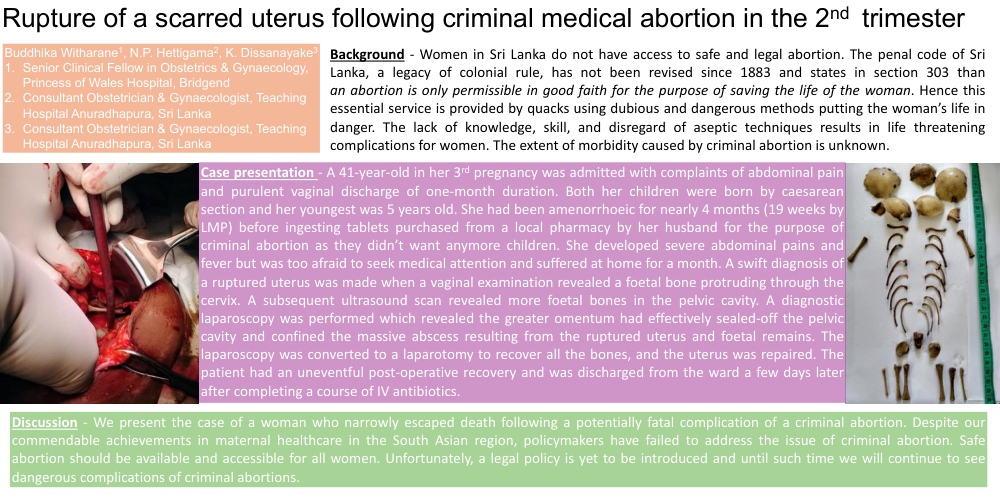
Case presentation - A 41-year-old in her 3rd pregnancy was admitted with complaints of abdominal pain and purulent vaginal discharge of one-month duration. Both her children were born by caesarean section and her youngest was 5 years old. She had been amenorrhoeic for nearly 4 months (19 weeks by LMP) before ingesting tablets purchased from a local pharmacy by her husband for the purpose of criminal abortion as they didn’t want anymore children. She developed severe abdominal pains and fever but was too afraid to seek medical attention and suffered at home for a month. A swift diagnosis of a ruptured uterus was made when a vaginal examination revealed a foetal bone protruding through the cervix. A subsequent ultrasound scan revealed more foetal bones in the pelvic cavity. A diagnostic laparoscopy was performed which revealed the greater omentum had effectively sealed-off the pelvic cavity and confined the massive abscess resulting from the ruptured uterus and foetal remains. The laparoscopy was converted to a laparotomy to recover all the bones, and the uterus was repaired. The patient had an uneventful post-operative recovery and was discharged from the ward a few days later after completing a course of IV antibiotics.
Discussion - We present the case of a woman who narrowly escaped death following a potentially fatal complication of a criminal abortion. Despite our commendable achievements in maternal healthcare in the South Asian region, policymakers have failed to address the issue of criminal abortion. Safe abortion should be available and accessible for all women. Unfortunately, a legal policy is yet to be introduced and until such time we will continue to see dangerous complications of criminal abortions.