2,281 posters, 63 videos, 56 audios, 43 topics, 18 sessions, 6,174 authors, 2,323 institutions
ePostersLive by SciGen Technologies S.A. All rights reserved.
RCOG World Congress 2025
June 23 - 25, 2025 | ExCeL London, UK
EP.0019
Abortion and foetal abnormality: an outdated legal inconsistency perpetuating ableist stereotypes
Poster Presenter
Authors
Affiliations
Part of Topic
Abortion care
Abortion and foetal abnormality: an outdated legal inconsistency perpetuating ableist stereotypes
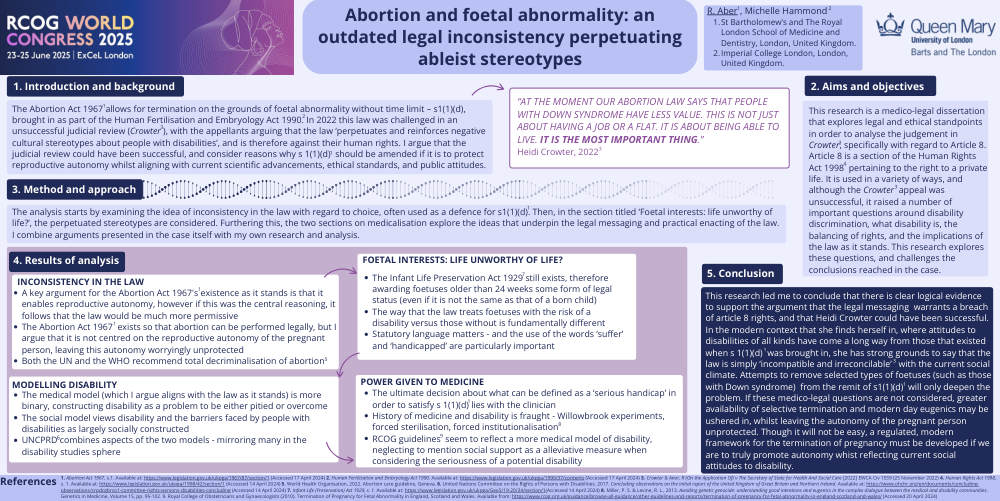
The Abortion Act 1967 allows for termination on the grounds of foetal abnormality without time limit – s1(1)(d), brought in as part of the Human Fertilisation and Embryology Act 1990. In 2022 this law was challenged in an unsuccessful judicial review (Crowter ), with the appellants arguing that the law ‘perpetuates and reinforces negative cultural stereotypes about people with disabilities’ , and is therefore against their human rights. I argue that the judicial review could have been successful, and consider reasons why s 1(1)(d) should be amended if it is to protect reproductive autonomy whilst aligning with current scientific advancements, ethical standards, and public attitudes.
This research is a medico-legal dissertation that explores legal and ethical standpoints in order to analyse the judgement in Crowter, specifically with regard to Article 8. Article 8 is a section of the Human Rights Act 1998 pertaining to the right to a private life. It is used in a variety of ways, and although the Crowter appeal was unsuccessful, it raised a number of important questions around disability discrimination, what disability is, the balancing of rights, and the implications of the law as it stands. This research explores these questions, and challenges the conclusions reached in the case
The analysis starts by examining the idea of inconsistency in the law with regard to choice, often used as a defence for s1(1)(d). Then, in the section titled ‘Foetal interests: life unworthy of life?’ , the perpetuated stereotypes are considered. Furthering this, the two sections on medicalisation explore the ideas that underpin the legal messaging and practical enacting of the law. I combine arguments presented in the case itself with my own research and analysis.
This research led me to conclude that there is clear logical evidence to support the argument that the legal messaging warrants a breach of article 8 rights, and that Heidi Crowter could have been successful. In the modern context that she finds herself in, where attitudes to disabilities of all kinds have come a long way from those that existed when s 1(1)(d) was brought in, she has strong grounds to say that the law is simply ‘incompatible and irreconcilable’ with the current social climate. Attempts to remove selected types of foetuses (such as those with Down syndrome) from the remit of s1(1)(d) will only deepen the problem. If these medico-legal questions are not considered, greater availability of selective termination and modern day eugenics may be ushered in, whilst leaving the autonomy of the pregnant person unprotected. Though it will not be easy, a regulated, modern framework for the termination of pregnancy must be developed if we are to truly promote autonomy whist reflecting current social attitudes to disability.