2,281 posters, 63 videos, 56 audios, 43 topics, 18 sessions, 6,174 authors, 2,323 institutions
ePostersLive by SciGen Technologies S.A. All rights reserved.
RCOG World Congress 2025
June 23 - 25, 2025 | ExCeL London, UK
EP.1946
ABCD Approach: A simpler way of improving elective section lists
Poster Presenter
Authors
Affiliations
Part of Topic
Quality improvement
BACKGROUND
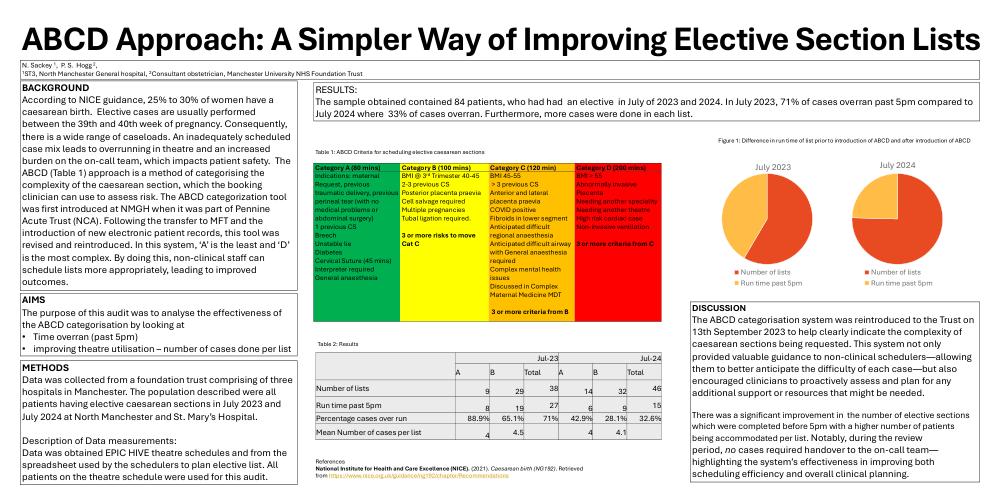
According to NICE guidance, 25% to 30% of women have a caesarean birth. Elective cases are usually performed between the 39th and 40th week of pregnancy. Consequently, there is a wide range of caseloads. An inadequately scheduled case mix leads to overrunning in theatre and an increased burden on the on-call team, which impacts patient safety. The ABCD (Table 1) approach is a method of categorising the complexity of the caesarean section, which the booking clinician can use to assess risk. The ABCD categorization tool was first introduced at NMGH when it was part of Pennine Acute Trust (NCA). Following the transfer to MFT and the introduction of new electronic patient records, this tool was revised and reintroduced. In this system, ‘A’ is the least and ‘D’ is the most complex. By doing this, non-clinical staff can schedule lists more appropriately, leading to improved outcomes.
AIMS
The purpose of this audit was to analyse the effectiveness of the ABCD categorisation by looking at
METHODS
Data was collected from a foundation trust comprising of three hospitals in Manchester. The population described were all patients having elective caesarean sections in July 2023 and July 2024 at North Manchester and St. Mary’s Hospital.
Description of Data measurements:
Data was obtained EPIC HIVE theatre schedules and from the spreadsheet used by the schedulers to plan elective list. All patients on the theatre schedule were used for this audit.
DISCUSSION
The ABCD categorisation system was reintroduced to the Trust on 13th September 2023 to help clearly indicate the complexity of caesarean sections being requested. This system not only provided valuable guidance to non-clinical schedulers—allowing them to better anticipate the difficulty of each case—but also encouraged clinicians to proactively assess and plan for any additional support or resources that might be needed.
There was a significant improvement in the number of elective sections which were completed before 5pm with a higher number of patients being accommodated per list. Notably, during the review period, no cases required handover to the on-call team—highlighting the system’s effectiveness in improving both scheduling efficiency and overall clinical planning.