2,281 posters, 63 videos, 56 audios, 43 topics, 18 sessions, 6,174 authors, 2,323 institutions
ePostersLive by SciGen Technologies S.A. All rights reserved.
RCOG World Congress 2025
June 23 - 25, 2025 | ExCeL London, UK
EP.1942
Relationship between delivery room equipment and the labor experience in low-income country
Poster Presenter
Part of Topic
Quality improvement
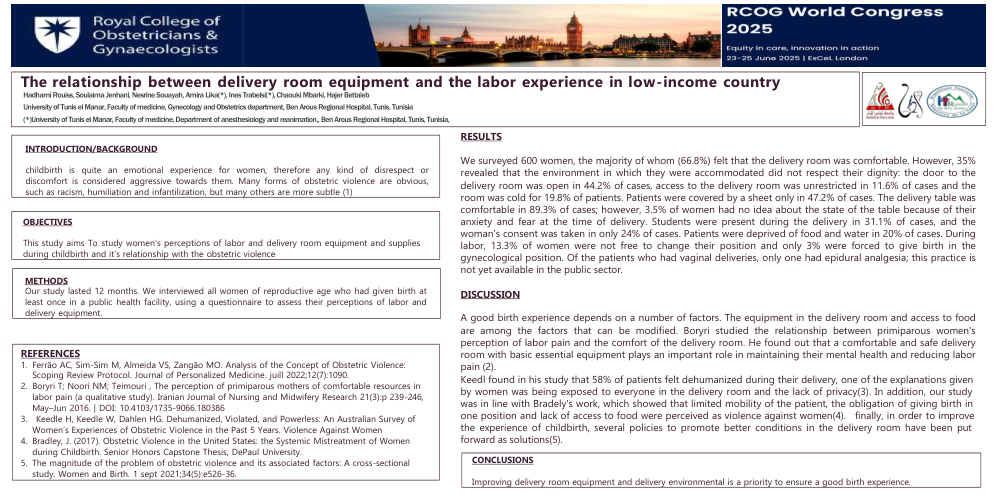
The relationship between delivery room equipment and the labor experience in low-income counutry
Hadhami Rouiss, Soulaima Jenhani, Nesrine Souayah, Amira Lika(*), Ines Trabelsi(*), Chaouki Mbarki, Hajer Bettaieb
University of Tunis el Manar, Faculty of medicine, Gynecology and Obstetrics department, Ben Arous Regional Hospital, Tunis, Tunisia
(*)University of Tunis el Manar, Faculty of medicine, Department of anesthesiology and reanimation,, Ben Arous Regional Hospital, Tunis, Tunisia
INTRODUCTION/BACKGROUND
childbirth is quite an emotional experience for women, therefore any kind of disrespect or discomfort is considered aggressive towards them. many forms of obstetric violence are obvious, such as racism, humiliation and infantilization, but many others are more subtle (1)
Objective: to study women's perceptions of labor and delivery room equipemnet and supplies during childbirth.
Design: This was a descriptive, cross-sectional, multicentre study.
Methods: Our study lasted 12 months. We interviewed all women of reproductive age who had given birth at least once in a public health facility, using a questionnaire to assess their perceptions of labor and delivery equipment.
Results: We surveyed 600 women, the majority of whom (66.8%) felt that the delivery room was comfortable. However, 35% revealed that the environment in which they were accommodated did not respect their dignity: the door to the delivery room was open in 44.2% of cases, access to the delivery room was unrestricted in 11.6% of cases and the room was cold for 19.8% of patients. Patients were covered by a sheet only in 47.2% of cases. The delivery table was comfortable in 89.3% of cases; however, 3.5% of women had no idea about the state of the table because of their anxiety and fear at the time of delivery. Students were present during the delivery in 31.1% of cases, and the woman's consent was taken in only 24% of cases. Patients were deprived of food and water in 20% of cases. During labour, 13.3% of women were not free to change their position and only 3% were forced to give birth in the gynaecological position. Of the patients who had vaginal deliveries, only one had epidural analgesia; this practice is not yet available in the public sector.
Discussion
A good birth experience depends on a number of factors. The equipment in the delivery room and access to food are among the factors that can be modified. Boryri studied the relationship between primiparous women's perception of labor pain and the comfort of the delivery room. He found out that a comfortable and safe delivery room with basic essential equipment plays an important role in maintaining their mental health and reducing labor pain (2).
Keedl found in his study that 58% of patients felt dehumanized during their delivery, one of the explanations given by women was being exposed to everyone in the delivery room and the lack of privacy(3). In addition, our study was in line with Bradely's work, which showed that limited mobility of the patient, the obligation of giving birth in one position and lack of access to food were perceived as violence against women(4). finally, in order to improve the experience of childbirth, several policies to promote better conditions in the delivery room have been put forward as solutions(5).
Conclusion:
Improving delivery room equipment and delivery environmental is a priority to ensure a good birth experience.
REFERENCES
1. Ferrão AC, Sim-Sim M, Almeida VS, Zangão MO. Analysis of the Concept of Obstetric Violence: Scoping Review Protocol. Journal of Personalized Medicine. juill 2022;12(7):1090.
- Boryri T; Noori NM; Teimouri , The perception of primiparous mothers of comfortable resources in labor pain (a qualitative study). Iranian Journal of Nursing and Midwifery Research 21(3):p 239-246, May–Jun 2016. | DOI: 10.4103/1735-9066.180386
- Keedle H, Keedle W, Dahlen HG. Dehumanized, Violated, and Powerless: An Australian Survey of Women’s Experiences of Obstetric Violence in the Past 5 Years. Violence Against Women
- Bradley, J. (2017). Obstetric Violence in the United States: the Systemic Mistreatment of Women during Childbirth. Senior Honors Capstone Thesis, DePaul University.
- The magnitude of the problem of obstetric violence and its associated factors: A cross-sectional study. Women and Birth. 1 sept 2021;34(5):e526‑36.