2,281 posters, 63 videos, 56 audios, 43 topics, 18 sessions, 6,174 authors, 2,323 institutions
ePostersLive by SciGen Technologies S.A. All rights reserved.
RCOG World Congress 2025
June 23 - 25, 2025 | ExCeL London, UK
EP.1922
Cook's balloon for labour induction increases the risk of cord prolapse LSCS.
Poster Presenter
Part of Topic
Quality improvement
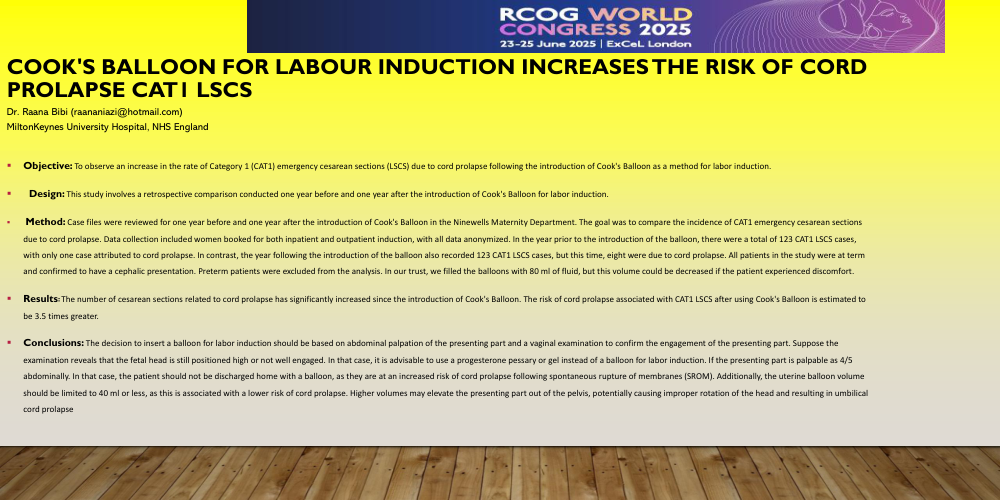
COOK'S BALLOON FOR LABOUR INDUCTION INCREASES THE RISK OF CORD PROLAPSE CAT1 LSCS DR RAANA BIBI NINEWELLS HOSPITAL, DUNDEE, UNITED KINGDOM • Objective: To observe an increase in the rate of Category 1 (CAT1) emergency cesarean sections (LSCS) due to cord prolapse following the introduction of Cook's Balloon as a method for labor induction. • Design: This study involves a retrospective comparison conducted one year before and one year after the introduction of Cook's Balloon for labor induction. • Method: Case files were reviewed for one year before and one year after the introduction of Cook's Balloon in the Ninewells Maternity Department. The goal was to compare the incidence of CAT1 emergency cesarean sections due to cord prolapse. Data collection included women booked for both inpatient and outpatient induction, with all data anonymized. In the year prior to the introduction of the balloon, there were a total of 123 CAT1 LSCS cases, with only one case attributed to cord prolapse. In contrast, the year following the introduction of the balloon also recorded 123 CAT1 LSCS cases, but this time, eight were due to cord prolapse. All patients in the study were at term and confirmed to have a cephalic presentation. Preterm patients were excluded from the analysis. In our trust, we filled the balloons with 80 ml of fluid, but this volume could be decreased if the patient experienced discomfort. • Results: The number of cesarean sections related to cord prolapse has significantly increased since the introduction of Cook's Balloon. The risk of cord prolapse associated with CAT1 LSCS after using Cook's Balloon is estimated to be 3.5 times greater. • Conclusions: The decision to insert a balloon for labor induction should be based on abdominal palpation of the presenting part and a vaginal examination to confirm the engagement of the presenting part. Suppose the examination reveals that the fetal head is still positioned high or not well engaged. In that case, it is advisable to use a progesterone pessary or gel instead of a balloon for labor induction. If the presenting part is palpable as 4/5 abdominally. In that case, the patient should not be discharged home with a balloon, as they are at an increased risk of cord prolapse following spontaneous rupture of membranes (SROM). Additionally, the uterine balloon volume should be limited to 40 ml or less, as this is associated with a lower risk of cord prolapse. Higher volumes may elevate the presenting part out of the pelvis, potentially causing improper rotation of the head and resulting in umbilical cord prolapse