2,281 posters, 63 videos, 56 audios, 43 topics, 18 sessions, 6,174 authors, 2,323 institutions
ePostersLive by SciGen Technologies S.A. All rights reserved.
RCOG World Congress 2025
June 23 - 25, 2025 | ExCeL London, UK
EP.1919
Evaluation of the Accuracy of On-Call Telephone Advice and Clinical Intervention Post-Escalation
Poster Presenter
Authors
Affiliations
Part of Topic
Quality improvement
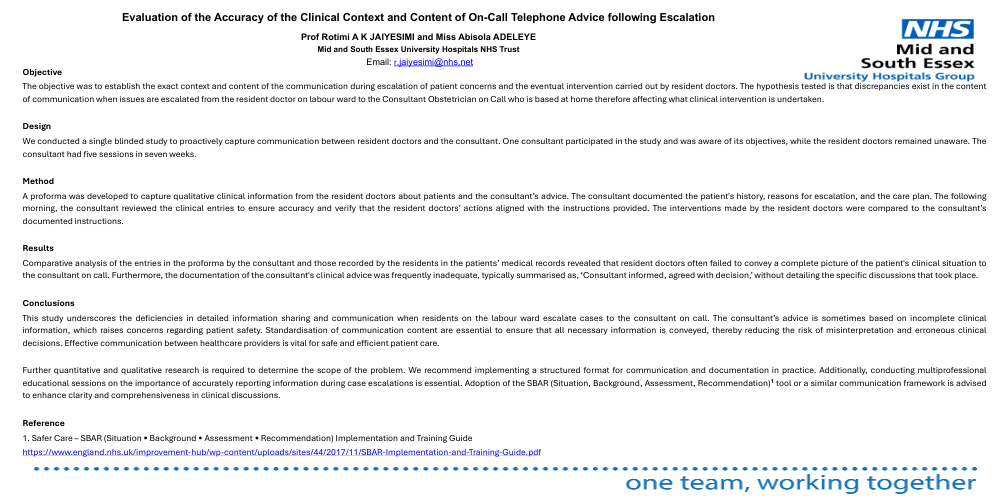
Evaluation of the Accuracy of the Clinical Context and Content of On-Call Telephone Advice following Escalation
Objective
The objective was to establish the exact context and content of the communication during escalation
of patient concerns and the eventual intervention carried out by resident doctors. The hypothesis
tested is that discrepancies exist in the content of communication when issues are escalated from
the resident doctor on labour ward to the Consultant Obstetrician on Call who is based at home
therefore affecting what clinical intervention is undertaken.
Design
We conducted a single blinded study to proactively capture communication between resident doctors
and the consultant. One consultant participated in the study and was aware of its objectives, while
the resident doctors remained unaware. The
consultant had five sessions in seven weeks.
Method
A proforma was developed to capture qualitative clinical information from the resident doctors
about patients and the consultant’s advice. The consultant documented the patient's history,
reasons for escalation, and the care plan. The following morning, the consultant reviewed the
clinical entries to ensure accuracy and verify that the resident doctors’ actions aligned with the
instructions provided. The interventions made by the resident doctors were compared to the
consultant’s documented instructions.
Results
Comparative analysis of the entries in the proforma by the consultant and those recorded by the
residents in the patients’ medical records revealed that resident doctors often failed to convey a
complete picture of the patient's clinical situation to the consultant on call. Furthermore, the
documentation of the consultant's clinical advice was frequently inadequate, typically summarised
as, ‘Consultant informed, agreed with decision,’ without detailing the specific discussions that
took place.
Conclusions
This study underscores the deficiencies in detailed information sharing and communication when
residents on the labour ward escalate cases to the consultant on call. The consultant’s advice is
sometimes based on incomplete clinical information, which raises concerns regarding patient safety.
Standardisation of communication content are essential to ensure that all necessary information is
conveyed, thereby reducing the risk of misinterpretation and erroneous clinical decisions.
Effective communication between healthcare providers is vital for safe and efficient patient care.
Further quantitative and qualitative research is required to determine the scope of the problem. We
recommend implementing a structured format for communication and documentation in practice.
Additionally, conducting multiprofessional educational sessions on the importance of accurately
reporting information during case escalations is essential. Adoption of the SBAR (Situation,
Background, Assessment, Recommendation)1 tool or a similar communication framework is advised to
enhance clarity and comprehensiveness in clinical discussions.
Reference
1. Safer Care – SBAR (Situation • Background • Assessment • Recommendation) Implementation and
Training Guide
https://www.england.nhs.uk/improvement-hub/wp-content/uploads/sites/44/2017/11/SBAR-Implementation-a
nd-Training-Guide.pdf