2,281 posters, 63 videos, 56 audios, 43 topics, 18 sessions, 6,174 authors, 2,323 institutions
ePostersLive by SciGen Technologies S.A. All rights reserved.
RCOG World Congress 2025
June 23 - 25, 2025 | ExCeL London, UK
EP.1918
Rate of Term NNU admissions in a DGH
Poster Presenter
Authors
Affiliations
Part of Topic
Quality improvement
Objective: As per NHSE data, over 20% of full-term neonatal admissions are avoidable, and preventing unnecessary separation reduces harm. Maternity and neonatal services must collaborate to identify cases where mother-baby contact can be safely maintained. Regionally, the admission rate of full-term babies to neonatal units is less than 6%. This audit aimed to evaluate whether our NHS Trust met this standard and to identify avoidable cases to develop targeted action plans for reduction.
Design: A retrospective audit was conducted using electronic records of mothers whose full-term babies were admitted to the neonatal unit at our NHS Trust, a district general hospital with approximately 3,800 deliveries per year.
Methods: The records were identified through ATTAIN meeting documentation, covering a three-month period from October to December 2025. Admissions were analysed based on gestational age, pregnancy complications, mode of delivery, meconium staining, antenatal steroid administration, ethnicity, and gestation at birth. Causes were categorised as respiratory distress syndrome (RDS), hypoglycaemia, infection, jaundice, or other factors to determine patterns and opportunities for reducing avoidable admissions.
Results:
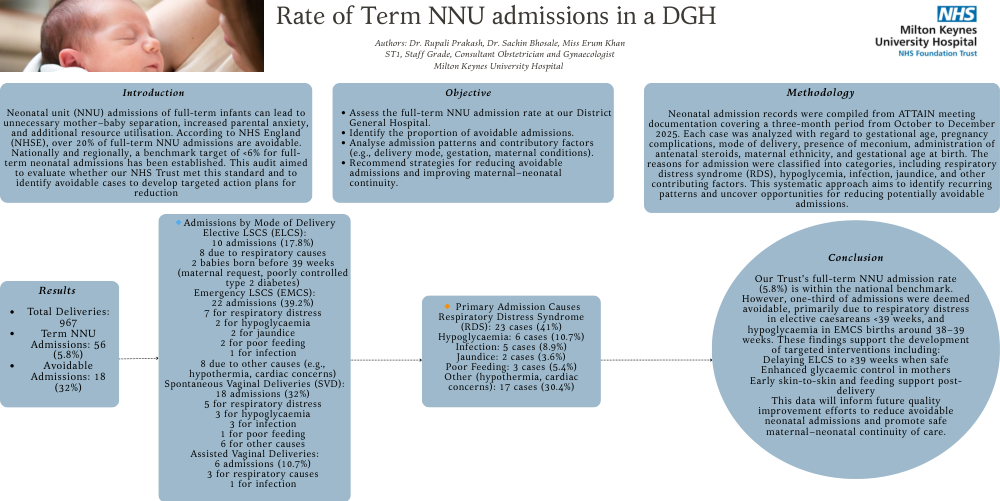
Among 967 deliveries, 56 (5.8%) babies required neonatal unit (NNU) admission, with 18 (32%) deemed avoidable. Most avoidable admissions were due to hypoglycaemia, hypothermia, poor feeding, and SGA.
ELCS Admissions (17.8%; 10/56):
8/10 were for respiratory causes, with 2 born before 39 weeks due to maternal request and a poorly engaged type 2 diabetic mother.
EMCS Admissions (39.2%; 22/56):
7/22 (31.8%) were for respiratory distress. Other causes included hypoglycaemia (9.09%; 2/22), jaundice (9.09%; 2/22), poor feeding (9.09%; 2/22), infection (4.5%; 1/22), and miscellaneous causes such as hypothermia and cardiac concerns (36.36%; 8/22).
Spontaneous Vaginal Deliveries (32%; 18/56):
Respiratory causes accounted for 5 admissions, hypoglycaemia for 3, infection for 3, poor feeding for 1, and 6 were miscellaneous.
Assisted Vaginal Deliveries (10.7%; 6/56):
3/6 (50%) were for respiratory causes, and 1 was for infection.
Conclusion:
RDS was the leading cause of NNU admission (41%; 23/56), often linked to ELCS <39 weeks and gestations ≥39 weeks. Hypoglycaemia (10.7%; 6/56) was common in 38–39 weeks gestation and EMCS deliveries. These findings will guide strategies to reduce avoidable admissions.