2,281 posters, 63 videos, 56 audios, 43 topics, 18 sessions, 6,174 authors, 2,323 institutions
ePostersLive by SciGen Technologies S.A. All rights reserved.
RCOG World Congress 2025
June 23 - 25, 2025 | ExCeL London, UK
EP.1917
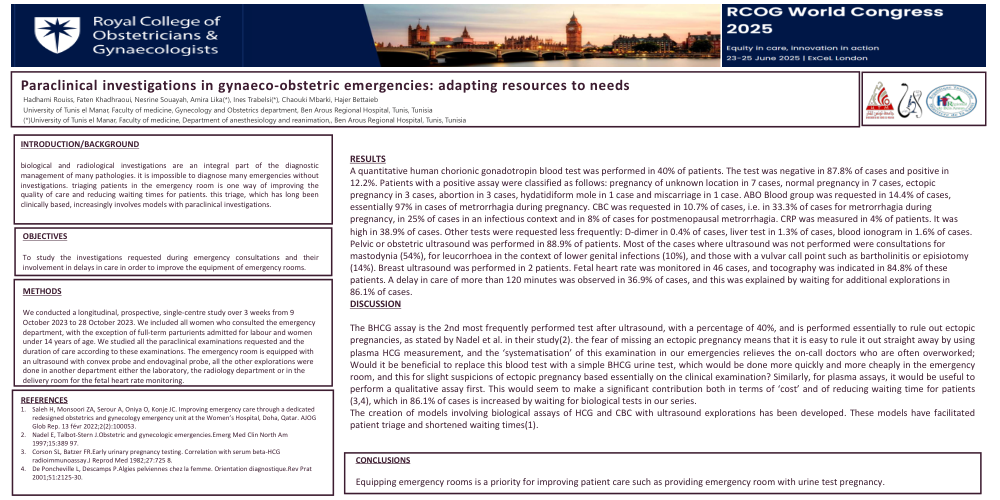
Paraclinical investigations in gynaeco-obstetric emergencies: adapting resources to needs
Part of Topic
Quality improvement
Paraclinical investigations in gynaeco-obstetric emergencies: adapting resources to needs
Hadhami Rouiss, Faten Khadhraoui, Nesrine Souayah, Amira Lika(*), Ines Trabelsi(*), Chaouki Mbarki, Hajer Bettaieb
University of Tunis el Manar, Faculty of medicine, Gynecology and Obstetrics department, Ben Arous Regional Hospital, Tunis, Tunisia
(*)University of Tunis el Manar, Faculty of medicine, Department of anesthesiology and reanimation,, Ben Arous Regional Hospital, Tunis, Tunisia
Introduction :
biological and radiological investigations are an integral part of the diagnostic management of many pathologies. it is impossible to diagnose many emergencies without investigations. triaging patients in the emergency room is one way of improving the quality of care and reducing waiting times for patients. this triage, which has long been clinically based, increasingly involves models with paraclinical investigations (1).
Objective: To study the investigations requested during emergency consultations and their involvement in delays in care in order to improve the equipment of emergency rooms.
Design: We conducted a longitudinal, prospective, single-centre study over 3 weeks from 9 October 2023 to 28 October 2023.
Methods : We included all women who consulted the emergency department, with the exception of full-term parturients admitted for labour and women under 14 years of age. We studied all the paraclinical examinations requested and the duration of care according to these examinations. The emergency room is equipped with an ultrasound with convex probe and endovaginal probe, all the other explorations were done in another department either the laboratory, the radiology department or in the delivery room for the fetal heart rate monitoring.
Results : A quantitative human chorionic gonadotropin blood test was performed in 40% of patients. The test was negative in 87.8% of cases and positive in 12.2%. Patients with a positive assay were classified as follows: pregnancy of unknown location in 7 cases, normal pregnancy in 7 cases, ectopic pregnancy in 3 cases, abortion in 3 cases, hydatidiform mole in 1 case and miscarriage in 1 case. ABO Blood group was requested in 14.4% of cases, essentially 97% in cases of metrorrhagia during pregnancy. CBC was requested in 10.7% of cases, i.e. in 33.3% of cases for metrorrhagia during pregnancy, in 25% of cases in an infectious context and in 8% of cases for postmenopausal metrorrhagia. CRP was measured in 4% of patients. It was high in 38.9% of cases. Other tests were requested less frequently: D-dimer in 0.4% of cases, liver test in 1.3% of cases, blood ionogram in 1.6% of cases. Pelvic or obstetric ultrasound was performed in 88.9% of patients. Most of the cases where ultrasound was not performed were consultations for mastodynia (54%), for leucorrhoea in the context of lower genital infections (10%), and those with a vulvar call point such as bartholinitis or episiotomy (14%). Breast ultrasound was performed in 2 patients. Fetal heart rate was monitored in 46 cases, and tocography was indicated in 84.8% of these patients. A delay in care of more than 120 minutes was observed in 36.9% of cases, and this was explained by waiting for additional explorations in 86.1% of cases.
Discussion
The BHCG assay is the 2nd most frequently performed test after ultrasound, with a percentage of 40%, and is performed essentially to rule out ectopic pregnancies, as stated by Nadel et al. in their study(2). the fear of missing an ectopic pregnancy means that it is easy to rule it out straight away by using plasma HCG measurement, and the ‘systematisation’ of this examination in our emergencies relieves the on-call doctors who are often overworked; Would it be beneficial to replace this blood test with a simple BHCG urine test, which would be done more quickly and more cheaply in the emergency room, and this for slight suspicions of ectopic pregnancy based essentially on the clinical examination? Similarly, for plasma assays, it would be useful to perform a qualitative assay first. This would seem to make a significant contribution both in terms of ‘cost’ and of reducing waiting time for patients (3,4), which in 86.1% of cases is increased by waiting for biological tests in our series.
The creation of models involving biological assays of HCG and CBC with ultrasound explorations has been developed. These models have facilitated patient triage and shortened waiting times(1).
Conclusion:
Equiping emergency rooms is a priority for improving patient care such as providing emergency room with urine test pregnancy.
Discussion:
- Saleh H, Monsoori ZA, Serour A, Oniya O, Konje JC. Improving emergency care through a dedicated redesigned obstetrics and gynecology emergency unit at the Women’s Hospital, Doha, Qatar. AJOG Glob Rep. 13 févr 2022;2(2):100053.
- Nadel E, Talbot-Stern J.Obstetric and gynecologic emergencies.Emerg Med Clin North Am 1997;15:389 97.
- Corson SL, Batzer FR.Early urinary pregnancy testing. Correlation with serum beta-HCG radioimmunoassay.J Reprod Med 1982;27:725 8.
- De Poncheville L, Descamps P.Algies pelviennes chez la femme. Orientation diagnostique.Rev Prat 2001;51:2125-30.