2,281 posters, 63 videos, 56 audios, 43 topics, 18 sessions, 6,174 authors, 2,323 institutions
ePostersLive by SciGen Technologies S.A. All rights reserved.
RCOG World Congress 2025
June 23 - 25, 2025 | ExCeL London, UK
EP.1916
Quality of care in gynaecological emergencies: what needs to be improved
Part of Topic
Quality improvement
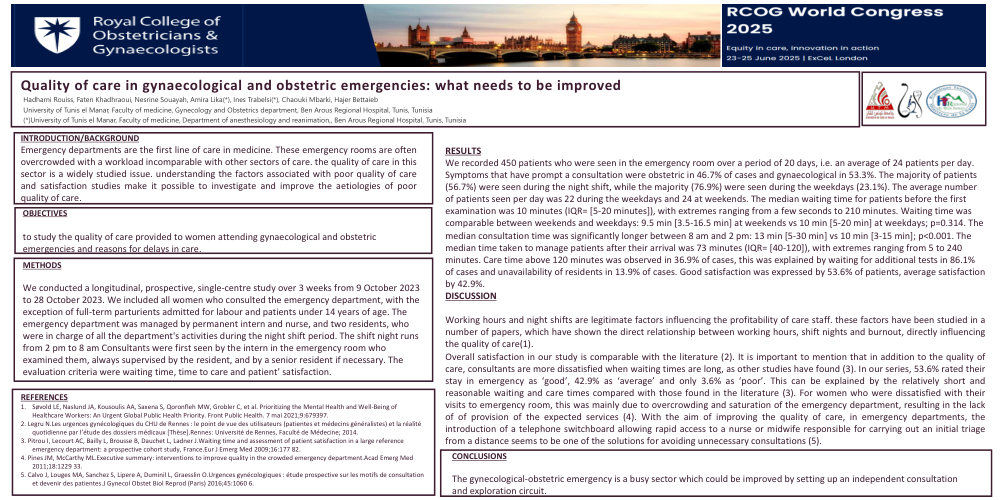
Quality of care in gynaecological and obstetric emergencies: what needs to be improved
Hadhami Rouiss, Faten Khadhraoui, Nesrine Souayah, Amira Lika(*), Ines Trabelsi(*), Chaouki Mbarki, Hajer Bettaieb
University of Tunis el Manar, Faculty of medicine, Gynecology and Obstetrics department, Ben Arous Regional Hospital, Tunis, Tunisia
(*)University of Tunis el Manar, Faculty of medicine, Department of anesthesiology and reanimation,, Ben Arous Regional Hospital, Tunis, Tunisia
Introduction :
Emergency departments are the first line of care in medicine. These emergency rooms are often overcrowded with a workload incomparable with other sectors of care. the quality of care in this sector is a widely studied issue. understanding the factors associated with poor quality of care and satisfaction studies make it possible to investigate and improve the aetiologies of poor quality of care.
Objective: to study the quality of care provided to women attending gynaecological and obstetric emergencies and reasons for delays in care.
Design: We conducted a prospective, single-centre, longitudinal descriptive study over 3 weeks from 9 October 2023 to 28 October 2023.
Methods : We included all women who consulted the emergency department, with the exception of full-term parturients admitted for labour and patients under 14 years of age. The emergency department was managed by permanent intern and nurse, and two residents, who were in charge of all the department's activities during the night shift period. The shift night runs from 2 pm to 8 am Consultants were first seen by the intern in the emergency room who examined them, always supervised by the resident, and by a senior resident if necessary. The evaluation criteria were waiting time, time to care and patient’ satisfaction.
Results :
We recorded 450 patients who were seen in the emergency room over a period of 20 days, i.e. an average of 24 patients per day. Symptoms that have prompt a consultation were obstetric in 46.7% of cases and gynaecological in 53.3%. The majority of patients (56.7%) were seen during the night shift, while the majority (76.9%) were seen during the weekdays (23.1%). The average number of patients seen per day was 22 during the weekdays and 24 at weekends. The median waiting time for patients before the first examination was 10 minutes (IQR= [5-20 minutes]), with extremes ranging from a few seconds to 210 minutes. Waiting time was comparable between weekends and weekdays: 9.5 min [3.5-16.5 min] at weekends vs 10 min [5-20 min] at weekdays; p=0.314. The median consultation time was significantly longer between 8 am and 2 pm: 13 min [5-30 min] vs 10 min [3-15 min]; p<0.001. The median time taken to manage patients after their arrival was 73 minutes (IQR= [40-120]), with extremes ranging from 5 to 240 minutes. Care time above 120 minutes was observed in 36.9% of cases, this was explained by waiting for additional tests in 86.1% of cases and unavailability of residents in 13.9% of cases. Good satisfaction was expressed by 53.6% of patients, average satisfaction by 42.9%.
Discussion :
Working hours and night shifts are legitimate factors influencing the profitability of care staff. these factors have been studied in a number of papers, which have shown the direct relationship between working hours, shift nights and burnout, directly influencing the quality of care(1).
Overall satisfaction in our study is comparable with the literature (2). It is important to mention that in addition to the quality of care, consultants are more dissatisfied when waiting times are long, as other studies have found (3). In our series, 53.6% rated their stay in emergency as ‘good’, 42.9% as ‘average’ and only 3.6% as ‘poor’. This can be explained by the relatively short and reasonable waiting and care times compared with those found in the literature (3). For women who were dissatisfied with their visits to emergency room, this was mainly due to overcrowding and saturation of the emergency department, resulting in the lack of of provision of the expected services (4). With the aim of improving the quality of care, in emergency departments, the introduction of a telephone switchboard allowing rapid access to a nurse or midwife responsible for carrying out an initial triage from a distance seems to be one of the solutions for avoiding unnecessary consultations (5).
Conclusion:
The gynaecological-obstetric emergency is a busy sector which could be improved by setting up an independent consultation and exploration circuit.
Références
1. Søvold LE, Naslund JA, Kousoulis AA, Saxena S, Qoronfleh MW, Grobler C, et al. Prioritizing the Mental Health and Well-Being of Healthcare Workers: An Urgent Global Public Health Priority. Front Public Health. 7 mai 2021;9:679397.
2. Legru N.Les urgences gynécologiques du CHU de Rennes : le point de vue des utilisateurs (patientes et médecins généralistes) et la réalité quotidienne par l’étude des dossiers médicaux [Thèse].Rennes: Université de Rennes, Faculté de Médecine; 2014.
3. Pitrou I, Lecourt AC, Bailly L, Brousse B, Dauchet L, Ladner J.Waiting time and assessment of patient satisfaction in a large reference emergency department: a prospective cohort study, France.Eur J Emerg Med 2009;16:177 82.
4. Pines JM, McCarthy ML.Executive summary: interventions to improve quality in the crowded emergency department.Acad Emerg Med 2011;18:1229 33.
5. Calvo J, Louges MA, Sanchez S, Lipere A, Duminil L, Graesslin O.Urgences gynécologiques : étude prospective sur les motifs de consultation et devenir des patientes.J Gynecol Obstet Biol Reprod (Paris) 2016;45:1060 6.