2,281 posters, 63 videos, 56 audios, 43 topics, 18 sessions, 6,174 authors, 2,323 institutions
ePostersLive by SciGen Technologies S.A. All rights reserved.
RCOG World Congress 2025
June 23 - 25, 2025 | ExCeL London, UK
EP.1914
Audit on Outpatient Hysteroscopy at a Tertiary Centre
Poster Presenter
Authors
Khaing Thu Thu, Nisha Martyres, Luiza Placintescu, Max Robinson, Nadine Di Donato
Affiliations
Part of Topic
Quality improvement
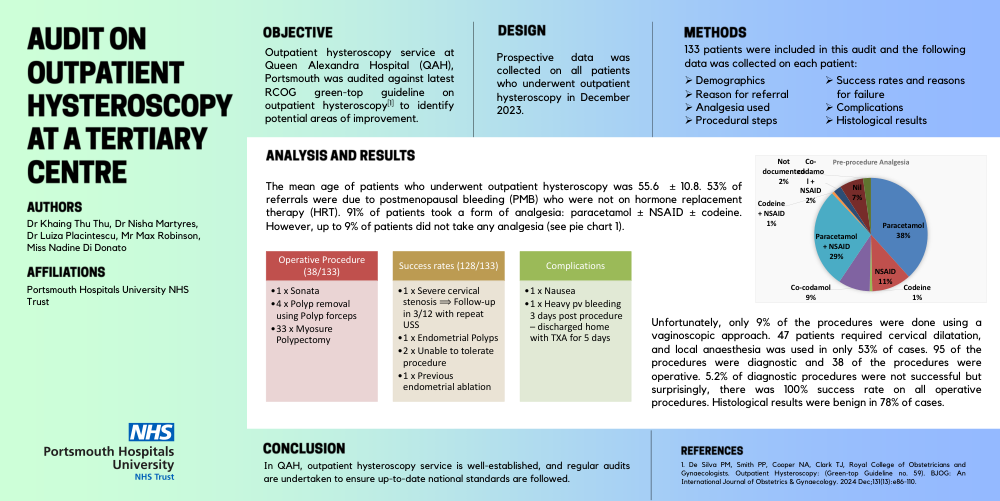
Objective: Outpatient hysteroscopy service at Queen Alexandra Hospital (QAH), Portsmouth was audited against latest RCOG green-top guideline on outpatient hysteroscopy[1] to identify potential areas of improvement.
Design: Prospective data was collected on all patients who underwent outpatient hysteroscopy in December 2023.
Method: 133 patients were included in this audit and the following data was collected on each patient:
-Demographics
-Reason for referral
-Analgesia used
-Procedural steps
-Success rates and reasons for failure
-Complications
-Histological results
Results: The mean age of patients who underwent outpatient hysteroscopy was 55.6 ± 10.8. 53% of referrals were due to postmenopausal bleeding (PMB) who were not on hormone replacement therapy (HRT). 91% of patients took a form of analgesia: paracetamol ± NSAID ± codeine. However, 9% of patients did not take any analgesia. Unfortunately, only 9% of the procedures were done using a vaginoscopic approach. 47 patients required cervical dilatation, and local anaesthesia was used in only 53% of cases. 95 of the procedures were diagnostic and 38 of the procedures were operative. 5.2% of diagnostic procedures were not successful but surprisingly, there was 100% success rate on all operative procedures. As for complications, one patient had nausea during the procedure and another re-presented with heavy menstrual bleeding 3 days post-procedure, but she was discharged home with oral tranexamic acid and did not require admission. Histological results were benign in 78% of cases.
In QAH, patient information leaflets are posted to patients prior to their appointment which includes advice regarding pre-procedural oral analgesia. RCOG advocates for use of vaginoscopic approach as a standard technique which is a new addition to the latest guideline. As our data was collected prior to the publication of the new guideline, a re-audit is required to determine if the service continues to meet the new national standards. Nonetheless, RCOG also recommends using local anaesthesia if cervical dilatation is anticipated and this has been highlighted as an area for improvement based on the audit results. Patients are given contact details for gynaecology emergency service post-procedure to ensure complications can be dealt with appropriately in a timely manner.
Conclusion: In QAH, outpatient hysteroscopy service is well-established, and regular audits are undertaken to ensure up-to-date national standards are followed.
References:
1. De Silva PM, Smith PP, Cooper NA, Clark TJ, Royal College of Obstetricians and Gynaecologists. Outpatient Hysteroscopy: (Green‐top Guideline no. 59). BJOG: An International Journal of Obstetrics & Gynaecology. 2024 Dec;131(13):e86-110.