2,281 posters, 63 videos, 56 audios, 43 topics, 18 sessions, 6,174 authors, 2,323 institutions
ePostersLive by SciGen Technologies S.A. All rights reserved.
RCOG World Congress 2025
June 23 - 25, 2025 | ExCeL London, UK
EP.1907
REVIEW OF POSTNATAL MATERNAL READMISSIONS IN A DISTRICT GENERAL HOSPITAL (UNITED KINGDOM)
Poster Presenter
Authors
Simran Seth, Gagbodawaththe Perera, Sana Bhatia, Vandna Verma
Affiliations
Part of Topic
Quality improvement
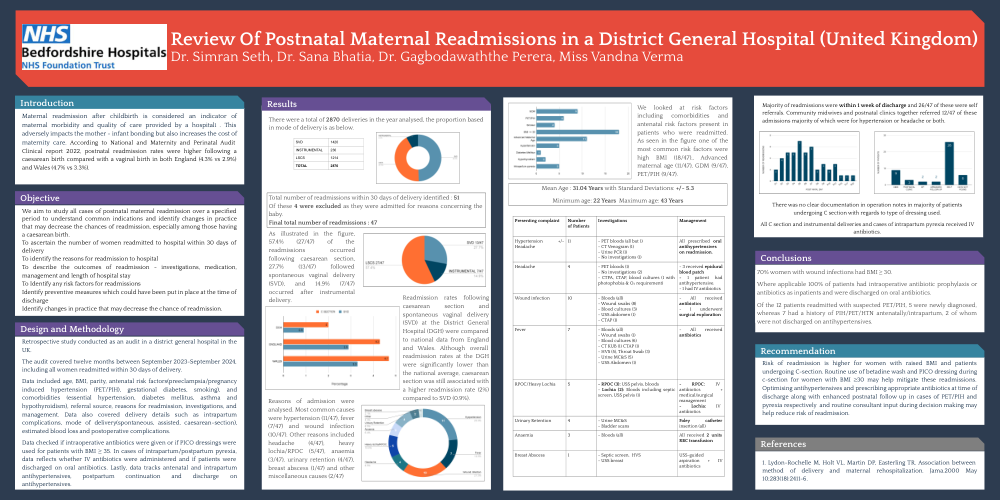
Review Of Postnatal Maternal Readmissions in a District General Hospital (United Kingdom)
Dr. Simran Seth, Dr. Sana Bhatia, Dr. Gagbodawaththe Perera, Miss Vandna Verma
Introduction:
Maternal readmission after childbirth is considered an indicator of maternal morbidity and quality of care provided by a hospital1 . This adversely impacts the mother - infant bonding but also increases the cost of maternity care. According to National and Maternity and Perinatal Audit Clinical report 2022, postnatal readmission rates were higher following a caesarean birth compared with a vaginal birth in both England (4.3% vs 2.9%) and Wales (4.7% vs 3.3%).
We aim to study all cases of postnatal maternal readmission over a specified period to understand common indications and identify changes in practice that may decrease the chances of readmission, especially among those having a caesarean birth.
To ascertain the number of women readmitted to hospital within 30 days of delivery
To identify the reasons for readmission to hospital
To describe the outcomes of readmission - investigations, medication, management and length of hospital stay
To Identify any risk factors for readmissions
Identify preventive measures which could have been put in place at the time of discharge
Identify changes in practice that may decrease the chance of readmission.
Retrospective study conducted as an audit in a district general hospital in the UK.
The audit covered twelve months between September 2023-September 2024, including all women readmitted within 30 days of delivery.
Data included age, BMI, parity, antenatal risk factors(preeclampsia/pregnancy induced hypertension (PET/PIH), gestational diabetes, smoking), and comorbidities (essential hypertension, diabetes mellitus, asthma and hypothyroidism), referral source, reasons for readmission, investigations, and management. Data also covered delivery details such as intrapartum complications, mode of delivery(spontaneous, assisted, caesarean-section), estimated blood loss and postoperative complications.
Data checked if intraoperative antibiotics were given or if PICO dressings were used for patients with BMI ≥ 35. In cases of intrapartum/postpartum pyrexia, data reflects whether IV antibiotics were administered and if patients were discharged on oral antibiotics. Lastly, data tracks antenatal and intrapartum antihypertensives, postpartum continuation and discharge on antihypertensives.