Loading...

2,281 posters, 63 videos, 56 audios, 43 topics, 18 sessions, 6,174 authors, 2,323 institutions

ePostersLive by SciGen Technologies S.A. All rights reserved.

RCOG World Congress 2025

June 23 - 25, 2025 | ExCeL London, UK

EP.1906

Effective consent for Obstetric procedures: A quantitive review of consent stickers
Part of Topic

Quality improvement

Effective Consent for Obstetric Procedures: A quantitative review of consent stickers

Dr Lucy Gold, Dr Camilla Roberts, Ms Saima Sharif North Middlesex University Hospital, Royal Free London NHS Foundation Trust


Objectives

Written consent is required for all caesarean sections and operative deliveries however the process of consent is not standardised and can often be time-consuming. The use of consent stickers offers the opportunity for uniformity in the consent process by providing clear clinical documentation of all associated risks of the intervention. This project aims to introduce consent stickers into Obstetrics at North Middlesex University Hospital and improve the process of consent.


Design

Quantitative study using staff and patient surveys to analyse effectiveness of consent stickers.


Method

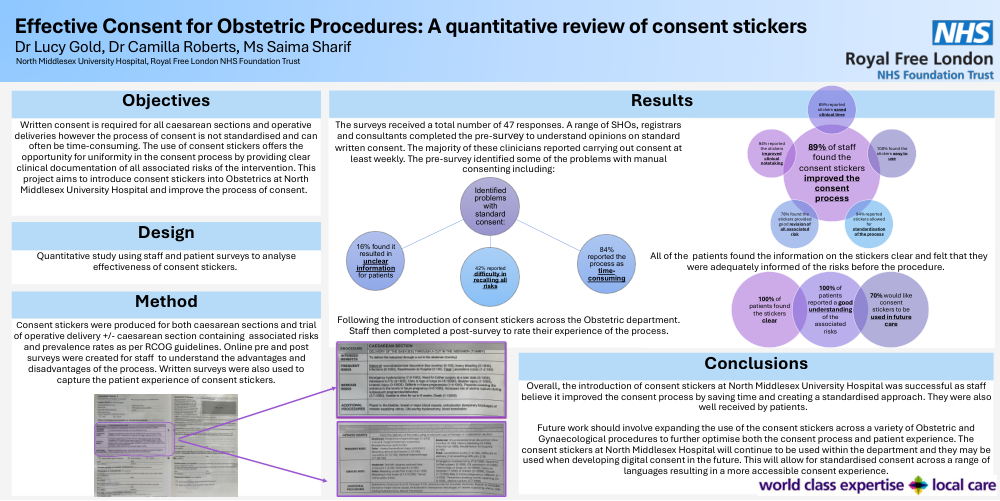
Consent stickers were produced for both caesarean sections and trial of operative delivery +/- caesarean section containing associated risks and prevalence rates as per RCOG guidelines. Online pre and post surveys were created for staff to understand the advantages and disadvantages of the process. Written surveys were also used to capture the patient experience of consent stickers.

Results

The surveys received a total number of 47 responses. A range of SHOs, registrars and consultants completed the pre-survey to understand opinions on standard written consent. The majority of these clinicians reported carrying out consent at least weekly. The pre-survey identified some of the problems with manual consenting including:

16% found it resulted in unclear informationfor patients

42% reported difficulty in recalling all risks

84% reported the process as time- consuming


Following the introduction of consent stickers across the Obstetric department. Staff then completed a post-survey to rate their experience of the process.

89% reported stickers saved clinical time

94% reported the stickers improved clinical notetaking

89% of staff found the consent stickersimproved the consent process

100% found the stickers easy to use

78% found the stickers provided good revision of all associated risk

94% reported stickers allowed for standardisation of the process


All of the patients found the information on the stickers clear and felt that they were adequately informed of the risks before the procedure.

100% of patients found the stickers clear

100% of patients reported a good understanding of the associated risks

70% would like consent stickers to be used in future care

Conclusions

Overall, the introduction of consent stickers at North Middlesex University Hospital was successful as staff believe it improved the consent process by saving time and creating a standardised approach. They were also well received by patients.

Future work should involve expanding the use of the consent stickers across a variety of Obstetric and Gynaecological procedures to further optimise both the consent process and patient experience. The consent stickers at North Middlesex Hospital will continue to be used within the department and they may be used when developing digital consent in the future. This will allow for standardised consent across a range of languages resulting in a more accessible consent experience.

Copyright © 2015-2026, ePostersLive® SciGen is a registered trademark of SciGen Technologies S.A. Patent pending.

This website and third-party tools we use rely on cookies for the best user experience. By selecting "I agree", you agree to cookie usage as described in our Privacy Policy.