2,281 posters, 63 videos, 56 audios, 43 topics, 18 sessions, 6,174 authors, 2,323 institutions
ePostersLive by SciGen Technologies S.A. All rights reserved.
RCOG World Congress 2025
June 23 - 25, 2025 | ExCeL London, UK
EP.1905
Optimising Preterm Birth Care: Audit of the Preterm Birth Clinic at RLH
Part of Topic
Quality improvement
Optimising Preterm Birth Care: Audit of the Preterm Birth Prevention Clinic at RLH
Isabella Phillips1, Elena Greco2,3, Man Ho Kwok2,3, W. Buttery, J. Althonayan, S. Sakaria, M. Hogg.
Introduction:
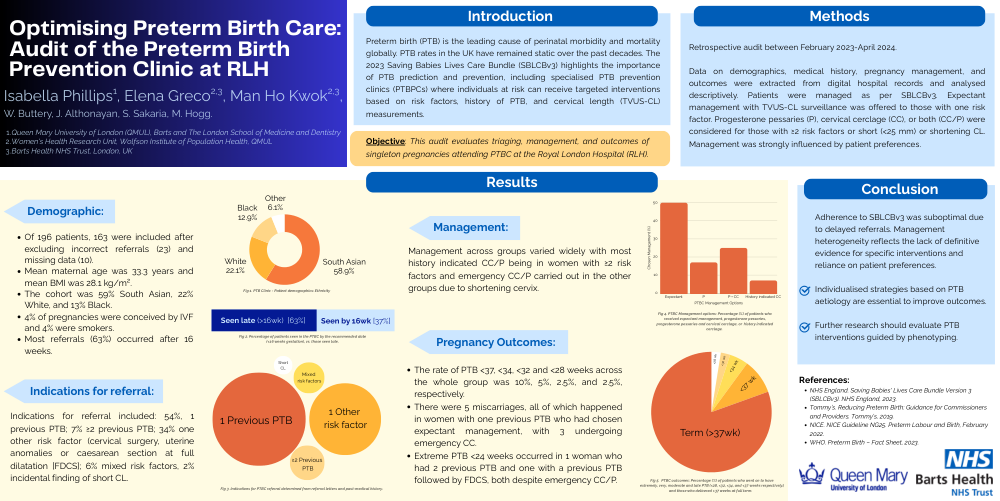
Preterm birth (PTB) is the leading cause of perinatal morbidity and mortality globally. PTB rates in the UK have remained static over the past decades. The 2023 Saving Babies Lives Care Bundle (SBLCBv3) highlights the importance of PTB prediction and prevention, including specialised PTB prevention clinics (PTBPCs) where individuals at risk can receive targeted interventions based on risk factors, history of PTB, and cervical length (TVUS-CL) measurements.
Objective:
This audit evaluates triaging, management, and outcomes of singleton pregnancies attending PTBC at the Royal London Hospital (RLH).
Methods:
Retrospective audit between February 2023-April 2024.
Data on demographics, medical history, pregnancy management, and outcomes were extracted from digital hospital records and analysed descriptively. Patients were managed as per SBLCBv3. Expectant management with TVUS-CL surveillance was offered to those with one risk factor. Progesterone pessaries (P), cervical cerclage (CC), or both (CC/P) were considered for those with ≥2 risk factors or short (<25 mm) or shortening CL. Management was strongly influenced by patient preferences.
Results:
Demographic:
- Of 196 patients, 163 were included after excluding incorrect referrals (23) and missing data (10).
- Mean maternal age was 33.3 years and mean BMI was 28.1 kg/m².
- The cohort was 59% South Asian, 22% White, and 13% Black.
- 4% of pregnancies were conceived by IVF and 4% were smokers.
- Most referrals (63%) occurred after 16 weeks.
Indications for referral:
Indications for referral included: 54%, 1 previous PTB; 7% ≥2 previous PTB; 34% one other risk factor (cervical surgery, uterine anomalies or caesarean section at full dilatation [FDCS]; 6% mixed risk factors, 2% incidental finding of short CL.
Management:
Management across groups varied widely with most history indicated CC/P being in women with ≥2 risk factors and emergency CC/P carried out in the other groups due to shortening cervix.
Pregnancy Outcomes:
- The rate of PTB <37, <34, <32 and <28 weeks across the whole group was 10%, 5%, 2.5%, and 2.5%, respectively.
- There were 5 miscarriages, all of which happened in women with one previous PTB who had chosen expectant management, with 3 undergoing emergency CC.
- Extreme PTB <24 weeks occurred in 1 woman who had 2 previous PTB and one with a previous PTB followed by FDCS, both despite emergency CC/P.
Conclusion:
Adherence to SBLCBv3 was suboptimal due to delayed referrals. Management heterogeneity reflects the lack of definitive evidence for specific interventions and reliance on patient preferences.
Individualised strategies based on PTB aetiology are essential to improve outcomes.
Further research should evaluate PTB interventions guided by phenotyping.
References:
- NHS England. Saving Babies' Lives Care Bundle Version 3 (SBLCBv3). NHS England, 2023.
- Tommy’s. Reducing Preterm Birth: Guidance for Commissioners and Providers. Tommy’s, 2019.
- NICE. NICE Guideline NG25. Preterm Labour and Birth, February 2022.
- WHO. Preterm Birth – Fact Sheet, 2023.