2,281 posters, 63 videos, 56 audios, 43 topics, 18 sessions, 6,174 authors, 2,323 institutions
ePostersLive by SciGen Technologies S.A. All rights reserved.
RCOG World Congress 2025
June 23 - 25, 2025 | ExCeL London, UK
EP.1902
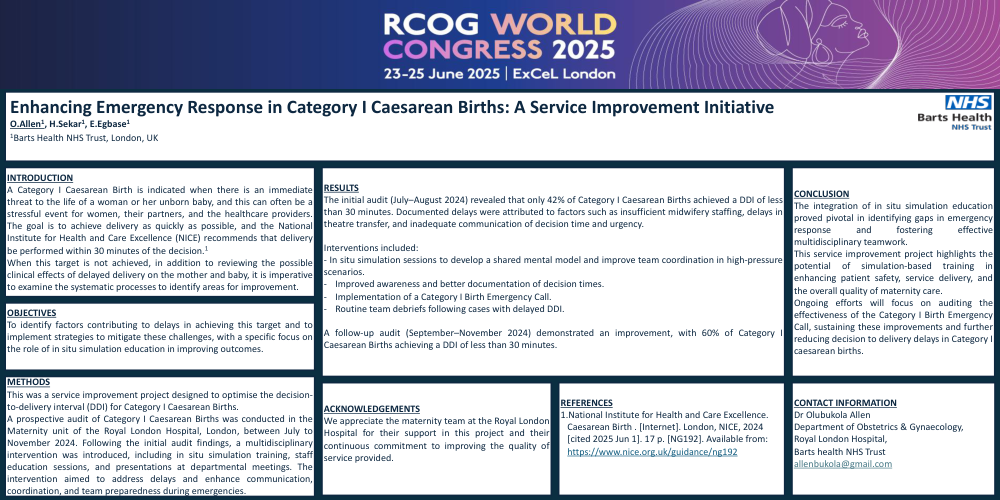
Enhancing Emergency Response in Category I Caesarean Births: A Service Improvement Initiative
Poster Presenter
Authors
Affiliations
Part of Topic
Quality improvement
Enhancing Emergency Response in Category I Caesarean Births: A Service Improvement Initiative
O.Allen1, H.Sekar1, E.Egbase1
1Barts Health NHS Trust, London, UK
INTRODUCTION
A Category I Caesarean Birth is indicated when there is an immediate threat to the life of a woman or her unborn baby, and this can often be a stressful event for women, their partners, and the healthcare providers. The goal is to achieve delivery as quickly as possible, and the National Institute for Health and Care Excellence (NICE) recommends that delivery be performed within 30 minutes of the decision.1
When this target is not achieved, in addition to reviewing the possible clinical effects of delayed delivery on the mother and baby, it is imperative to examine the systematic processes to identify areas for improvement.
OBJECTIVES
To identify factors contributing to delays in achieving this target and to implement strategies to mitigate these challenges, with a specific focus on the role of in situ simulation education in improving outcomes.
METHODS
This was a service improvement project designed to optimise the decision-to-delivery interval (DDI) for Category I Caesarean Births.
A prospective audit of Category I Caesarean Births was conducted in the Maternity unit of the Royal London Hospital, London, between July to November 2024. Following the initial audit findings, a multidisciplinary intervention was introduced, including in situ simulation training, staff education sessions, and presentations at departmental meetings. The intervention aimed to address delays and enhance communication, coordination, and team preparedness during emergencies.
RESULTS
The initial audit (July–August 2024) revealed that only 42% of Category I Caesarean Births achieved a DDI of less than 30 minutes. Documented delays were attributed to factors such as insufficient midwifery staffing, delays in theatre transfer, and inadequate communication of decision time and urgency.
Interventions included:
- In situ simulation sessions to develop a shared mental model and improve team coordination in high-pressure scenarios.
A follow-up audit (September–November 2024) demonstrated an improvement, with 60% of Category I Caesarean Births achieving a DDI of less than 30 minutes.
CONCLUSION
The integration of in situ simulation education proved pivotal in identifying gaps in emergency response and fostering effective multidisciplinary teamwork.
This service improvement project highlights the potential of simulation-based training in enhancing patient safety, service delivery, and the overall quality of maternity care.
Ongoing efforts will focus on auditing the effectiveness of the Category I Birth Emergency Call, sustaining these improvements and further reducing decision to delivery delays in Category I caesarean births.
ACKNOWLEDGEMENTS
We appreciate the maternity team at the Royal London Hospital for their support in this project and their continuous commitment to improving the quality of service provided.
REFERENCES