2,281 posters, 63 videos, 56 audios, 43 topics, 18 sessions, 6,174 authors, 2,323 institutions
ePostersLive by SciGen Technologies S.A. All rights reserved.
RCOG World Congress 2025
June 23 - 25, 2025 | ExCeL London, UK
PP.0037
Harnessing PNDSR to Revolutionize Stillbirth Prevention, Neonatal Survival, and Healthcare Excellence.
Poster Presenter
Part of Topic
Quality improvement
Harnessing PNDSR to Revolutionize Stillbirth Prevention, Neonatal Survival, and Healthcare Excellence.
Objectives:
This research leverages PNDSR to analyze causes of stillbirths and neonatal deaths, improve data reporting, and design targeted interventions. It emphasizes strengthening healthcare systems, informed policy changes, and raising provider awareness. The study aims to establish benchmarks, offer evidence-based recommendations, and reduce perinatal mortality for improved maternal and neonatal health.
Design:
This prospective cohort study uses the PNDSR framework to analyse perinatal deaths at MC, PIMS, tracking pregnant women and reviewing stillbirths and neonatal deaths over 12–18 months. It identifies preventable causes, monitors trends, evaluates interventions, and provides evidence-based recommendations to reduce perinatal mortality and improve maternal and neonatal outcomes.
Methodology:
This 2019–2023 prospective cohort study at MCH Centre, PIMS, utilized PNDSR to analyze stillbirths (≥28 weeks) and neonatal deaths (≤7 days). Data from records and PNDSR reviews identified mortality causes, trends, and preventable factors. Findings highlighted care gaps, guiding targeted strategies to reduce perinatal mortality and improve maternal-neonatal health outcomes.
Results:
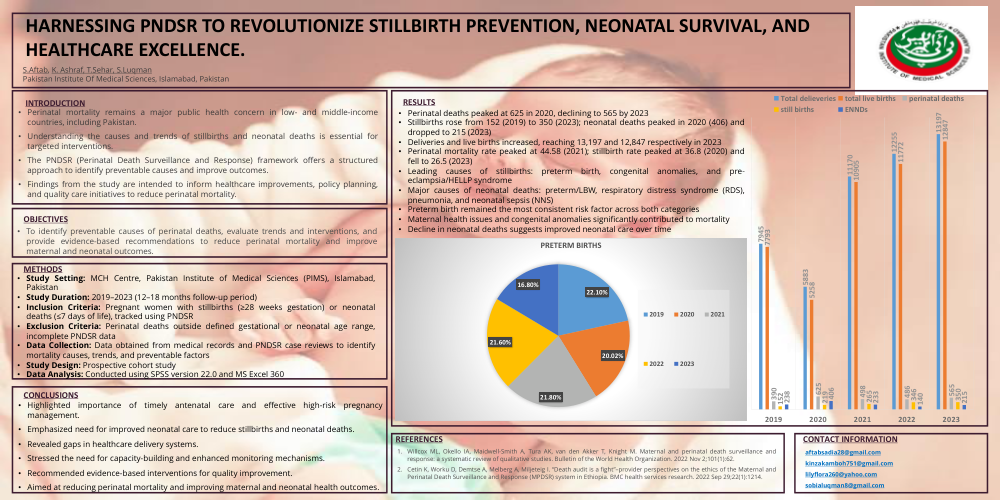
Between 2019 and 2023, perinatal deaths fluctuated, peaking at 625 in 2020 and declining to 565 in 2023. Stillbirths rose steadily from 152 in 2019 to 350 in 2023, while neonatal deaths were highest in 2020 (406) but dropped to 215 in 2023. Deliveries and live births increased over the years, with 13,197 deliveries and 12,847 live births in 2023. The perinatal mortality rate varied, reaching 44.58 in 2021, while the stillbirth rate peaked at 36.8 in 2020 before decreasing to 26.5 in 2023.
Common causes of stillbirths included pre-term birth, congenital issues, and pre-eclampsia/HELLP. Neonatal deaths were largely due to pre-term/LBW, RDS, pneumonia, and NNS. Key trends showed pre-term birth as a consistent leading factor, with congenital and maternal health conditions contributing significantly. Improvements in neonatal care may explain the decline in early neonatal deaths from 2020 to 2023.
Conclusion:
The study conducted at the MCH Centre, PIMS (2019–2023), utilizing the PNDSR framework, highlighted significant trends and causes of perinatal mortality, including preterm births, congenital anomalies, and preventable maternal complications. The findings underscored the critical role of timely antenatal care, effective management of high-risk pregnancies, and improved neonatal care in reducing stillbirths and neonatal deaths. The study identified gaps in healthcare delivery, emphasizing the need for capacity-building initiatives, enhanced monitoring systems, and evidence-based interventions. The results provide actionable insights to guide targeted quality improvement strategies, ultimately aiming to reduce perinatal mortality and improve maternal and neonatal health outcomes.