2,281 posters, 63 videos, 56 audios, 43 topics, 18 sessions, 6,174 authors, 2,323 institutions
ePostersLive by SciGen Technologies S.A. All rights reserved.
RCOG World Congress 2025
June 23 - 25, 2025 | ExCeL London, UK
EP.1889
Evaluation of respiratory admissions in term infants at Basildon Neonatal unit :
Poster Presenter
Authors
Hira Mumtaz, Muniba Qureshi, Kwabena Asante-Mante, Sanjida Mahmood, Amita Sahare, Poorva Rathod
Affiliations
Part of Topic
Quality improvement
EVALUATION OF RESPIRATORY ADMISSIONS IN TERM INFANTS AT BASILDON NEONATAL UNIT
H.MUMTAZ, M.QURESHI, K.ASANTE-MANTE, S.MAHMOOD, A.SAHARE, P.RATHOD
BASILDON UNIVERSITY HOSPITAL MSE NHS TRUST
Background: Respiratory problems are the leading cause of admission of term babies to neonatal units, constituting approximately 25% of cases according to NHS England. Modifiable factors, such as gestational diabetes, smoking, LGA and caesarean sections (CS) before 39 week are known contributors.
Aims: To evaluate respiratory admissions in term infants at Basildon Neonatal unit over one year and compare findings to NHS England standards, with a focus on modifiable factors.
Methods: A retrospective review was conducted of 63 term infants (≥37 weeks gestation) admitted to Basildon Neonatal unit for signs of respiratory distress from October 2022 to October 2023. Data on maternal antenatal risk factors like gestational diabetes, PET, smoking, intrauterine growth restriction, gestation at birth, mode of delivery, birth weight, admission source, resuscitation needs, temperature profiles, respiratory support, and length of stay were analysed.
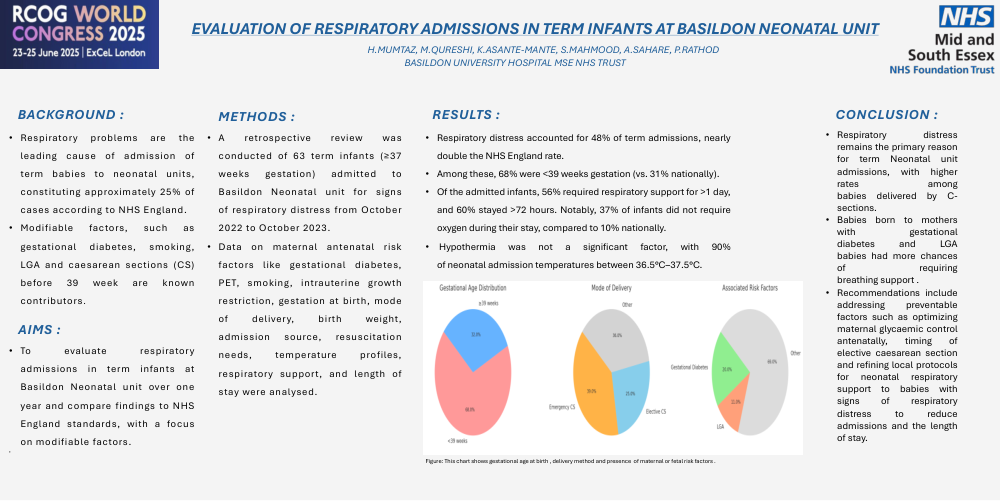
Results: Respiratory distress accounted for 48% of term admissions, nearly double the NHS England rate. Among these, 68% were <39 weeks gestation (vs. 31% nationally). Of the admitted infants, 56% required respiratory support for >1 day, and 60% stayed >72 hours. Notably, 37% of infants did not require oxygen during their stay, compared to 10% nationally. Hypothermia was not a significant factor, with 90% of neonatal admission temperatures between 36.5°C–37.5°C.
Caesarean section delivery(39% Emergency C-sections and 25% of Elective C-sections), LGA and babies born to mothers with gestational diabetes were found to be major factors in those cases which accounted for 65%, 11% and 20 % of the cases respectively.
Conclusions: Respiratory distress remains the primary reason for term Neonatal unit admissions, with higher rates among babies delivered by C-sections. Babies born to mothers with gestational diabetes and LGA babies had more chances of requiring breathing support .Recommendations include addressing preventable factors such as optimizing maternal glycaemic control antenatally, timing of elective caesarean section and refining local protocols for neonatal respiratory support to babies with signs of respiratory distress to reduce admissions and the length of stay.