2,281 posters, 63 videos, 56 audios, 43 topics, 18 sessions, 6,174 authors, 2,323 institutions
ePostersLive by SciGen Technologies S.A. All rights reserved.
RCOG World Congress 2025
June 23 - 25, 2025 | ExCeL London, UK
EP.1885
Optimizing Antenatal Iron Prescriptions: A Targeted Approach to Overcome Anemia
Poster Presenter
Authors
Affiliations
Part of Topic
Quality improvement
Optimizing Antenatal Iron Prescriptions: A Targeted Approach to Overcome Anemia
Objective:
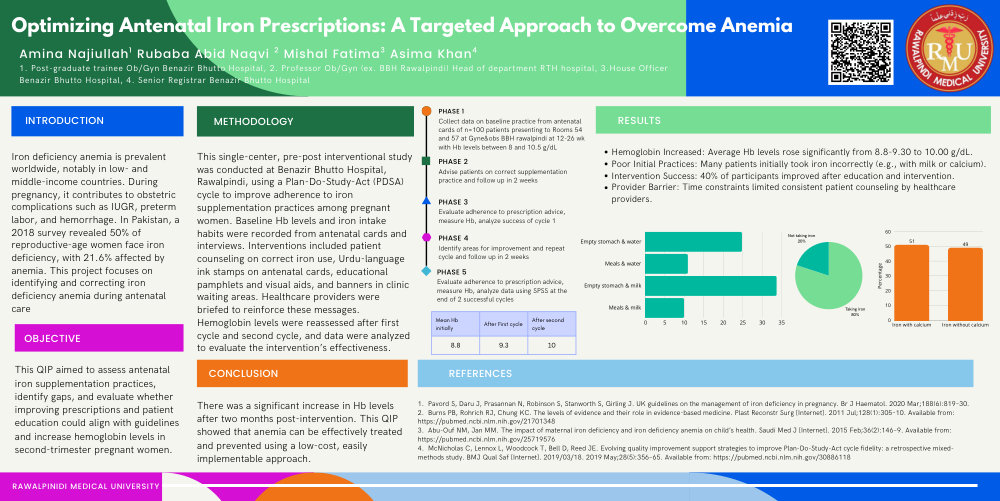
The primary objective of this quality improvement project (QIP) was to evaluate whether antenatal iron supplementation practices align with established guidelines and to assess whether improving prescription practices and patient education can increase hemoglobin (Hb) levels among pregnant women in their second trimester. The study aimed to identify gaps in current practices and test interventions to enhance compliance and efficacy.
Design:
This was a single-center, pre-post interventional study conducted at Benazir Bhutto Hospital, Rawalpindi, a tertiary care hospital with over 10,000 annual deliveries. A Plan-Do-Study-Act (PDSA) cycle approach was adopted to implement and evaluate the effectiveness of interventions aimed at improving patient and healthcare provider adherence to proper iron supplementation practices.
Method:
The study included 100 anemic pregnant women in their second trimester (12–26 weeks) with Hb levels between 8 and 10.5 g/dL. Women receiving intravenous iron supplementation, those with Hb <8 g/dL or >10.5 g/dL, those in their third trimester, and patients with known thalassemia were excluded. Baseline data on Hb levels and iron supplementation practices were collected from antenatal cards and patient interviews. Interventions included counseling patients on correct iron intake methods, distributing pamphlets and visual aids, placing educational banners in clinic waiting areas, and using an Urdu-language ink stamp with instructions on antenatal cards. Healthcare providers were briefed to reinforce patient education. Hb levels were rechecked after one month, and data were analyzed using paired t-tests.
Results:
The mean Hb level significantly increased from 9.30 g/dL (SD=0.570) at baseline to 10.00 g/dL (SD=0.467) post-intervention (t(99) = -14.027, p < 0.05). Incorrect practices, such as taking iron with milk or simultaneously with calcium, were prevalent among most patients pre-intervention. After education and interventions, 40% of participants showed Hb improvement within the follow-up period. Healthcare providers reported time constraints as a barrier to consistent patient counseling.
Conclusions:
This QIP demonstrated that simple, low-cost interventions can significantly improve adherence to antenatal iron supplementation practices, resulting in better Hb levels. Sustained improvements require periodic staff training and integration of findings into hospital policies. Future research should explore long-term adherence and the impact of mitigating side effects on outcomes. These findings underscore the potential of localized, scalable solutions to improve maternal and fetal health outcomes.