2,281 posters, 63 videos, 56 audios, 43 topics, 18 sessions, 6,174 authors, 2,323 institutions
ePostersLive by SciGen Technologies S.A. All rights reserved.
RCOG World Congress 2025
June 23 - 25, 2025 | ExCeL London, UK
EP.1882
Validation of the Arabic Birth Satisfaction Scale Revised (BSS-R) in Egypt
Poster Presenter
Authors
Affiliations
Part of Topic
Quality improvement
Validation of the Egyptian Version of the Birth Satisfaction Scale-Revised (BSS-R)
Background and Rationale
In Arab societies, discussions around childbirth satisfaction and emotional experiences remain culturally sensitive and underreported. Women often endure their symptoms silently, while healthcare providers may hesitate to ask, resulting in missed opportunities to improve maternity care. The Birth Satisfaction Scale Revised (BSS-R) is a validated 10-item tool originally developed in English to assess women’s experiences during childbirth. However, no culturally adapted and psychometrically validated Arabic version has been available. This study aimed to fill this critical gap
Aim
Design: Cross-sectional psychometric validation
study Setting: Two hospitals in Cairo, Egypt Participants: 200 postpartum women Procedure: Translation and cultural adaptation of the BSS-R, Reverse coding of negatively worded items (G2, G4, G7, G8, G9) Statistical analysis including: Descriptive statistics Confirmatory Factor Analysis (CFA) Exploratory Factor Analysis (EFA) Internal consistency (Cronbach’s α) Test-retest reliability (ICC)
Conclusion
Bifactoral model
Model tests Label X² df p User Model 23.3 8 0.003 Baseline Model 112.1 15 <.001
This bifactor model applied to a sample using the UK-BSS-R does not support a well-fitting structure, This bifactor model applied to a sample using the UK-BSS-R does not support a well-fitting structure, particularly in representing a clear and statistically significant factor structure for Women's Attributes (WA). The model is more promising for Stress Experienced (SE), with G2TRANS being a strong and valid indicator.
Given the original BSS-R structure includes 3 subscales (stress, attributes, quality of care), this 2-factor bifactor solution might oversimplify the complexity
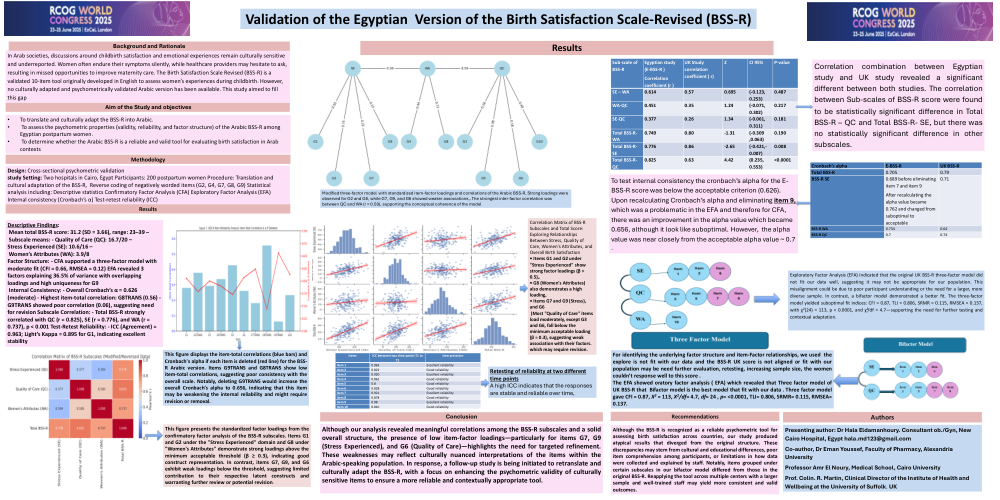
Although our analysis revealed meaningful correlations among the BSS-R subscales and a solid overall structure, the presence of low item-factor loadings—particularly for items G7, G9 (Stress Experienced), and G6 (Quality of Care)—highlights the need for targeted refinement. These weaknesses may reflect culturally nuanced interpretations of the items within the Arabic-speaking population. In response, a follow-up study is being initiated to retranslate and culturally adapt the BSS-R, with a focus on enhancing the psychometric validity of culturally sensitive items to ensure a more reliable and contextually appropriate tool.
Descriptive Findings:
Mean total BSS-R score: 31.2 (SD = 3.66), range: 23–39 –
Subscale means: - Quality of Care (QC): 16.7/20 –
Stress Experienced (SE): 10.6/16 –
Women’s Attributes (WA): 3.9/8
Factor Structure: - CFA supported a three-factor model with moderate fit (CFI = 0.66, RMSEA = 0.12) EFA revealed 3 factors explaining 36.5% of variance with overlapping loadings and high uniqueness for G9
Internal Consistency: - Overall Cronbach’s α = 0.626 (moderate) - Highest item-total correlation: G8TRANS (0.56) - G9TRANS showed poor correlation (0.06), suggesting need for revision Subscale Correlation: - Total BSS-R strongly correlated with QC (r = 0.825), SE (r = 0.776), and WA (r = 0.737), p < 0.001 Test-Retest Reliability: - ICC (Agreement) = 0.963; Light’s Kappa = 0.895 for G1, indicating excellent stability
The Arabic BSS-R is a promising instrument for clinical and research use in Arab maternal health. We recommend its use in postpartum quality audits, health system evaluations, and cross-cultural studies. Continued validation, including qualitative cognitive interviews and testing in different Arab contexts, will enhance its robustness and applicability