2,281 posters, 63 videos, 56 audios, 43 topics, 18 sessions, 6,174 authors, 2,323 institutions
ePostersLive by SciGen Technologies S.A. All rights reserved.
RCOG World Congress 2025
June 23 - 25, 2025 | ExCeL London, UK
EP.1881
HEAVY MENSTRUAL BLEEDING REQUIRING BLOOD TRANSFUSION-WHAT CLINICIANS NEED TO KNOW
Poster Presenter
Authors
Affiliations
Part of Topic
Quality improvement
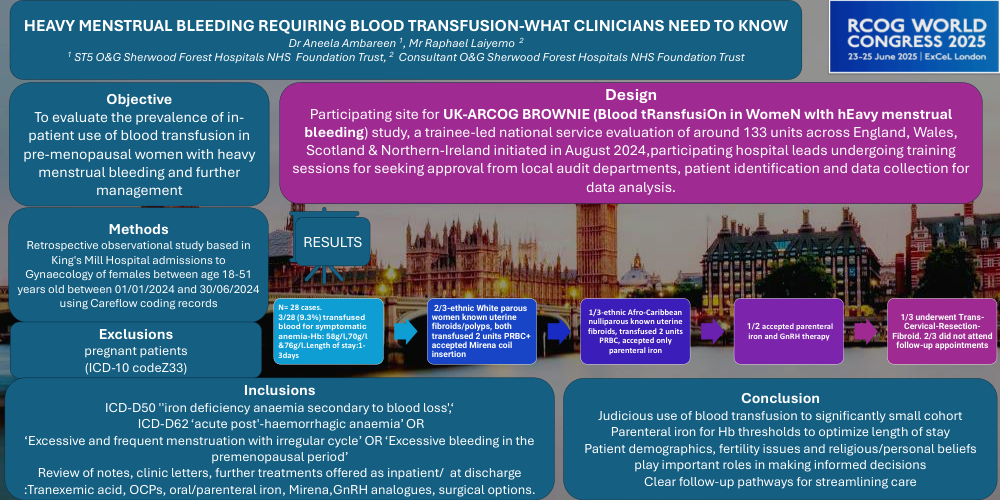
Objective:To evaluate the prevalence of inpatient use of blood transfusion in pre-menopausal women with heavy menstrual bleeding(HMB) and further guidance of managing this cohort.
Design: Participating site for UK-ARCOG BROWNIE (Blood tRansfusiOn in WomeN wIth hEavy menstrual bleeding)study,a trainee-led national service evaluation of around 133 units across England,Wales,Scotland&Northern-Ireland initiated in August 2024,participating hospital leads undergoing training sessions for seeking approval from local audit departments,patient identification and data collection for data analysis.
Methods:Retrospective observational study based on King'sMillHospital admissions to Gynaecology of females between age 18-51 years of age between 01/01/2024 and 30/06/2024 using Careflow coding records:Exclusions: pregnant patients(ICD-10 code Z33)Inclusions: patients coded with ‘iron deficiency anaemia’, and also coded with‘Excessive and frequent menstruation with regular cycle’ OR ‘Excessive and frequent menstruation with irregular cycle’ OR‘Excessive menstruation at puberty’ OR ‘Excessive bleeding in the premenopausal period’ followed by review of notes,clinic letters,further treatments offered either as inpatient or at discharge as Tranexemic acid,OCPs,oral/parenteral iron,Mirena,GnRH analogues,surgical options.
Results:Using ICD-D50 and D62 ''iron deficiency anaemia secondary to blood loss',‘‘acute post'-haemorrhagic anaemia’ yielded 28 results during the six months of study period.Out of 28 cases,only 3(9.3%)were treated with blood transfusion for symptomatic anaemia after informed consent,1 case of grandmultiparous woman had declined transfusion based on personal choice despite severe anaemia and discharged on iron infusion.Two of the three cases were ethnic white parous women known to have uterine fibroids/polyps as causes of HMB and presenting haemoglobin (Hb) levels of 70g/l and 76g/l.Both women were transfused two units of packed-red-cells each and post transfusion Hb levels 80g/l,91g/l,both accepted MIrena coil insertion as inpatient while one accepted parenteral iron and GnRH therapy.The third case was black Afro-carribean nulliparous woman known to have fibroids, pre-transfusion Hb 58g/l and post-transfusion 75g/l after two units of packed-cells,accepted only pareteral Iron infusion. All three were offered diagnostic/therapeutic options as hysteroscopy/laparosocpy,and only one multipara underwent Trans-Cervical-Resection-Fibroid, while the other two DNAéd follow-up appointments.Length of stay(LOS)1-3 days.
Conclusion;The data highlights judicious use of blood transfusion to significantly small cohort of our patients,and topping up with parenteral iron for Hb thresholds,thus optimizing LOS.Patient demographics,fertility issues and religious/personal beliefs play important roles in making informed decisions.Clear pathways need to be implemented for streamlining care.