2,281 posters, 63 videos, 56 audios, 43 topics, 18 sessions, 6,174 authors, 2,323 institutions
ePostersLive by SciGen Technologies S.A. All rights reserved.
RCOG World Congress 2025
June 23 - 25, 2025 | ExCeL London, UK
EP.1875
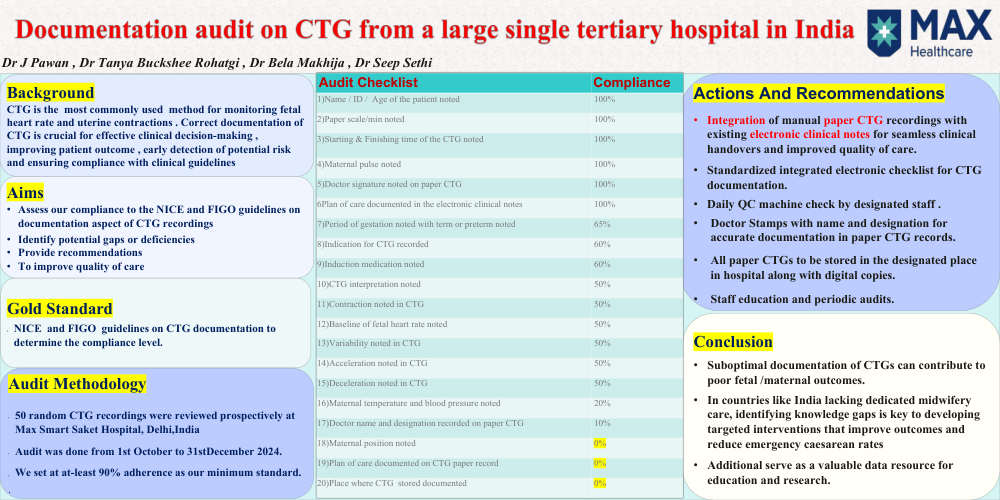
Documentation audit on CTG from a large single tertiary hospital in India
Poster Presenter
Authors
Affiliations
Part of Topic
Quality improvement
Documentation audit on CTG from a large single tertiary hospital in India
Dr J Pawan , Dr Tanya Buckshee Rohatgi , Dr Bela Makhija , Dr Seep Sethi
Background CTG is the most commonly used method for monitoring fetal heart rate and uterine contractions . Correct documentation of CTG is crucial for effective clinical decision-making , improving patient outcome , early detection of potential risk and ensuring compliance with clinical guidelines.
Aims Assess our compliance to the NICE and FIGO guidelines on documentation aspect of CTG recordings Identify potential gaps or deficiencies Provide recommendations To improve quality of care.
Gold Standard NICE and FIGO guidelines on CTG documentation to determine the compliance level.
Audit Methodology 50 random CTG recordings were reviewed prospectively at Max Smart Saket Hospital, Delhi,India Audit was done from 1st October to 31stDecember 2024. We set at at-least 90% adherence as our minimum standard.
Actions And Recommendations Integration of manual paper CTG recordings with existing electronic clinical notes for seamless clinical handovers and improved quality of care. Standardized integrated electronic checklist for CTG documentation. Daily QC machine check by designated staff . Doctor Stamps with name and designation for accurate documentation in paper CTG records. All paper CTGs to be stored in the designated place in hospital along with digital copies. Staff education and periodic audits.
|
Audit Checklist |
Compliance |
|
1)Name / ID / Age of the patient noted |
100% |
|
2)Paper scale/min noted |
100% |
|
3)Starting & Finishing time of the CTG noted
|
100% |
|
4)Maternal pulse noted |
100% |
|
5)Doctor signature noted on paper CTG |
100% |
|
6Plan of care documented in the electronic clinical notes |
100% |
|
7)Period of gestation noted with term or preterm noted |
65% |
|
8)Indication for CTG recorded |
60% |
|
9)Induction medication noted |
60% |
|
10)CTG interpretation noted |
50% |
|
11)Contraction noted in CTG |
50% |
|
12)Baseline of fetal heart rate noted |
50% |
|
13)Variability noted in CTG |
50% |
|
14)Acceleration noted in CTG |
50% |
|
15)Deceleration noted in CTG |
50% |
|
16)Maternal temperature and blood pressure noted |
20% |
|
17)Doctor name and designation recorded on paper CTG |
10% |
|
18)Maternal position noted |
0% |
|
19)Plan of care documented on CTG paper record |
0% |
|
20)Place where CTG stored documented |
0% |
Conclusion Suboptimal documentation of CTGs can contribute to poor fetal /maternal outcomes. In countries like India lacking dedicated midwifery care, identifying knowledge gaps is key to developing targeted interventions that improve outcomes and reduce emergency caesarean rates Additional serve as a valuable data resource for education and research.