2,281 posters, 63 videos, 56 audios, 43 topics, 18 sessions, 6,174 authors, 2,323 institutions
ePostersLive by SciGen Technologies S.A. All rights reserved.
RCOG World Congress 2025
June 23 - 25, 2025 | ExCeL London, UK
EP.1874
Audit and re-audit of the Use of Carbetocin in Caesarean Births
Poster Presenter
Part of Topic
Quality improvement
Introduction:
Post-partum haemorrhage is a significant cause of maternal morbidity and mortality worldwide, and there is higher risk of post-partum haemorrhage in for those undergoing a Caesarean section compared to a normal vaginal delivery.
Carbetocin is a synthetic analogue of oxytocin with a significantly longer duration of action. It is recommended only for the prevention of postpartum haemorrhage for patients having a caesarean birth3. It is given by slow intravenous injection over 1 minute as soon as possible after delivery4.
In September 2023, NICE published Intrapartum Care Guidelines which recommended that carbetocin is offered, by slow intravenous injection, to all women who have had a Caesarean birth for the prevention of post-partum haemorrhage.
We introduced the use of carbetocin at MKUH in mid-January 2024.
Objectives:
This audit aimed to assess the use of carbetocin post-birth for those those having a caesarean birth at MKUH in accordance with NICE guidelines.
Standard 1: 100% of caesarean births without the contraindications for the use of carbetocin, should be given carbetocin post-birth instead of syntocinon infusion.
Standard 2: 100% of women with contraindications to carbetocin should not receive this.
Methods:
A prospective audit was conducted over 6 weeks from January 15th to February 29th, 2024. Re-audit was conducted retrospectively looking at the 6-week period from 15th July to 28th August 2024. We included all patients who underwent an elective or emergency caesarean birth. Cases were identified from theatre lists and the notes were reviewed on the electronic system (eCare).
Results:
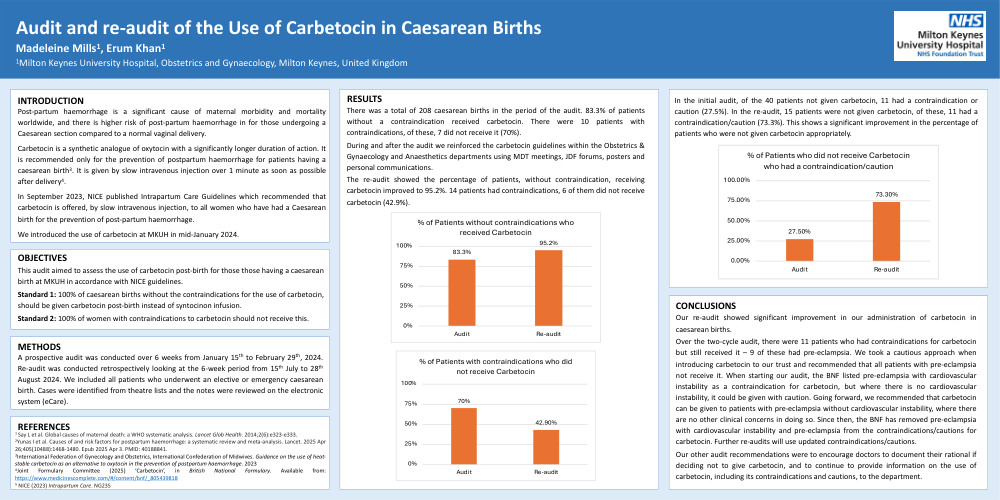
There was a total of 208 caesarean births in the period of the audit. 83.3% of patients without a contraindication received carbetocin. There were 10 patients with contraindications, of these, 7 did not receive it (70%).
During and after the audit we reinforced the carbetocin guidelines within the Obstetrics & Gynaecology and Anaesthetics departments using MDT meetings, JDF forums, posters and personal communications.
The re-audit showed the percentage of patients, without contraindication, receiving carbetocin improved to 95.2%. 14 patients had contraindications, 6 of them did not receive carbetocin (42.9%).
In the initial audit, of the 40 patients not given carbetocin, 11 had a contraindication or caution (27.5%). In the re-audit, 15 patients were not given carbetocin, of these, 11 had a contraindication/caution (73.3%). This shows a significant improvement in the percentage of patients who were not given carbetocin appropriately.
Conclusions:
Our re-audit showed significant improvement in our administration of carbetocin in caesarean births.
Over the two-cycle audit, there were 11 patients who had contraindications for carbetocin but still received it – 9 of these had pre-eclampsia. We took a cautious approach when introducing carbetocin to our trust and recommended that all patients with pre-eclampsia not receive it. When starting our audit, the BNF listed pre-eclampsia with cardiovascular instability as a contraindication for carbetocin, but where there is no cardiovascular instability, it could be given with caution. Going forward, we recommended that carbetocin can be given to patients with pre-eclampsia without cardiovascular instability, where there are no other clinical concerns in doing so. Since then, the BNF has removed pre-eclampsia with cardiovascular instability and pre-eclampsia from the contraindications/cautions for carbetocin. Further re-audits will use updated contraindications/cautions.
Our other audit recommendations were to encourage doctors to document their rational if deciding not to give carbetocin, and to continue to provide information on the use of carbetocin, including its contraindications and cautions, to the department.