2,281 posters, 63 videos, 56 audios, 43 topics, 18 sessions, 6,174 authors, 2,323 institutions
ePostersLive by SciGen Technologies S.A. All rights reserved.
RCOG World Congress 2025
June 23 - 25, 2025 | ExCeL London, UK
EP.1871
Aspirin Prescription for High-risk Obstetric Population at Outpatient; A Quality Improvement Project
Part of Topic
Quality improvement
Aspirin Prescription for High-risk Obstetric Population at Outpatient; A Quality Improvement Project
Authors Dr. Islam Elkhateb¹,², Dr. Wael Ragab¹, Dr. Ahmed Hassan¹, Kenzy Elessawy³, Dr. Abeer Alzaydai¹
INTRODUCTION
OBJECTIVE
Increase aspirin prescription rates for moderate- and high-risk obstetric populations.
METHODOLOGY
Affiliations ¹ Department of Obstetrics and Gynecology, Adan Hospital – Kuwait Ministry of Health, Ahmadi, Kuwait ² Department of Obstetrics and Gynecology, Cairo University Students’ Hospital, Cairo, Egypt ³ School of Medicine, Newgiza University, Giza, Egypt
Preeclampsia complicates 3-5% of pregnancies, characterized by hypertension, proteinuria, and end-organ dysfunction after 20 weeks. Low-dose aspirin reduces preeclampsia and related outcomes (preterm birth, growth restriction) by 10-70% in moderate to high- risk patients. Aspirin has an excellent maternal and fetal safety profile, making it a reasonable preventive strategy. A pilot study showed that only 40% of eligible patients received aspirin prescriptions.
Design: Quality improvement project based on a cross-
sectional analysis.
Interventions included:
Labels with obstetric population risk assessment and
eligible patient scores were placed in each room of the
outpatient department. Topic discussed in morning
meetings. Covered in biweekly department scientific
meetings. A message sent to the Obstetrics and
Gynecology department team.
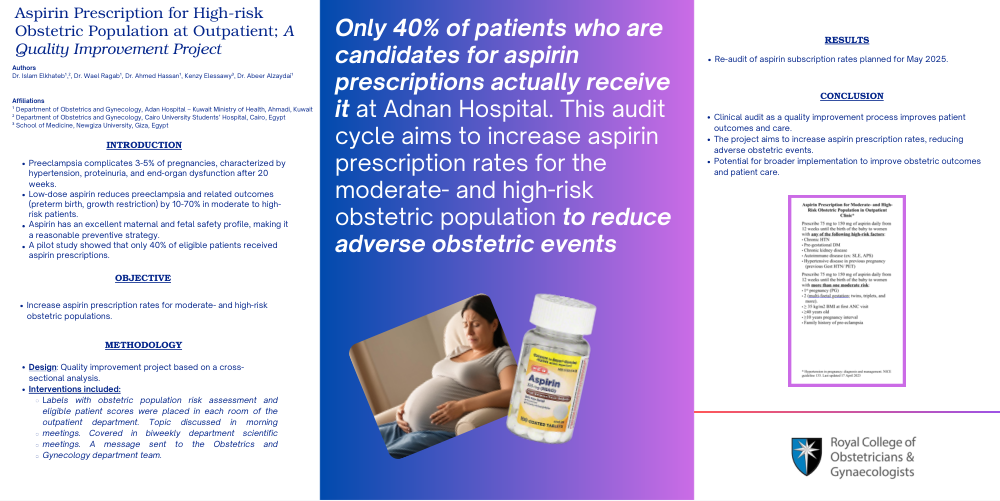
Only 40% of patients who are candidates for aspirin prescriptions actually receive it at Adnan Hospital. This audit cycle aims to increase aspirin prescription rates for the moderate- and high-risk obstetric population to reduce adverse obstetric events
RESULTS
Re-audit of aspirin subscription rates planned for May 2025.
CONCLUSION
Clinical audit as a quality improvement process improves patient outcomes and care. The project aims to increase aspirin prescription rates, reducing adverse obstetric events. Potential for broader implementation to improve obstetric outcomes and patient care.