2,281 posters, 63 videos, 56 audios, 43 topics, 18 sessions, 6,174 authors, 2,323 institutions
ePostersLive by SciGen Technologies S.A. All rights reserved.
RCOG World Congress 2025
June 23 - 25, 2025 | ExCeL London, UK
EP.1869
Evaluation of Venous Thromboembolism (VTE) Thromboprophylaxis in Pregnancy: A Retrospective Audit
Poster Presenter
Authors
Oladayo Kuku, Anam Azeemi, Ajantha Sanjeevi, Fahad Zulfiqar, hanan jamal
Affiliations
Part of Topic
Quality improvement
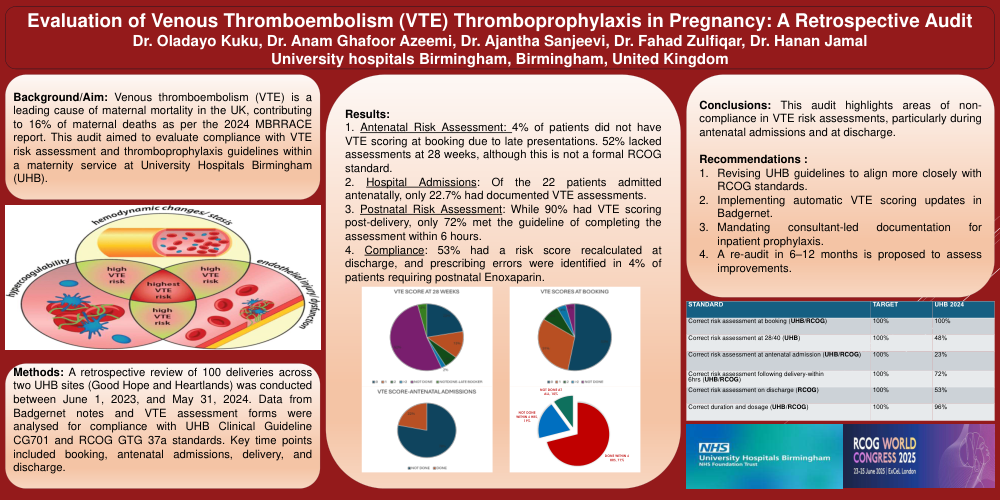
Evaluation of Venous Thromboembolism (VTE) Thromboprophylaxis in Pregnancy: A Retrospective Audit Dr. Oladayo Kuku, Dr. Anam Ghafoor Azeemi, Dr. Ajantha Sanjeevi, Dr. Fahad Zulfiqar, Dr. Hanan Jamal University hospitals Birmingham, Birmingham, United Kingdom Background/Aim: Venous thromboembolism (VTE) is a leading cause of maternal mortality in the UK, contributing to 16% of maternal deaths as per the 2024 MBRRACE report. This audit aimed to evaluate compliance with VTE risk assessment and thromboprophylaxis guidelines within a maternity service at University Hospitals Birmingham (UHB). Methods: A retrospective review of 100 deliveries across two UHB sites (Good Hope and Heartlands) was conducted between June 1, 2023, and May 31, 2024. Data from Badgernet notes and VTE assessment forms were analysed for compliance with UHB Clinical Guideline CG701 and RCOG GTG 37a standards. Key time points included booking, antenatal admissions, delivery, and discharge. Results: 1. Antenatal Risk Assessment: 4% of patients did not have VTE scoring at booking due to late presentations. 52% lacked assessments at 28 weeks, although this is not a formal RCOG standard. 2. Hospital Admissions: Of the 22 patients admitted antenatally, only 22.7% had documented VTE assessments. 3. Postnatal Risk Assessment: While 90% had VTE scoring post-delivery, only 72% met the guideline of completing the assessment within 6 hours. 4. Compliance : 53% had a risk score recalculated at discharge, and prescribing errors were identified in 4% of patients requiring postnatal Enoxaparin. NOT DONE WITHIN 6 HRS, 19% Conclusions: This audit highlights areas of non compliance in VTE risk assessments, particularly during antenatal admissions and at discharge. Recommendations : 1. Revising UHB guidelines to align more closely with RCOGstandards. 2. Implementing automatic VTE scoring updates in Badgernet. 3. Mandating consultant-led documentation for inpatient prophylaxis. 4. A re-audit in 6–12 months is proposed to assess improvements. STANDARD Correct risk assessment at booking (UHB/RCOG) Correct risk assessment at 28/40 (UHB) Correct risk assessment at antenatal admission (UHB/RCOG) Correct risk assessment following delivery-within 6hrs (UHB/RCOG) NOT DONE AT ALL, 10% Correct risk assessment on discharge (RCOG) TARGET 100% 100% 100% 100% 100% UHB 2024 100% 48% 23% 72% 53% Correct duration and dosage (UHB/RCOG) DONE WITHIN 6 HRS, 71% 100% 96%