2,281 posters, 63 videos, 56 audios, 43 topics, 18 sessions, 6,174 authors, 2,323 institutions
ePostersLive by SciGen Technologies S.A. All rights reserved.
RCOG World Congress 2025
June 23 - 25, 2025 | ExCeL London, UK
EP.1867
Awareness of contraceptive methods in Egypt
Part of Topic
Quality improvement
Awareness of contraceptive methods in Egypt
INTRODUCTION/BACKGROUND Contraception allows for adequate spacing of pregnancies and gives time to actively manage the
family and its future. It also protects females from adverse effects of close repetitive deliveries.
Recently, Egypt has adopted the use of contraceptives in combat the increasing incidence of
unplanned pregnancies and the population growth, however, not many women know about the
types, uses, and durations of the contraceptive techniques.
OBJECTIVES/AIMS
Our aim is to educate females of adolescent age and above about the various contraceptives,
their uses and side effects and how to use them.
METHODS
A survey consisting of 18 multiple-choice questions was conducted among 1190 participants to
gauge their understanding of different contraceptives, indications and contraindications, failure
rates, importance of practicing safe sex.
Participants were selected from various demographic backgrounds, different age groups and
different education levels. Data collection involved administering the survey and analyzing
responses to assess awareness levels before and after intervention.
Subsequently, We gathered questionnaires and distributed pamphlets regarding contraceptives,
their uses and effects. An educational video summarizing the main points of contraception and
advices were made and shared on the official page and group of Mansoura University for public
awareness and environmental services and community development affairs.
RESULTS
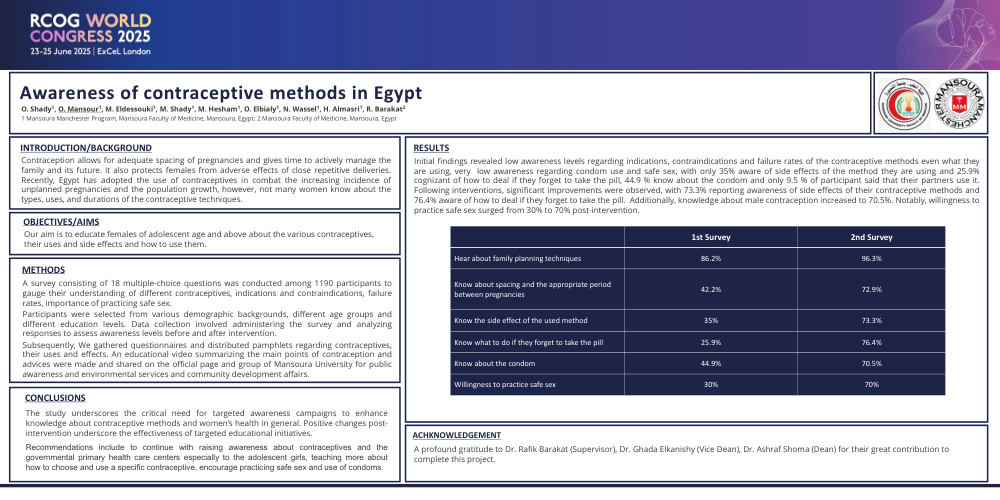
Initial findings revealed low awareness levels regarding indications, contraindications and failure rates of the contraceptive methods even what they
are using, very low awareness regarding condom use and safe sex, with only 35% aware of side effects of the method they are using and 25.9%
cognizant of how to deal if they forget to take the pill, 44.9 % know about the condom and only 9.5 % of participant said that their partners use it.
Following interventions, significant improvements were observed, with 73.3% reporting awareness of side effects of their contraceptive methods and
76.4% aware of how to deal if they forget to take the pill. Additionally, knowledge about male contraception increased to 70.5%. Notably, willingness to
practice safe sex surged from 30% to 70% post-intervention.
CONCLUSIONS
The study underscores the critical need for targeted awareness campaigns to enhance
knowledge about contraceptive methods and women’s health in general. Positive changes post-
intervention underscore the effectiveness of targeted educational initiatives.
Recommendations include to continue with raising awareness about contraceptives and the
governmental primary health care centers especially to the adolescent girls, teaching more about
how to choose and use a specific contraceptive, encourage practicing safe sex and use of condoms.