2,281 posters, 63 videos, 56 audios, 43 topics, 18 sessions, 6,174 authors, 2,323 institutions
ePostersLive by SciGen Technologies S.A. All rights reserved.
RCOG World Congress 2025
June 23 - 25, 2025 | ExCeL London, UK
EP.1866
Selective Urinalysis in Antenatal Clinics: Cost-Effective and Sustainable Without Compromising Patient Safety?
Poster Presenter
Authors
Yasmin Youssef, Damilola Jimoh, Alison Ferguson, Jaspreet Cheema, Abigail Anness
Affiliations
Part of Topic
Quality improvement
Selective Urinalysis in Antenatal Clinics: Cost-Effective and Sustainable Without Compromising Patient Safety?
Background
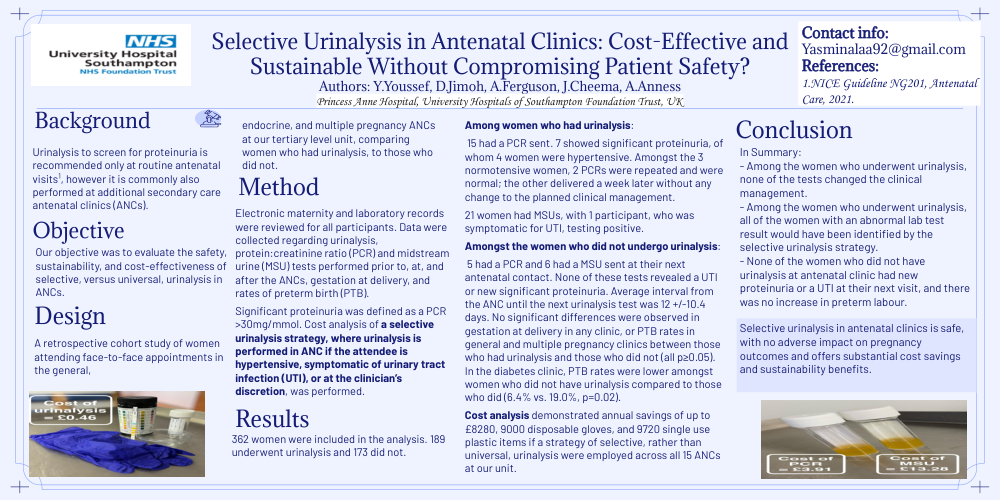
Electronic maternity and laboratory records were reviewed for all participants. Data were collected regarding urinalysis, protein:creatinine ratio (PCR) and midstream urine (MSU) tests performed prior to, at, and after the ANCs, gestation at delivery, and rates of preterm birth (PTB).
Significant proteinuria was defined as a PCR >30mg/mmol. Cost analysis of a selective urinalysis strategy, where urinalysis is performed in ANC if the attendee is hypertensive, symptomatic of urinary tract infection (UTI), or at the clinician’s discretion, was performed.Among women who had urinalysis:
15 had a PCR sent. 7 showed significant proteinuria, of whom 4 women were hypertensive. Amongst the 3 normotensive women, 2 PCRs were repeated and were normal; the other delivered a week later without any change to the planned clinical management.
21 women had MSUs, with 1 participant, who was symptomatic for UTI, testing positive.
Amongst the women who did not undergo urinalysis:
5 had a PCR and 6 had a MSU sent at their next antenatal contact. None of these tests revealed a UTI or new significant proteinuria. Average interval from the ANC until the next urinalysis test was 12 +/-10.4 days. No significant differences were observed in gestation at delivery in any clinic, or PTB rates in general and multiple pregnancy clinics between those who had urinalysis and those who did not (all p≥0.05). In the diabetes clinic, PTB rates were lower amongst women who did not have urinalysis compared to those who did (6.4% vs. 19.0%, p=0.02).
Cost analysis demonstrated annual savings of up to £8280, 9000 disposable gloves, and 9720 single use plastic items if a strategy of selective, rather than universal, urinalysis were employed across all 15 ANCs at our unit.
Among women who had urinalysis:
15 had a PCR sent. 7 showed significant proteinuria, of whom 4 women were hypertensive. Amongst the 3 normotensive women, 2 PCRs were repeated and were normal; the other delivered a week later without any change to the planned clinical management.
21 women had MSUs, with 1 participant, who was symptomatic for UTI, testing positive.
Amongst the women who did not undergo urinalysis:
5 had a PCR and 6 had a MSU sent at their next antenatal contact. None of these tests revealed a UTI or new significant proteinuria. Average interval from the ANC until the next urinalysis test was 12 +/-10.4 days. No significant differences were observed in gestation at delivery in any clinic, or PTB rates in general and multiple pregnancy clinics between those who had urinalysis and those who did not (all p≥0.05). In the diabetes clinic, PTB rates were lower amongst women who did not have urinalysis compared to those who did (6.4% vs. 19.0%, p=0.02).
Cost analysis demonstrated annual savings of up to £8280, 9000 disposable gloves, and 9720 single use plastic items if a strategy of selective, rather than universal, urinalysis were employed across all 15 ANCs at our unit.
Conclusion
In Summary:
- Among the women who underwent urinalysis, none of the tests changed the clinical management.
- Among the women who underwent urinalysis, all of the women with an abnormal lab test result would have been identified by the selective urinalysis strategy.
- None of the women who did not have urinalysis at antenatal clinic had new proteinuria or a UTI at their next visit, and there was no increase in preterm labour.
Selective urinalysis in antenatal clinics is safe, with no adverse impact on pregnancy outcomes and
offers substantial cost savings and sustainability benefits.