2,281 posters, 63 videos, 56 audios, 43 topics, 18 sessions, 6,174 authors, 2,323 institutions
ePostersLive by SciGen Technologies S.A. All rights reserved.
RCOG World Congress 2025
June 23 - 25, 2025 | ExCeL London, UK
EP.1863
Clinical audit: Implementing WHO surgical checklist in a tertiary care hospital
Poster Presenter
Authors
Affiliations
Part of Topic
Quality improvement
Clinical audit: Implementing WHO surgical checklist in a tertiary care hospital
Professor Sadia Khan (Head of Department), Assistant Professor Hina Gul, Senior Registrar Mariam Zaheer, Post Graduate Trainee Zeshan Ahmad
Rawalpindi Medical University, Rawalpindi, Pakistan
Title
Clinical audit: Implementing WHO surgical checklist in a tertiary care hospital
Abstract
Objective
To complete an audit on implementation of the WHO Surgical Safety Checklist (SSC) in the operation theatres of the Obstetrics and Gynecology (OB/GYN) department at BBH.
Design
A prospective study was conducted. The WHO SSC is a 19-items checklist designed to be used during three critical phases of surgery: prior to anesthesia induction (Sign In), before the skin incision (Time Out), and before the patient leaves the operating room (Sign Out). The effective implementation of the WHO SSC has been shown to significantly reduce adverse events. However, adoption and consistent use of the checklist pose challenges, particularly in resource-limited settings. This study seeks to explore these challenges within the OB/GYN context.
Methodology
60 surgical procedures were observed in OB/GYN operation theatres for WHO SSC implementation. The study was carried out from September 1, 2024, to November 1, 2024. WHO SSC forms were provided in both emergency and elective operation theatres and. Data was analyzed and interventions were carried out by a series of rigorous meetings and discussions with medical and nursing staff. Results were re-audited after two weeks.
Results
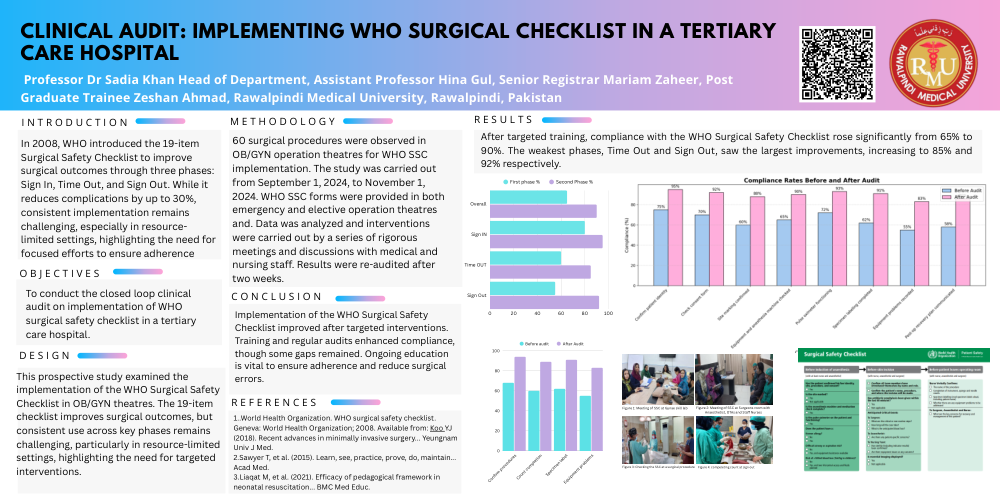
Out of 60 surgical procedures observed, the initial audit revealed an overall compliance of 65% with the WHO Surgical Safety Checklist. Compliance was highest during the Sign In phase (80%) but lower during the Time Out (60%) and Sign Out (55%) phases, with common omissions including patient identity checks, site marking, and instrument counts. After interventions, including training and staff discussions, a re-audit showed a significant increase in compliance to 90%. The Sign In phase improved to 95%, Time Out to 85%, and Sign Out to 92%. The most noticeable improvement was in Time Out, where communication and procedure checks were better followed.
Conclusion
The implementation of the WHO Surgical Safety Checklist showed significant improvement in surgical safety practices following targeted interventions. Training and regular reinforcement played a crucial role in enhancing compliance, though some lapses, particularly in the Sign Out phase, remained. This study highlights the importance of continuous education and audits to maintain high adherence to safety protocols and reduce the potential for surgical errors.