2,281 posters, 63 videos, 56 audios, 43 topics, 18 sessions, 6,174 authors, 2,323 institutions
ePostersLive by SciGen Technologies S.A. All rights reserved.
RCOG World Congress 2025
June 23 - 25, 2025 | ExCeL London, UK
EP.1858
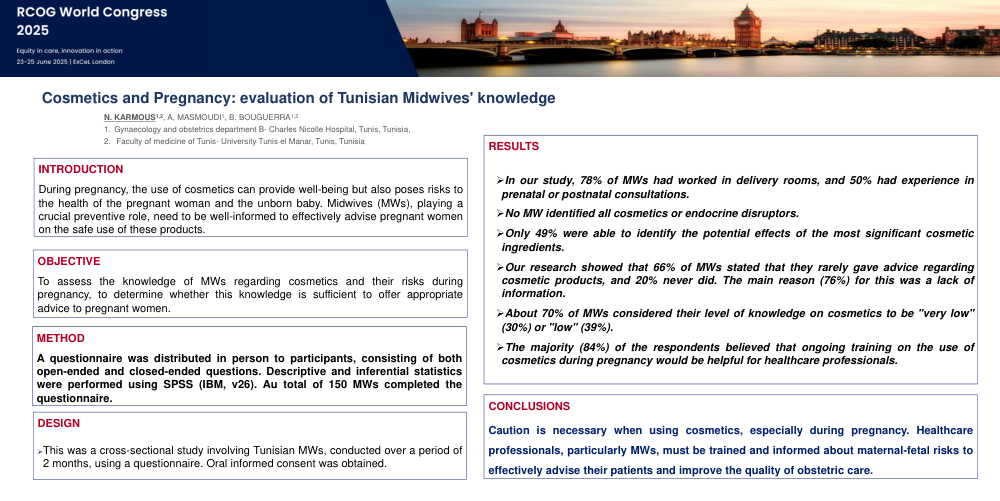
Cosmetics and Pregnancy: evaluation of Tunisian Midwives' knowledge
Poster Presenter
Authors
Affiliations
Department of Gynaecology and Obstetrics, Charles Nicolle Hospital, Department B- Charles Nicolle Hospital, Gynaecology and Obstetrics Department B, Charles Nicolle Hospital, Department Bof Obstetrics and Gynaecology, Charles Nicolle Hospital, Department of Obstetrics and Gynecology B, Charles Nicolle Hospital, Gynaecology and Obstetrics Department B of Charles Nicolle Hospital, Gynaecology and Obstetrics department B- Charles Nicolle Hospital, Charles Nicolle Hospital, Obstetrics and Gynaecology Service B, Department B of Gynaecology and Obstetrics- Charles Nicolle Hospital, Department B of Obstetrics and Gynecology, Charles Nicolle Hospital
Part of Topic
Quality improvement
Cosmetics and Pregnancy: evaluation of Tunisian Midwives' knowledge
Introduction:
During pregnancy, the use of cosmetics can provide well-being but also poses risks to the health of the pregnant woman and the unborn baby. Midwives (MWs), playing a crucial preventive role, need to be well-informed to effectively advise pregnant women on the safe use of these products.
Objective:
The aim of this study was to assess the knowledge of MWs regarding cosmetics and their risks during pregnancy, to determine whether this knowledge is sufficient to offer appropriate advice to pregnant women.
Design:
This was a cross-sectional study involving Tunisian MWs, conducted over a period of 2 months, using a questionnaire. Oral informed consent was obtained.
Methods:
A questionnaire was distributed in person to participants, consisting of both open-ended and closed-ended questions. Descriptive and inferential statistics were performed using SPSS (IBM, v26). Au total of 150 MWs completed the questionnaire.
Results:
In our study, 78% of MWs had worked in delivery rooms, and 50% had experience in prenatal or postnatal consultations. No MW identified all cosmetics or endocrine disruptors. Only 49% were able to identify the potential effects of the most significant cosmetic ingredients. Our research showed that 66% of MWs stated that they rarely gave advice regarding cosmetic products, and 20% never did. The main reason (76%) for this was a lack of information. About 70% of MWs considered their level of knowledge on cosmetics to be "very low" (30%) or "low" (39%). The majority (84%) of the respondents believed that ongoing training on the use of cosmetics during pregnancy would be helpful for healthcare professionals.
Conclusions:
Caution is necessary when using cosmetics, especially during pregnancy. Healthcare professionals, particularly MWs, must be trained and informed about maternal-fetal risks to effectively advise their patients and improve the quality of obstetric care.