2,281 posters, 63 videos, 56 audios, 43 topics, 18 sessions, 6,174 authors, 2,323 institutions
ePostersLive by SciGen Technologies S.A. All rights reserved.
RCOG World Congress 2025
June 23 - 25, 2025 | ExCeL London, UK
EP.1857
IVF Without Delays: How Smart Reminders Saved Time, Costs, and Fertility Hopes
Poster Presenter
Authors
Affiliations
Part of Topic
Quality improvement
IVF Without Delays: How Smart Reminders Saved Time, Costs, and Fertility Hopes
Background
Infertility affects 1 in 6 couples globally. Fertility treatments can be a lifeline for many couples and individuals struggling to conceive, but access to these services is increasingly restricted due to financial constraints within the NHS.
NICE guidelines recommend offering 3 full cycles of IVF to women under 40, as this significantly improves the chances of a successful pregnancy. Despite this, funding for NHS fertility treatment remains inconsistent across the UK, with access dictated by geographical location rather than clinical need.
Many Integrated Care Boards (ICBs) fail to provide 3 cycles, with some offering only a single cycle, or none at all.
At the Wolfson Fertility Centre, we noted that patients frequently attended follow-up appointments with incomplete investigations, leading to additional follow-up visits at a cost of £101.21
Due to waiting times, repeat follow-up appointments often occurred after 3–4 months, which is especially important considering the time-sensitive nature of fertility treatment within the NHS.
Aim
Amid increasing financial pressures on the NHS, this project aimed to optimise patient flow within the Wolfson Fertility Centre reducing the likelihood of repeated appointments and wasted funding.
Objective
To quantify the issue of incomplete investigations, explore reasons behind
gaps and implement an effective solution.
Method
Retrospective audit of follow-up appointments in May 2024.
Standard: 100% of patients should have complete investigations
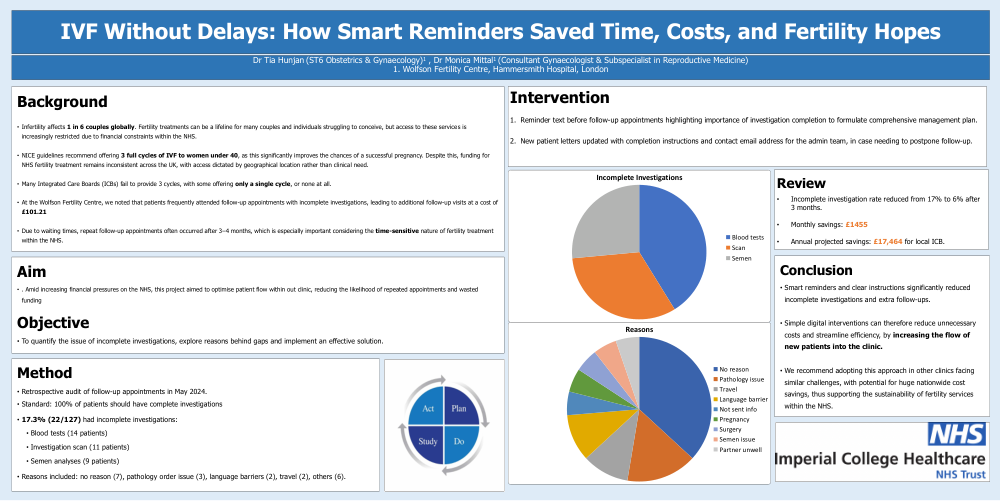
17.3% (22/127) had incomplete investigations:
Blood tests (14 patients)
Investigation scan (11 patients)
Semen analyses (9 patients)
Reasons included: no reason (7), pathology order issue (3), language barriers (2), travel (2), others (6).
Intervention
Review
Incomplete investigation rate reduced from 17% to 6% after 3 months.
Monthly savings: £1455
Conclusion
Smart reminders and clear instructions significantly reduced incomplete investigations and extra follow-ups.
Simple digital interventions can therefore reduce unnecessary costs and streamline efficiency, by increasing the flow of new patients into the clinic.
We recommend adopting this approach in other clinics facing similar challenges, with potential for huge nationwide cost savings, thus supporting the sustainability of fertility services within the NHS.