2,281 posters, 63 videos, 56 audios, 43 topics, 18 sessions, 6,174 authors, 2,323 institutions
ePostersLive by SciGen Technologies S.A. All rights reserved.
RCOG World Congress 2025
June 23 - 25, 2025 | ExCeL London, UK
EP.1854
Emergency Decision-to-Incision Interval: A Multidisciplinary Quality Improvement Project
Poster Presenter
Authors
Eslam Elkoumy, Abdallah ali, ahmed Rady, Mohamed sayed, Maram Dadoua
Affiliations
MUST University_ Faculty of Medicine _Obstetrics and Gynecology Department, MUST University_ Faculty of Medicine _ Urology Department, MUST University_ Faculty of Medicine _ orthopdic Department, Obstetrics and Gynecology Department, health plus center
Part of Topic
Quality improvement
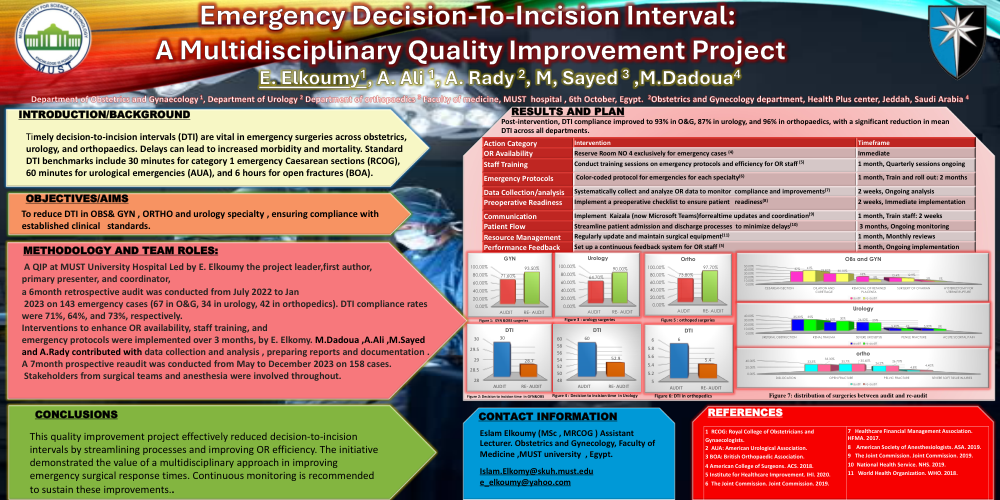
Background: Timely decision-to-incision intervals (DTI) are vital in emergency surgeries across obstetrics, urology, and orthopaedics. Delays can lead to increased morbidity and mortality. Standard DTI benchmarks include 30 minutes for category 1 emergency Caesarean sections (RCOG), 60 minutes for urological emergencies (AUA), and 6 hours for open fractures (BOA).
Aim: To reduce DTI in these specialties, ensuring compliance with established clinical standards.
Methodology: A 6 -month retrospective audit conducted at Souad kafafi university hospital between July 2022 till Jan 2023 of 143 emergency cases (67 in O&G, 34 in urology, 42 in orthopaedics) revealed DTI compliance rates of 71%, 64%, and 73%, respectively. Changes were implemented over 3 months, focusing on enhancing OR availability, staff training, and emergency protocols. A prospective re-audit was conducted over a period of 7 months post-implementation on 158 cases from May till December 2023
Results: Post-intervention, DTI compliance improved to 93% in O&G, 87% in urology, and 96% in orthopaedics, with a significant reduction in mean DTI across all departments.
Conclusion: This quality improvement project effectively reduced decision-to-incision intervals by streamlining processes and improving OR efficiency. The initiative demonstrated the value of a multidisciplinary approach in improving emergency surgical response times. Continuous monitoring is recommended to sustain these improvements.