2,281 posters, 63 videos, 56 audios, 43 topics, 18 sessions, 6,174 authors, 2,323 institutions
ePostersLive by SciGen Technologies S.A. All rights reserved.
RCOG World Congress 2025
June 23 - 25, 2025 | ExCeL London, UK
EP.1851
Using the Compass Methodology to manage Surgical Site Complications in Caesarean Sections
Poster Presenter
Authors
Affiliations
Part of Topic
Quality improvement
Using the Compass Methodology to manage Surgical Site Complications in Caesarean Sections
Rashmi Srivastava, Samuel Enokela, Danielle Briggs
Objectives
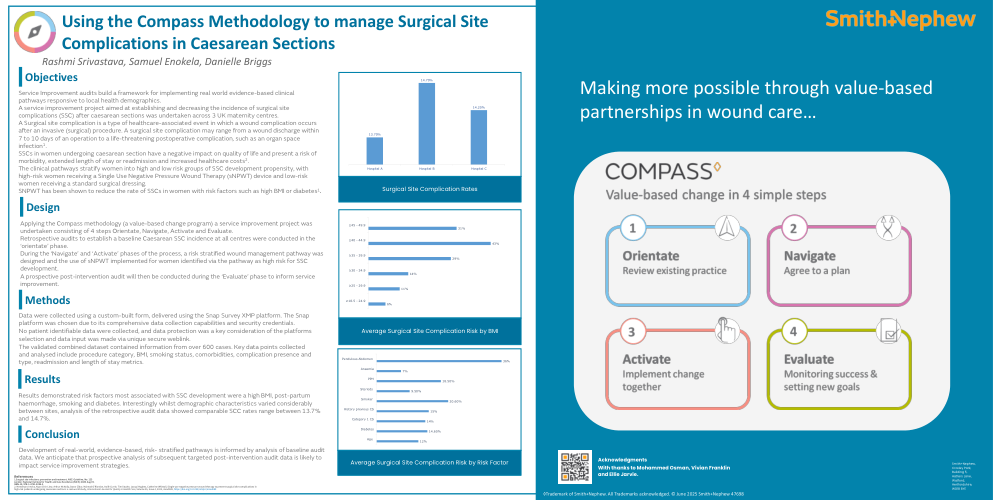
Service Improvement audits build a framework for implementing real world evidence-based clinical pathways responsive to local health demographics.
A service improvement project aimed at establishing and decreasing the incidence of surgical site complications (SSC) after caesarean sections was undertaken across 3 UK maternity centres.
A Surgical site complication is a type of healthcare-associated event in which a wound complication occurs after an invasive (surgical) procedure. A surgical site complication may range from a wound discharge within 7 to 10 days of an operation to a life-threatening postoperative complication, such as an organ space infection1.
SSCs in women undergoing caesarean section have a negative impact on quality of life and present a risk of morbidity, extended length of stay or readmission and increased healthcare costs2.
The clinical pathways stratify women into high and low risk groups of SSC development propensity, with high-risk women receiving a Single Use Negative Pressure Wound Therapy (sNPWT) device and low-risk women receiving a standard surgical dressing.
SNPWT has been shown to reduce the rate of SSCs in women with risk factors such as high BMI or diabetes1.