2,281 posters, 63 videos, 56 audios, 43 topics, 18 sessions, 6,174 authors, 2,323 institutions
ePostersLive by SciGen Technologies S.A. All rights reserved.
RCOG World Congress 2025
June 23 - 25, 2025 | ExCeL London, UK
EP.1850
INCIDENCE AND ASSOCIATED RISK FACTORS OF POST-NATAL DEPRESSION-THIEVE STEALING MOTHERHOOD
Poster Presenter
Part of Topic
Quality improvement
Objectives:
This research article aims to investigate the prevalence, risk factors, and impact of post-natal depression (PPD) on mothers and infants. It explores effective prevention and treatment strategies, focusing on psychosocial and psychological interventions, including psychotherapy and pharmacological treatments like SSRIs and intravenous brexanolone. The study also evaluates protective factors such as emotional support, healthy dietary habits, and antenatal education in preventing PPD, while assessing its implications on maternal and infant health, including cognitive, emotional, and behavioral outcomes for the child.
Design:
Mental health, particularly post-natal depression (PPD), is gaining attention due to limited data on its prevalence, risk factors, and treatment. In developing countries, there is a scarcity of research on PPD. To address this gap, a cross-sectional study was conducted on a vulnerable population at a tertiary care hospital to explore the factors associated with PPD and identify the preferred treatment options.
Methodology:
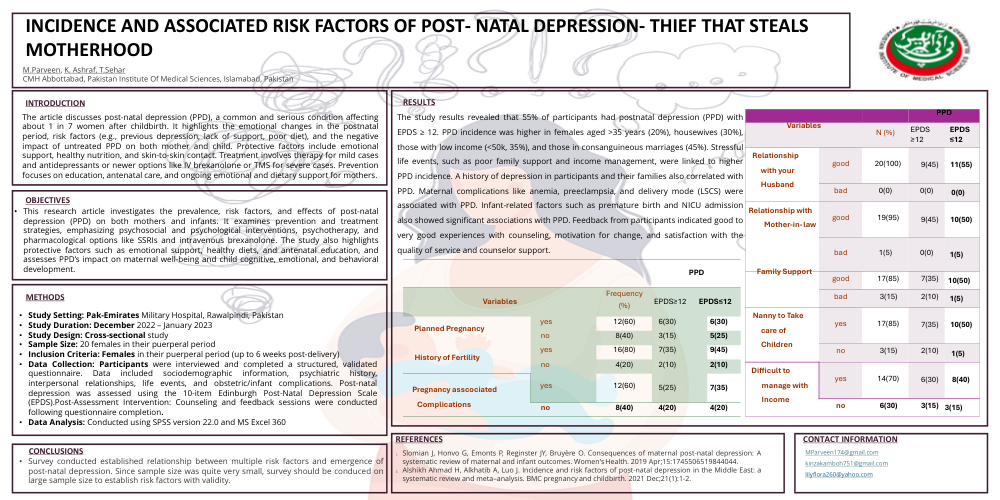
A cross-sectional study was conducted on females in their puerperal period at Pak-Emirates Military Hospital, Rawalpindi, during December 2022 and January 2023. The study involved a sample size of 20 participants, who were interviewed and filled out questionnaires. A structured, validated questionnaire was used to collect sociodemographic data, psychiatric history, interpersonal relationships, life events, and obstetric and infant complications. The Edinburgh Post-Natal Depression Scale (EPDS), a 10-item self-rating tool, was used to assess post-natal depression. Following the questionnaire, a counseling session and feedback session were held with the participants.
Results:
The study results revealed that 55% of participants had postnatal depression (PPD) with EPDS ≥ 12. PPD incidence was higher in females aged >35 years (20%), housewives (30%), those with low income (<50k, 35%), and those in consanguineous marriages (45%). Stressful life events, such as poor family support and income management, were linked to higher PPD incidence. A history of depression in participants and their families also correlated with PPD. Maternal complications like anemia, preeclampsia, and delivery mode (LSCS) were associated with PPD. Infant-related factors such as premature birth and NICU admission also showed significant associations with PPD. Feedback from participants indicated good to very good experiences with counseling, motivation for change, and satisfaction with the quality of service and counselor support.
Conclusion:
Survey conducted established relationship between multiple risk factors and emergence of post-natal depression. Since sample size was quite very small, survey should be conduced on large sample size to establish risk factors with validity.