2,281 posters, 63 videos, 56 audios, 43 topics, 18 sessions, 6,174 authors, 2,323 institutions
ePostersLive by SciGen Technologies S.A. All rights reserved.
RCOG World Congress 2025
June 23 - 25, 2025 | ExCeL London, UK
EP.1836
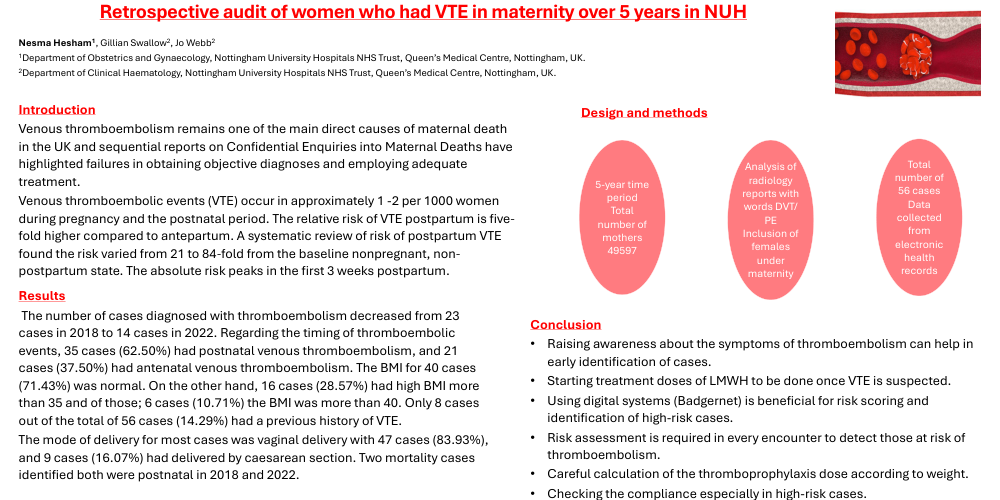
Retrospective audit of women who had VTE in maternity over 5 years
Poster Presenter
Authors
Affiliations
Part of Topic
Quality improvement
Retrospective audit of women who had VTE in maternity over 5 years in NUH
Nesma Hesham1, Gillian Swallow2, Jo Webb2
1Department of Obstetrics and Gynaecology, Nottingham University Hospitals NHS Trust, Queen’s Medical Centre, Nottingham, UK.
2Department of Clinical Haematology, Nottingham University Hospitals NHS Trust, Queen’s Medical Centre, Nottingham, UK.
Introduction
Venous thromboembolism remains one of the main direct causes of maternal death in the UK and sequential reports on Confidential Enquiries into Maternal Deaths have highlighted failures in obtaining objective diagnoses and employing adequate treatment.
Venous thromboembolic events (VTE) occur in approximately 1 -2 per 1000 women during pregnancy and the postnatal period. The relative risk of VTE postpartum is five-fold higher compared to antepartum. A systematic review of risk of postpartum VTE found the risk varied from 21 to 84-fold from the baseline nonpregnant, non-postpartum state. The absolute risk peaks in the first 3 weeks postpartum.
Results
The number of cases diagnosed with thromboembolism decreased from 23 cases in 2018 to 14 cases in 2022. Regarding the timing of thromboembolic events, 35 cases (62.50%) had postnatal venous thromboembolism, and 21 cases (37.50%) had antenatal venous thromboembolism. The BMI for 40 cases (71.43%) was normal. On the other hand, 16 cases (28.57%) had high BMI more than 35 and of those; 6 cases (10.71%) the BMI was more than 40. Only 8 cases out of the total of 56 cases (14.29%) had a previous history of VTE.
The mode of delivery for most cases was vaginal delivery with 47 cases (83.93%), and 9 cases (16.07%) had delivered by caesarean section. Two mortality cases identified both were postnatal in 2018 and 2022.
Conclusion