2,281 posters, 63 videos, 56 audios, 43 topics, 18 sessions, 6,174 authors, 2,323 institutions
ePostersLive by SciGen Technologies S.A. All rights reserved.
RCOG World Congress 2025
June 23 - 25, 2025 | ExCeL London, UK
EP.1835
Accuracy of ultrasound scan to predict a large for gestational age fetus
Poster Presenter
Authors
Affiliations
Part of Topic
Quality improvement
Introduction
We noticed a high number of normal birth weight babies being delivered by elective caesarean section because of suspected large for gestational age (LGA) fetus, as defined by an estimated fetal weight (EFW) above the 90th centile on a customised birth chart (Gap & Grow). Due to this we wanted to evaluate the accuracy of growth scans at diagnosing a LGA fetus in a district general hospital.
Design
We performed a retrospective cohort study of 186 women who underwent an intervention (induction or caesarean section) for the indication of a LGA fetus between June and December 2023 in a single district general hospital. Estimated fetal weight from scan was compared to actual birth weight (ABW) and accuracy of the scan was defined as percentage of LGA predicted babies who were born with an ABW > 90th centile. We excluded cases of EFW being incorrectly labelled as LGA or scans from a different hospital. The remaining 166 women were divided into following groups: EFW >90th centile, EFW >97th centile, symmetrical growth and asymmetrical growth. Asymmetrical growth was defined as >10 centile difference between head circumference (HC) and abdominal circumference (AC). Secondary outcomes included rates of postpartum hemorrhage, perineal trauma, shoulder dystocia and return to theatre. We also looked at induction of labour outcomes.
Method
We defined the population using E3 database criterium of LGA as indication for intervention. Subsequently we reviewed growth scan results of 166 women collecting data on EFW, HC, AC and femur length (FL). EFW centile was defined using gap and grow charts. Hadlock formula was used to define centiles of HC, AC and FL. We divided the population into groups based on those centiles as defined in the design section. We calculated accuracy of growth scans at diagnosing a LGA fetus for each group. E3 database and scans of written medical records were used to investigate complication types and rates, as well as induction of labour outcomes.
Results
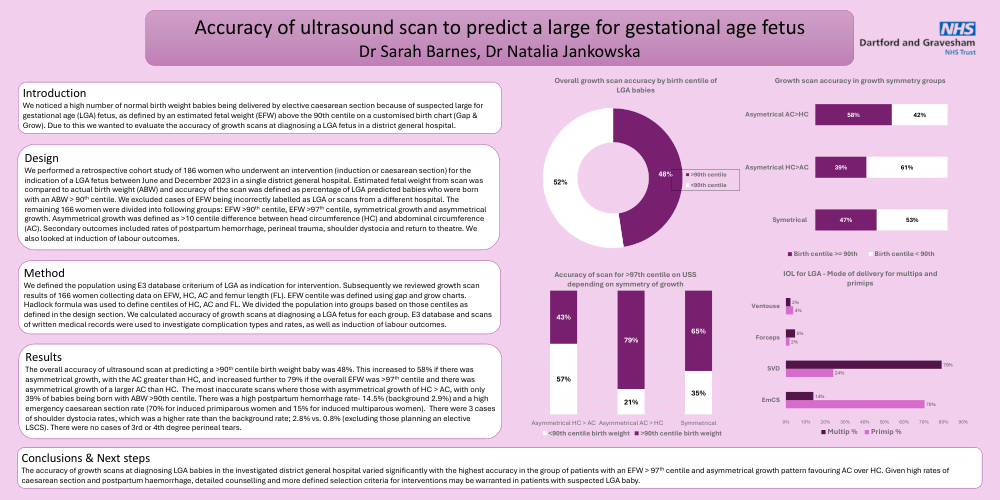
The overall accuracy of ultrasound scan at predicting a >90th centile birth weight baby was 48%. This increased to 58% if there was asymmetrical growth, with the AC greater than HC, and increased further to 79% if the overall EFW was >97th centile and there was asymmetrical growth of a larger AC than HC. The most inaccurate scans where those with asymmetrical growth of HC > AC, with only 39% of babies being born with ABW >90th centile. There was a high postpartum hemorrhage rate- 14.5% (background 2.9%) and a high emergency caesarean section rate (70% for induced primiparous women and 15% for induced multiparous women). There were 3 cases of shoulder dystocia rates, which was a higher rate than the background rate; 2.8% vs. 0.8% (excluding those planning an elective LSCS). There were no cases of 3rd or 4th degree perineal tears.
Conclusions & Next steps
The accuracy of growth scans at diagnosing LGA babies in the investigated district general hospital varied significantly with the highest accuracy in the group of patients with an EFW > 97th centile and asymmetrical growth pattern favouring AC over HC. Given high rates of caesarean section and postpartum haemorrhage, detailed counselling and more defined selection criteria for interventions may be warranted in patients with suspected LGA baby.