2,281 posters, 63 videos, 56 audios, 43 topics, 18 sessions, 6,174 authors, 2,323 institutions
ePostersLive by SciGen Technologies S.A. All rights reserved.
RCOG World Congress 2025
June 23 - 25, 2025 | ExCeL London, UK
EP.1832
Parental involvement in decision-making about planned late preterm and early term birth
Poster Presenter
Authors
Affiliations
Part of Topic
Quality improvement
Video
Parental involvement in decision-making about planned late preterm and early term birth
Frances J Mielewczyk, Caroline A Mulvaney & Elaine M Boyle
Background
- Late preterm and early term (LPET) birth is associated with increased risks of adverse health outcomes throughout life.
- When such births are decided upon in advance many parents are dissatisfied with the input they are able to have in the decision-making process.
- In this study we explored:
- the input expectant parents want and expect in decision-making about possible planned LPET birth
- how their experiences compare with those wishes and expectations
- how they feel about the input they have
Methods
- Qualitative interview study
- Recruitment via social media, community groups, charities and snowballing
- Parents were eligible if their babies were born in the UK ≤ 6 months before their interview and they had been involved in discussions with doctors in the UK about possible planned LPET birth
- 12 parents of 9 babies were interviews (including three mother-father dyads)
- Data were analysed using Reflexive Thematic Analysis
(Braun, V. & Clarke, V., 2022. Thematic analysis: a practical guide. Sage, London)
Results
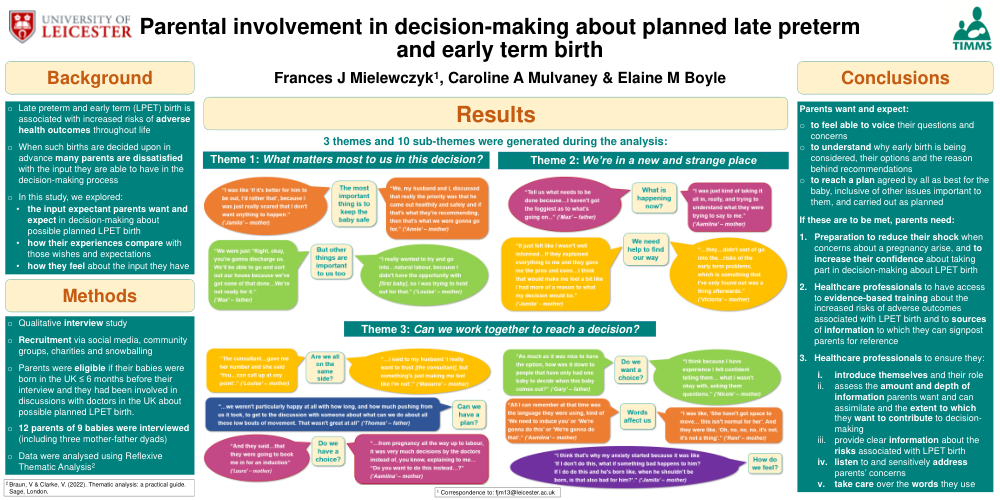
3 themes and 10 sub-themes were generated during the analysis:
Theme 1: What matters most to us in this decision?
- The most important thing is to keep the baby safe
“I was like ‘If it’s better for him to be out, I’d rather that’, because I was just really scared that I don’t want anything to happen.” (‘Jamila’ – mother)
“We, my husband and I, discussed that really the priority was that he came out healthily and safely and if that’s what they’re recommending, then that’s what we were gonna go for.” (‘Annie – mother’)
- But other things are important to us too
“We were just ‘Right, okay, you’re gonna discharge us. We’ll be able to go and sort out our house because we’ve got none of that done…We’re not ready for it.” (‘Max’ – father)
“I really wanted to try and go into…natural labour, because I didn’t have the opportunity with [first baby], so I was trying to hold out for that.” (‘Louise’ – mother)
Theme 2: We’re in a new and strange place
- What is happening now?
“Tell us what needs to be done because…I haven’t got the foggiest as to what’s going on…” (‘Max’ – father)
“I was just kind of taking it all in, really, and trying to understand what they were trying to say to me.” (‘Aamiina’ – mother)
- We need help to find our way
“It just felt like I wasn’t well informed…if they explained everything to me and they gave me the pros and cons…I think that would make me feel a bit like I had more of a reason to what my decision would be.” (‘Jamila’ – mother)
“they…didn’t sort of go into the…risks of the early term problems, which is something that I’ve only found out was a thing afterwards.” (‘Victoria’ – mother)
Theme 3: Can we work together to reach a decision?
- Are we all on the same side?
“The consultant…gave me her number and she said ‘You…can call up at any point’.” (‘Louise’ – mother)
“...I said to my husband ‘I really want to trust [the consultant], but something’s just making me feel like I’m not’.” (‘Masarra’ – mother)
- Can we have a plan?
“…we weren’t particularly happy at all with how long, and how much pushing from us it took, to get to the discussion with someone about what can we do about all these low bouts of movement. That wasn’t great at all.” (‘Thomas’ – father)
- Do we have a choice?
“And they said…that they were going to book me in for an induction.” (‘Laura’ – mother)
“…from pregnancy all the way up to labour, it was very much decisions by the doctors instead of, you know, explaining to me…’Do you want to do this instead…?” (‘Aamiina’ – mother)
- Do we want a choice?
“As much as it was nice to have the option, how was it down to people that have only had one baby to decide when this baby comes out?” (‘Gary’ – father)
“I think because I have experience I felt confident telling them…what I wasn’t okay with, asking them questions.” (‘Nicole’ – mother)
- Words affect us
“All I can remember at that time was the language they were using, kind of ‘We need to induce you’ or ‘We’re gonna do this’ or ‘We’re gonna do that’.” (‘Aamiina’ – mother)
“I was like, ‘She hasn’t got space to move…this isn’t normal for her’. And they were like, ‘Oh no, no, no, it’s not, it’s not a thing’.” (‘Rani’ – mother)
- How do we feel?
“I think that’s why my anxiety started because it was like ‘If I don’t do this, what if something bad happens to him? If I do do this and he’s born like, when he shouldn’t be born, is that also bad for him?’”…” (‘Jamila’ – mother)
Conclusions
Parents want and expect:
- to feel able to voice their questions and concerns
- to understand why early birth is being considered, their options and the reason behind recommendations
- to reach a plan agreed by all as best for the baby, inclusive of other issues important tot hem, and carried out as planned.
If these are to be met, parents need:
- Preparation to reduce their shock when concerns about a pregnancy arise, and to increase their confidence about taking part in decision-making about LPET birth
- Healthcare professionals to have access to evidence-based training about the increased risks of adverse outcomes associated with LPET birth and to sources of information to which they can signpost parents for reference
- Healthcare professionals to ensure they:
- introduce themselves and their role
- assess the amount and depth of information parents want and can assimilate and the extent to which they want to contribute to decision-making
- provide clear information about the risks associated with LPET birth
- listen to and sensitively address parents’ concerns
- take care over the words they use