2,281 posters, 63 videos, 56 audios, 43 topics, 18 sessions, 6,174 authors, 2,323 institutions
ePostersLive by SciGen Technologies S.A. All rights reserved.
RCOG World Congress 2025
June 23 - 25, 2025 | ExCeL London, UK
EP.1831
The Outcome of Fast-Track Clinics. Hysteroscopy Referrals for Women with Post-Menopausal Bleeding
Poster Presenter
Part of Topic
Quality improvement
The Fast-track clinic outcome and hysteroscopy referral for women with post-menopausal bleeding.
Alabdali H1, Hussain S1, Patel P1, Adamson S1
1Worthing Hospital, University Hospitals Sussex NHS Foundation Trust
Introduction
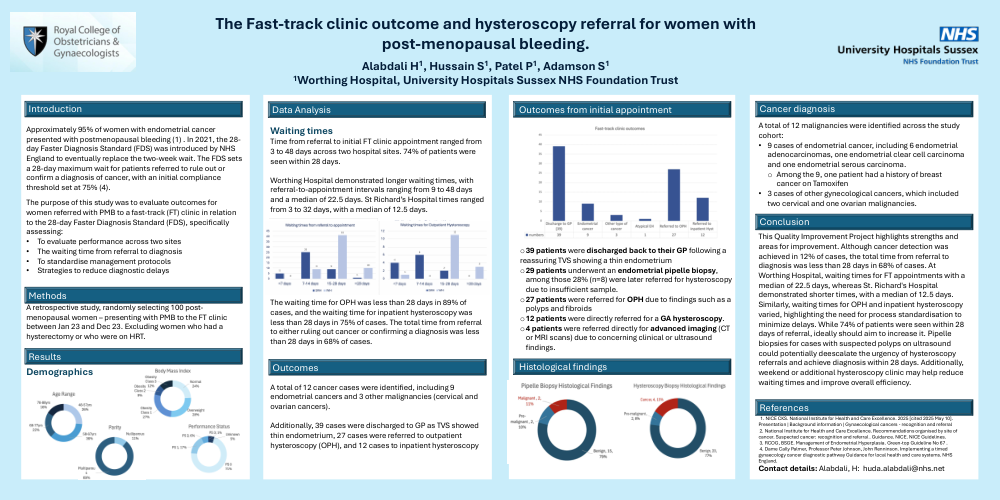
Approximately 95% of women with endometrial cancer presented with postmenopausal bleeding (1) . In 2021, the 28 day Faster Diagnosis Standard (FDS) was introduced by NHS England to eventually replace the two-week wait. The FDS sets a 28-day maximum wait for patients referred to rule out or confirm a diagnosis of cancer, with an initial compliance threshold set at 75% (4). The purpose of this study was to evaluate outcomes for women referred with PMB to a fast-track (FT) clinic in relation to the 28-day Faster Diagnosis Standard (FDS), specifically assessing: • To evaluate performance acrosstwo sites • The waiting time from referral to diagnosis • To standardise management protocols • Strategies to reduce diagnostic delays
Methods A retrospective study, randomly selecting 100 post menopausal women – presenting with PMB to the FT clinic between Jan 23 and Dec 23. Excluding women who had a hysterectomy or who were on HRT.
Data Analysis:
Waiting times Time from referral to initial FT clinic appointment ranged from 3 to 48 days across two hospital sites. 74% of patients were seen within 28 days. Worthing Hospital demonstrated longer waiting times, with referral-to-appointment intervals ranging from 9 to 48 days and a median of 22.5 days. St Richard’s Hospital times ranged from 3 to 32 days, with a median of 12.5 days. The waiting time for OPH was less than 28 days in 89% of cases, and the waiting time for inpatient hysteroscopy was less than 28 days in 75% of cases. The total time from referral to either ruling out cancer or confirming a diagnosis was less than 28 days in 68% of cases.
Outcomes:
A total of 12 cancer cases were identified, including 9 endometrial cancers and 3 other malignancies (cervical and ovarian cancers). Additionally, 39 cases were discharged to GP as TVS showed thin endometrium, 27 cases were referred to outpatient hysteroscopy (OPH), and 12 cases to inpatient hysteroscopy.
Outcomes from initial appointment:
o39 patients were discharged back to their GP following a reassuring TVS showing a thin endometrium o29 patients underwent an endometrial pipelle biopsy, among those 28% (n=8) were later referred for hysteroscopy due to insufficient sample. o27 patients were referred for OPH due to findings such as a polyps and fibroids o12 patients were directly referred for a GA hysteroscopy. o4 patients were referred directly for advanced imaging (CT or MRI scans) due to concerning clinical or ultrasound findings.
Cancer diagnosis.
A total of 12 malignancies were identified across the study cohort: • 9 cases of endometrial cancer, including 6 endometrial adenocarcinomas, one endometrial clear cell carcinoma and one endometrial serous carcinoma. o Among the 9, one patient had a history of breast cancer on Tamoxifen • 3 cases of other gynecological cancers, which included two cervical and one ovarian malignancies.
Conclusion This Quality Improvement Project highlights strengths and areas for improvement. Although cancer detection was achieved in 12% of cases, the total time from referral to diagnosis was less than 28 days in 68% of cases. At Worthing Hospital, waiting times for FT appointments with a median of 22.5 days, whereas St. Richard's Hospital demonstrated shorter times, with a median of 12.5 days. Similarly, waiting times for OPH and inpatient hysteroscopy varied, highlighting the need for process standardisation to minimize delays. While 74% of patients were seen within 28 days of referral, ideally should aim to increase it. Pipelle biopsies for cases with suspected polyps on ultrasound could potentially deescalate the urgency of hysteroscopy referrals and achieve diagnosis within 28 days. Additionally, weekend or additional hysteroscopy clinic may help reduce waiting times and improve overall efficiency. v References 1. NICE CKS. National Institute for Health and Care Excellence. 2025 [cited 2025 May 10]. Presentation | Background information | Gynaecological cancers - recognition and referral 2. National Institute for Health and Care Excellence. Recommendations organised by site of cancer. Suspected cancer: recognition and referral . Guidance. NICE. NICE Guidelines. 3. RCOG, BSGE. Management of Endometrial Hyperplasia. Green-top Guideline No 67 . 4. Dame Cally Palmer, Professor Peter Johnson, John Renninson. Implementing a timed gynaecology cancer diagnostic pathway Guidance for local health and care systems. NHS England.
Contact details: Alabdali, H: huda.alabdali@nhs.net.