2,281 posters, 63 videos, 56 audios, 43 topics, 18 sessions, 6,174 authors, 2,323 institutions
ePostersLive by SciGen Technologies S.A. All rights reserved.
RCOG World Congress 2025
June 23 - 25, 2025 | ExCeL London, UK
EP.1830
Audit on red flag referrals for women with unscheduled bleeding on HRT
Poster Presenter
Part of Topic
Quality improvement
Audit on red flag referrals for women with unscheduled bleeding on HRT: A quality improvement project
Objectives:
1) To evaluate the red flag referrals for women with unscheduled bleeding on Hormone Replacement Therapy and to make sure that, these women are initially managed and referred as per the recent British Menopausal Society joint guideline, published in April 2024, “Management of unscheduled bleeding on hormone replacement therapy”. By this the waiting period for women at high risk needing urgent attention can be reduced.
2) To assess the need for a one-stop menopausal clinic at South west Acute Hospital, Enniskillen.
Background / rationale:
Unscheduled bleeding on HRT is defined as irregular bleeding which occurs after initiating, or changing, an HRT preparation which should be ‘bleed free’ – continuous combined hormone replacement therapy (ccHRT) or, which occurs, in addition to the scheduled monthly withdrawal bleed in persons taking sequential preparations (sHRT).
Criteria & Standards used:
Management of unscheduled bleeding on hormone replacement therapy: BMS joint guideline , published in April 2024
Design:
Prospective
Sample size: 30 patients
Time scale : 16/5/24 to 3/10/24
Method:
List of patients attending the outpatient hysteroscopy clinic in SWAH/Omagh DPU were prospectively retrieved from patient access booking office.
Red flag referrals from GP for women with unscheduled bleeding on HRT were selected.
Data of completed procedures with histology reports were collected in an Excel sheet from electronic case records and analysed.
Results:
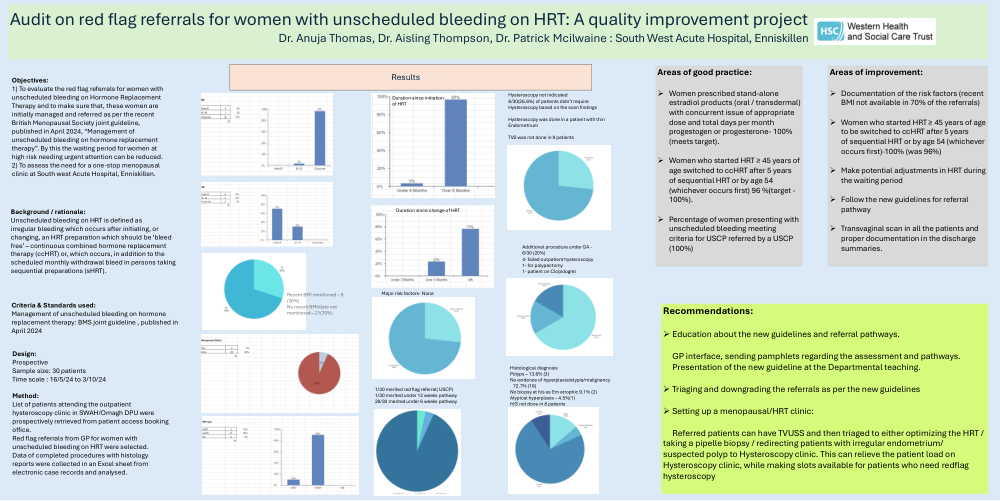
3% of the women were in the 45-49 years age group and 97 %, in the group, 50 years and above. 70 % were having a BMI under 30 and 30% had BMI of 30-39.7% of the women were perimenopausal while 93% were postmenopausal. 10% of the women were on sequential HRT and 90% on continuous combined HRT. None of the women in the study had any major risk factors, while 26.7% of them had 1 minor risk factor, being BMI 30-39. Out of the 30 red flag referrals, only 1 merited Urgent Suspicion of Cancer Pathway and 1 merited under 12 weeks pathway. The rest 28 merited under 6 weeks pathway referral. 26.6% of patients didn’t require hysteroscopy based on the scan findings. Additional procedure under general anesthesia was required for 20% of women. On histological examination, a diagnosis of polyp was made in 13.6% and atypical hyperplasia in 4.5% of women. There was no evidence of hyperplasia/atypia/malignancy in 72.7% of women. No biopsy was taken at hysteroscopy in 9.1% of women as endometrium was atrophic. Areas of good practice and those requiring improvement were identified and recommendations made accordingly.
Areas of good practice:
Women prescribed stand-alone estradiol products (oral / transdermal) with concurrent issue of appropriate dose and total days per month progestogen or progesterone- 100% (meets target).
Areas of improvement:
Women who started HRT ≥ 45 years of age to be switched to ccHRT after 5 years of sequential HRT or by age 54 (whichever occurs first)-100% (was 96%)
Make potential adjustments in HRT during the waiting period
Follow the new guidelines for referral pathway
Recommendations:
Education about the new guidelines and referral pathways.
GP interface, sending pamphlets regarding the assessment and pathways.
Presentation of the new guideline at the Departmental teaching.
Triaging and downgrading the referrals as per the new guidelines
Setting up a menopausal/HRT clinic:
Referred patients can have TVUSS and then triaged to either optimizing the HRT / taking a pipelle biopsy / redirecting patients with irregular endometrium/ suspected polyp to Hysteroscopy clinic. This can relieve the patient load on Hysteroscopy clinic, while making slots available for patients who need redflag hysteroscopy