2,281 posters, 63 videos, 56 audios, 43 topics, 18 sessions, 6,174 authors, 2,323 institutions
ePostersLive by SciGen Technologies S.A. All rights reserved.
RCOG World Congress 2025
June 23 - 25, 2025 | ExCeL London, UK
EP.1823
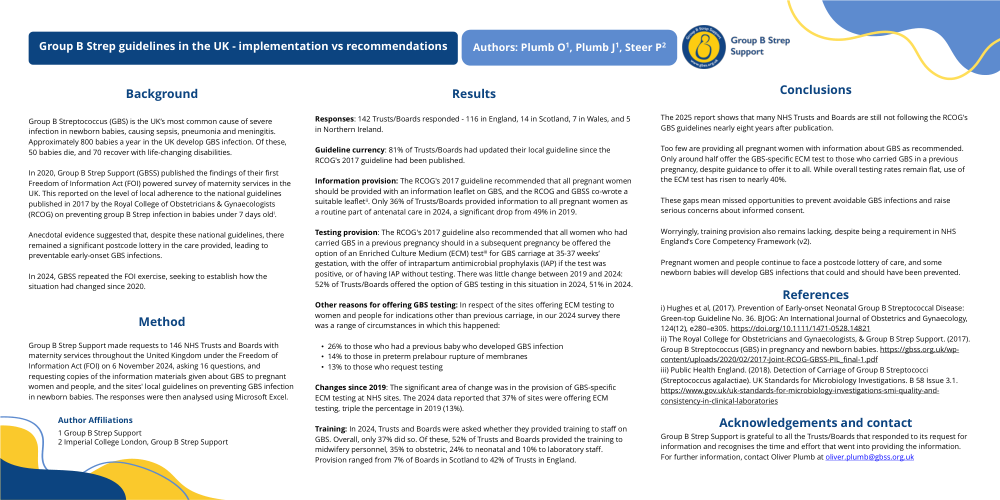
Group B Strep guidelines in the UK - implementation vs recommendations
Poster Presenter
Authors
Affiliations
Part of Topic
Quality improvement
Group B Strep guidelines in the UK - implementation vs recommendations
Authors: Plumb O1, Plumb J1, Steer P2
Author Affiliations
1 Group B Strep Support
2 Imperial College London, Group B Strep Support
Background
Group B Streptococcus (GBS) is the UK’s most common cause of severe infection in newborn babies, causing sepsis, pneumonia and meningitis. Approximately 800 babies a year in the UK develop GBS infection. Of these, 50 babies die, and 70 recover with life-changing disabilities.
In 2020, Group B Strep Support (GBSS) published the findings of their first Freedom of Information Act (FOI) powered survey of maternity services in the UK. This reported on the level of local adherence to the national guidelines published in 2017 by the Royal College of Obstetricians & Gynaecologists (RCOG) on preventing group B Strep infection in babies under 7 days oldi.
Anecdotal evidence suggested that, despite these national guidelines, there remained a significant postcode lottery in the care provided, leading to preventable early-onset GBS infections.
In 2024, GBSS repeated the FOI exercise, seeking to establish how the situation had changed since 2020.
Method
Group B Strep Support made requests to 146 NHS Trusts and Boards with maternity services throughout the United Kingdom under the Freedom of Information Act (FOI) on 6 November 2024, asking 16 questions, and requesting copies of the information materials given about GBS to pregnant women and people, and the sites' local guidelines on preventing GBS infection in newborn babies. The responses were then analysed using Microsoft Excel.
Results
Responses: 142 Trusts/Boards responded - 116 in England, 14 in Scotland, 7 in Wales, and 5 in Northern Ireland.
Guideline currency: 81% of Trusts/Boards had updated their local guideline since the RCOG's 2017 guideline had been published.
Information provision: The RCOG's 2017 guideline recommended that all pregnant women should be provided with an information leaflet on GBS, and the RCOG and GBSS co-wrote a suitable leafletii. Only 36% of Trusts/Boards provided information to all pregnant women as a routine part of antenatal care in 2024, a significant drop from 49% in 2019.
Testing provision: The RCOG's 2017 guideline also recommended that all women who had carried GBS in a previous pregnancy should in a subsequent pregnancy be offered the option of an Enriched Culture Medium (ECM) testiii for GBS carriage at 35-37 weeks’ gestation, with the offer of intrapartum antimicrobial prophylaxis (IAP) if the test was positive, or of having IAP without testing. There was little change between 2019 and 2024: 52% of Trusts/Boards offered the option of GBS testing in this situation in 2024, 51% in 2024.
Other reasons for offering GBS testing: In respect of the sites offering ECM testing to women and people for indications other than previous carriage, in our 2024 survey there was a range of circumstances in which this happened:
26% to those who had a previous baby who developed GBS infection
14% to those in preterm prelabour rupture of membranes
13% to those who request testing
Changes since 2019: The significant area of change was in the provision of GBS-specific ECM testing at NHS sites. The 2024 data reported that 37% of sites were offering ECM testing, triple the percentage in 2019 (13%).
Training: In 2024, Trusts and Boards were asked whether they provided training to staff on GBS. Overall, only 37% did so. Of these, 52% of Trusts and Boards provided the training to midwifery personnel, 35% to obstetric, 24% to neonatal and 10% to laboratory staff. Provision ranged from 7% of Boards in Scotland to 42% of Trusts in England.
Conclusions
The 2025 report shows that many NHS Trusts and Boards are still not following the RCOG's GBS guidelines nearly eight years after publication.
Too few are providing all pregnant women with information about GBS as recommended. Only around half offer the GBS-specific ECM test to those who carried GBS in a previous pregnancy, despite guidance to offer it to all. While overall testing rates remain flat, use of the ECM test has risen to nearly 40%.
These gaps mean missed opportunities to prevent avoidable GBS infections and raise serious concerns about informed consent.
Worryingly, training provision also remains lacking, despite being a requirement in NHS England’s Core Competency Framework (v2).
Pregnant women and people continue to face a postcode lottery of care, and some newborn babies will develop GBS infections that could and should have been prevented.
References
i) Hughes et al, (2017). Prevention of Early-onset Neonatal Group B Streptococcal Disease: Green-top Guideline No. 36. BJOG: An International Journal of Obstetrics and Gynaecology, 124(12), e280–e305. https://doi.org/10.1111/1471-0528.14821
ii) The Royal College for Obstetricians and Gynaecologists, & Group B Strep Support. (2017). Group B Streptococcus (GBS) in pregnancy and newborn babies. https://gbss.org.uk/wp-content/uploads/2020/02/2017-Joint-RCOG-GBSS-PIL_final-1.pdf
iii) Public Health England. (2018). Detection of Carriage of Group B Streptococci (Streptococcus agalactiae). UK Standards for Microbiology Investigations. B 58 Issue 3.1. https://www.gov.uk/uk-standards-for-microbiology-investigations-smi-quality-and-consistency-in-clinical-laboratories
Acknowledgements and contact
Group B Strep Support is grateful to all the Trusts/Boards that responded to its request for information and recognises the time and effort that went into providing the information.
For further information, contact Oliver Plumb at oliver.plumb@gbss.org.uk